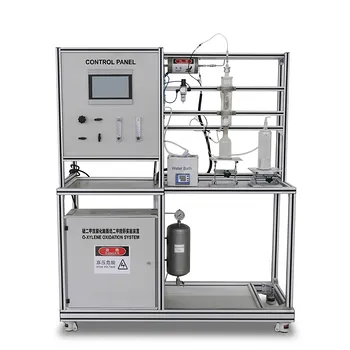
Activation energy magnitude is critical because it determines how strongly a reactor’s reaction rate responds to temperature. Through the Arrhenius relationship, a high activation energy produces large changes in the rate constant from small temperature variations, while a low activation energy produces a more gradual response. In pilot-scale reactors, this sensitivity directly affects thermal-control precision, runaway risk, kinetic-model accuracy, and the reliability of scale-up decisions.
Activation energy is not merely a laboratory parameter. Its magnitude determines how much temperature variation a reactor can tolerate, how aggressively heat must be removed or supplied, and how accurately experiments must be controlled to produce useful kinetic data.
Why Activation Energy Controls Reactor Sensitivity
The Arrhenius relationship
The temperature dependence of a rate constant is commonly represented by:
[ k = A_0 e^{-E/(RT)} ]
or, in linear form:
[ \ln k = -\frac{E}{R}\frac{1}{T}+\ln A_0 ]
Here, (E) is the activation energy, (R) is the gas constant, (T) is absolute temperature, and (A_0) is the pre-exponential factor.
High activation energy creates steep rate changes
For a high-activation-energy reaction, a small increase in temperature can cause a substantial increase in (k). The reaction may therefore accelerate faster than the thermal-control system can respond if heating or cooling capacity is inadequate.
A low-activation-energy reaction is less affected by the same temperature disturbance. Its rate remains comparatively stable, although temperature control is still necessary for accurate measurement and reproducible operation.
Temperature sensitivity also depends on operating temperature
The relative sensitivity of the rate constant to temperature is approximately:
[ \frac{d\ln k}{dT}=\frac{E}{RT^2} ]
For the same activation energy, this sensitivity is greater at lower absolute temperatures because of the (T^2) term in the denominator.
This means that temperature sensitivity cannot be judged from activation energy alone. Engineers must evaluate the combination of activation energy and the intended operating temperature range.
Why This Matters in Pilot-Scale Thermal Control
Small temperature errors can become rate errors
A pilot reactor may experience local temperature differences caused by imperfect mixing, heat-transfer limitations, sensor placement, or utility fluctuations. In a high-(E) system, these differences can create significant local changes in reaction rate.
The resulting rate variation can affect conversion, selectivity, residence-time requirements, and product quality. A reported reactor temperature may therefore conceal important temperature gradients inside the vessel.
Exothermic reactions can amplify temperature excursions
In an exothermic reaction, an increase in temperature can increase the reaction rate. The faster reaction then releases heat more rapidly, potentially causing a further temperature increase.
This positive feedback is the basis of thermal-runaway risk. A large activation energy strengthens the kinetic part of that feedback, making precise measurement, rapid heat removal, interlocks, and emergency response particularly important.
Thermal-control capacity must match kinetic sensitivity
The reactor’s jacket, coil, heat exchanger, control valve, and utility system must be able to manage the heat generated or consumed as the reaction rate changes. A controller cannot compensate indefinitely for insufficient heat-transfer capacity.
For highly temperature-sensitive reactions, pilot-scale design should consider:
- Fast and accurately positioned temperature sensors.
- Adequate heating and cooling capacity.
- Effective mixing and heat-transfer surfaces.
- High- and low-temperature alarms.
- Independent shutdown or quench provisions where appropriate.
- Operating limits based on credible disturbances, not only normal conditions.
Why Activation Energy Matters in Kinetic Experiments
Accurate temperature control is part of the measurement
To determine activation energy, engineers measure rate constants at multiple temperatures and regress (\ln k) against (1/T). The slope of the resulting line is:
[ -\frac{E}{R} ]
Temperature errors therefore affect both the calculated rate constants and the independent variable used in the regression.
If the temperature is poorly controlled or inaccurately recorded, the fitted activation energy may be distorted. That error can then propagate into reactor sizing, heat-transfer calculations, process simulations, and safety studies.
Controlled temperature spacing improves the experiment
The selected temperature range must be large enough to reveal a measurable kinetic change but narrow enough to avoid changing the reaction mechanism, phase behavior, catalyst condition, or transport regime.
For a high-activation-energy reaction, even a narrow temperature range may produce large rate changes. The experiment may then require smaller temperature increments, shorter residence times, or dilution to keep measurements within a reliable operating window.
The rate model must remain valid across the test range
Arrhenius analysis assumes that the measured rate constants represent the same kinetic regime. A change in mechanism, catalyst behavior, mass transfer, viscosity, or phase distribution can produce curvature in the (\ln k) versus (1/T) plot.
A good activation-energy experiment therefore checks more than the regression line. It also examines repeatability, residuals, mixing, heat transfer, concentration control, and whether the measured rate is genuinely reaction-controlled.
How Activation Energy Supports Scale-Up
Bench data must predict pilot behavior
A kinetic model obtained at laboratory scale is used to predict rates at pilot scale and under different thermal conditions. The activation energy determines how confidently that model can be extrapolated across the intended temperature range.
A small error in (E) may have little consequence over a narrow range, but it can produce a large rate-prediction error when the model is applied at substantially different temperatures.
Reactor temperature profiles affect performance
In tubular reactors, temperature may vary along the reactor length. In stirred reactors, heat generation and removal may create differences between bulk and wall temperatures.
The activation energy determines how strongly these temperature profiles influence the local reaction rate. It is therefore central to predicting conversion, hot spots, selectivity, and the required reactor volume.
Heat-transfer design depends on reaction-rate prediction
For an exothermic process, the heat-generation rate depends on the reaction rate. Since the rate depends on (E), activation energy enters directly into calculations for jacket duty, coolant flow, heat-exchanger area, and maximum credible temperature rise.
Using an inaccurate activation energy can lead to an undersized cooling system or overly optimistic safety limits.
Understanding the Trade-offs
High activation energy improves temperature leverage but reduces tolerance
A high activation energy can be useful when engineers need substantial rate changes from modest temperature adjustments. It can also make temperature-based optimization effective.
The corresponding disadvantage is reduced operating tolerance. Sensor noise, controller oscillation, local hot spots, and utility disturbances can all produce meaningful kinetic consequences.
Low activation energy simplifies thermal control but may limit separation
Low-activation-energy reactions are less sensitive to temperature fluctuations, which generally simplifies control and reduces kinetic amplification of disturbances.
However, larger temperature changes may be required to achieve a significant rate increase. That can increase utility demand or create problems related to material limits, side reactions, solvent boiling, or product stability.
The “doubling every 10 °C” rule is not universal
The often-used rule that reaction rates double for every 10 °C increase is only a rough approximation. The actual change depends on both activation energy and the absolute temperature.
For example, an activation energy near (52\ \text{kJ/mol}) gives approximately a twofold increase in rate constant for a 10 K increase near 300 K, but the same temperature increment will not produce the same factor at every temperature or for every reaction.
A fitted activation energy may be regime-specific
The measured value may reflect an apparent activation energy rather than a fundamental barrier for one elementary reaction. It can incorporate effects from parallel reactions, reversible steps, transport limitations, catalyst condition, or changes in the dominant mechanism.
Treating one fitted value as universally valid can produce unsafe or inaccurate predictions outside the experimental range.
Making the Right Choice for Your Goal
Activation energy should be treated as both a kinetic parameter and a thermal-design input.
- If your primary focus is thermal safety: Use the measured activation energy together with heat-generation, heat-removal, mixing, and control-response analyses to define conservative operating limits and runaway safeguards.
- If your primary focus is kinetic measurement: Use precise temperature sensing, stable setpoints, repeatable rate measurements, and an operating range that preserves the same reaction regime.
- If your primary focus is reactor scale-up: Propagate activation-energy uncertainty through conversion, temperature-profile, residence-time, and heat-transfer calculations before selecting pilot operating conditions.
- If your primary focus is process optimization: Evaluate activation energy at the actual temperature range of interest and confirm that improved rate does not compromise selectivity, product quality, or thermal stability.
Understanding activation-energy magnitude allows engineers to design pilot experiments that are both quantitatively reliable and thermally manageable.
Summary Table:
| Key area | Why activation energy matters | Design implication |
|---|---|---|
| Temperature sensitivity | Higher activation energy causes larger rate changes from small temperature variations. | Use precise sensors, stable setpoints, and rapid control response. |
| Thermal safety | Faster rates can amplify heat generation in exothermic reactions. | Provide sufficient cooling, alarms, interlocks, and emergency safeguards. |
| Kinetic experiments | Temperature errors distort rate constants and fitted activation energy. | Maintain accurate temperature control and repeatable test conditions. |
| Scale-up | Activation energy affects conversion, hot spots, heat duty, and reactor volume. | Include kinetic uncertainty in thermal and reactor-design calculations. |
| Operating range | Apparent activation energy may vary with mechanism or transport limits. | Confirm the same kinetic regime across the test range. |
Ready to improve the safety and reliability of your pilot-scale process? Contact LABPARK to discuss Educational and Vocational Unit Operations Pilot Plants for chemical engineering, bioprocess and biotech, or environmental and water treatment applications. Our pilot-scale systems help universities, research institutes, and enterprises generate dependable kinetic data, evaluate thermal-control performance, validate heat-transfer requirements, and make more confident scale-up decisions. Share your process conditions and training or research goals with LABPARK, and we can help identify a practical pilot-plant configuration for your experiments.
Related Products
- Fixed-Bed Chemical Reaction and Gas Dust Tar Removal Unit Operations Pilot Plant
- Methanol Synthesis and Catalyst Performance Evaluation Educational Unit Operations Pilot Plant
- Fixed Bed Gas Solid Catalytic Reaction Educational Pilot Plant
- Residence Time Distribution and Reactor Flow Characteristics Determination Educational Pilot Plant
- Micro-Scale Gas-Solid Catalytic Reaction Educational Pilot Plant
People Also Ask
- When to transition from PID to adaptive control in pilot plants? Key process indicators.
- How do deviations in estimating latent heat impact pilot plant thermal systems? Avoid hardware mis-sizing.
- Why Compare Predicted and Experimental Excess Enthalpy? Key to Accurate Pilot Plant Scale-up
- How can pilot plants demonstrate a control strategy in a design space? Practical QbD implementation.
- Why Use PTFE & Hastelloy in Chemical Pilot Plants? Prevent Corrosion & Ensure Safety