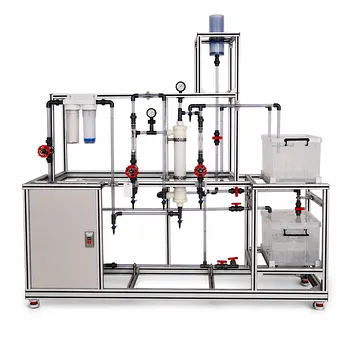
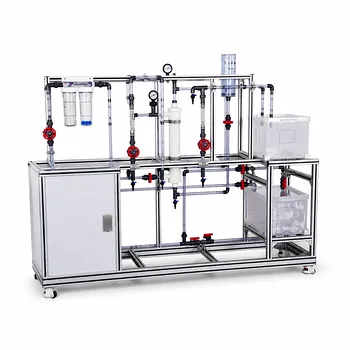
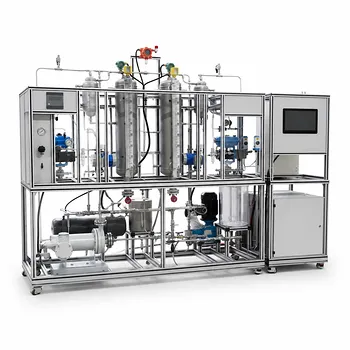
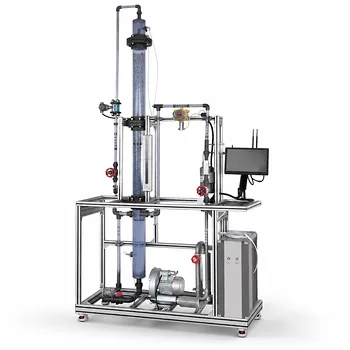
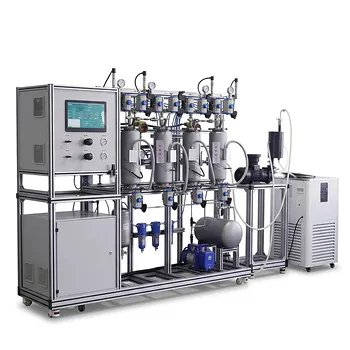
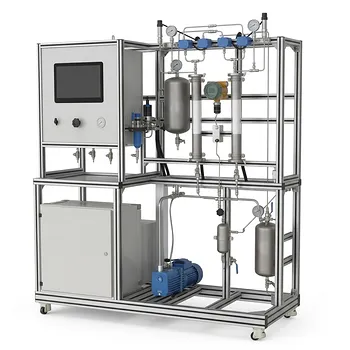
A membrane pervaporation pilot plant is highly suitable for student training because it circumvents the thermodynamic dead-end that makes traditional distillation impractical for azeotropes. Instead of relying on boiling points, pervaporation exploits chemical affinity and diffusivity through a selective membrane, achieving high-purity dehydration without hazardous entrainers. This transforms a complex industrial problem into a safe, energy-efficient, and visually intuitive teaching platform that directly demonstrates modern separation science.
The fundamental advantage is that pervaporation separates by molecular chemistry, not vapor-liquid equilibrium. For students, this means they can safely break an ethanol-water azeotrope in a single step, using no toxic additives, while learning core principles of green process engineering and membrane technology.
Why Traditional Distillation Gets Stuck
The Thermodynamic Wall of Azeotropes
Many common organic solvents — ethanol, propanols, ethyl acetate — form minimum-boiling azeotropes with water. These mixtures have a constant boiling point, so conventional distillation reaches a purity ceiling where no further separation is possible using heat alone.
The Messy Reality of Entrainer Distillation
To get past that ceiling, industry turns to azeotropic distillation with a chemical entrainer. This introduces a third component that alters the vapor-liquid equilibrium, but at a cost for teaching labs: it adds chemical complexity, safety hazards, and requires high minimum capacities to be economically viable. Managing the entrainer loop demands continuous monitoring and significant infrastructure, making it impractical and unsafe for hands-on student training at pilot scale.
The Pervaporation Advantage: Affinity Over Boiling Point
Bypassing Vapor-Liquid Equilibrium
A pervaporation membrane replaces the distillation column’s dependence on relative volatility. Separation is driven by differences in chemical potential, solubility, and diffusivity through a dense selective layer. This means the process sidesteps the azeotropic barrier entirely, allowing a student to dehydrate ethanol to 99.8% purity in a single, additive-free step.
The Three-Step Molecular Dance
Students can directly observe and analyze the fundamental mechanism: preferential sorption of one component onto the membrane surface, selective diffusion through the membrane matrix driven by a pressure or concentration gradient, and finally desorption as a vapor on the permeate side. This three-step sequence makes an abstract unit operation tangible and teachable.
Educational Benefits: Safer, Greener, and More Intuitive
Eliminating Chemical Entrainers from the Lab
No toxic third-party solvents are needed. This completely avoids the risk of unwanted side reactions like hydrolysis and eliminates the disposal challenges of hazardous entrainer mixtures. For an academic environment, that translates directly into lower risk assessments, simpler safety protocols, and far less regulatory burden.
A Clear Demonstration of Green Chemistry
Because only the permeating component is vaporized — not the entire feed stream — pervaporation consumes 30-40% less energy compared to azeotropic distillation. Operating at ambient or moderate temperatures also makes it suitable for heat-sensitive materials, giving students a measurable case study in sustainable process design and carbon footprint reduction.
Modular and Fit for Purpose
Unlike entrainer distillation, which struggles at low throughputs, a pervaporation pilot plant is economically viable at the liter-scale. Its compact footprint and modular design allow easy integration into standard unit operations labs, while recovering 90-97% of the solvent on-site. This mirrors the modular, distributed recovery strategies students will encounter in the pharmaceutical and fine chemical industries.
Understanding the Trade-offs of Membrane Technology
No Silver Bullet, but a Genuinely Better Teaching Tool
While the advantages are significant, a trusted advisor must also illuminate the limitations. Membrane flux is inherently slower than the throughput of a distillation column, meaning pervaporation is ideal for small-scale purification, not bulk separation. Membranes can foul or degrade with certain feed mixtures, and the selectivity-permeability trade-off requires careful selection. However, in a training context, these constraints become powerful learning opportunities about process intensification, lifecycle management, and the real-world boundary conditions that define modern membrane engineering.
How to Match the Technology to Your Teaching Goals
Consider what you want your students to take away:
- If your primary focus is teaching a fundamentally different separation principle: Pervaporation lets students break an azeotrope through chemical affinity and diffusivity, concepts that most distillation-centric curricula only mention in theory.
- If your primary focus is maximizing lab safety and simplicity: Eliminating entrainers and operating at low temperatures removes chemical and thermal hazards, creating a cleaner, more manageable student experience.
- If your primary focus is demonstrating energy-efficient, sustainable processes: The 30-40% energy savings and single-step, additive-free operation provides a compelling, data-rich case for green engineering.
- If your primary focus is preparing students for modern industrial practice: Hands-on work with membrane modules, vacuum systems, and on-site solvent recovery equips them with skills directly applicable to pharmaceutical, fine chemical, and bioprocessing careers.
By choosing a membrane pervaporation pilot plant, you’re not merely teaching a separation method — you’re showing the next generation of engineers how to think beyond the textbook constraints of vapor-liquid equilibrium.
Summary Table:
| Feature | Membrane Pervaporation Pilot Plant | Traditional Entrainer Distillation |
|---|---|---|
| Separation Mechanism | Chemical affinity & membrane diffusivity | Vapor-liquid equilibrium (boiling points) |
| Azeotropic Barrier | Bypassed easily in a single step | Requires toxic chemical entrainers |
| Chemical Safety | Additive-free, low-risk operation | High toxicity and chemical disposal hazards |
| Energy Consumption | 30-40% lower (only permeate vaporized) | High thermal energy (entire feed boiled) |
| Lab Suitability | Compact, modular, liter-scale | Large footprint, high infrastructure needs |
Bring Next-Gen Separation Science to Your Lab
Ready to upgrade your chemical engineering curriculum? LABPARK provides state-of-the-art Educational and Vocational Unit Operations Pilot Plants in chemical engineering, bioprocess & biotech, and environmental & water treatment for universities, research institutes, and enterprises.
Equip your students with safe, hands-on experience in modern membrane technology and green process engineering. Contact LABPARK today to customize a pilot plant tailored to your teaching goals!
Related Products
- Ultrafiltration Membrane Separation Educational Pilot Plant
- Multifunctional Membrane Separation Educational Pilot Plant with Ultrafiltration, Nanofiltration, Reverse Osmosis
- Hollow Fiber Ultrafiltration Membrane Separation Educational Pilot Plant
- Multi Functional Membrane Crystallization Educational Unit Operations Pilot Plant
- Multi-Functional Membrane Separation Educational Pilot Plant for Unit Operations Lab
People Also Ask
- How do PEI, PVDF, and PSU membranes compare in pilot plants? Find the best fit.
- Pervaporation vs. Vapor Permeation: Handling Suspended Solids in Membrane Pilot Plants
- Why Use a Membrane Separation Pilot Plant vs. Lab Testing? Avoid Costly Scale-Up Failures
- How do membrane pilot plants demonstrate synthetic vs biological membrane advantages?
- Isotropic vs. Anisotropic Membranes: How to Choose the Best Pilot Plant Modules