The vapor pressure remains constant not because the system is static, but because it is dynamically self-correcting. When you change the volume of a closed vessel at a constant temperature, the liquid phase instantly compensates by either vaporizing more molecules or allowing excess vapor to condense. This continuous adjustment ensures the density of the gas phase—and therefore the pressure it exerts—always returns to the exact same equilibrium value for that specific temperature.
The liquid phase acts as a molecular reservoir. Changing the volume of the vessel only dictates how much space the vapor currently occupies; it does not change the intrinsic energy of the molecules. As long as liquid remains present to enforce the equilibrium, the pressure is fixed solely by the temperature.
Understanding the Dynamic Equilibrium
Before analyzing a volume change, you must understand what is happening at the surface of the liquid on a molecular level.
The Balance of Escape and Capture
In a closed vessel, the system is never static. High-energy molecules constantly escape the liquid phase (evaporation), while low-energy molecules in the vapor are simultaneously recaptured by the liquid (condensation). At equilibrium, the rate of evaporation exactly equals the rate of condensation.
The Definition of Saturated Vapor Pressure
The pressure exerted by the vapor in this state of balance is the saturated vapor pressure. It represents the maximum partial pressure the substance can achieve at a given temperature before the net flow of molecules turns back toward the liquid phase.
The Instantaneous Response to Volume Change
To understand why the pressure doesn't permanently drop, you must track what happens the moment you alter the volume.
The Immediate Disruption
If you instantly increase the vessel volume, the same number of vapor molecules now occupy a larger space. The vapor density drops sharply. Consequently, the pressure temporarily falls below the equilibrium value.
The Restorative Action of the Reservoir
Because the density has dropped, the rate of condensation immediately decreases. Fewer vapor molecules are hitting the liquid surface per second. However, the rate of evaporation remains unchanged because it depends only on the liquid's temperature. Evaporation now outpaces condensation.
The net vaporization continues, pumping more molecules into the gas phase until the vapor density is restored to its original value. At that point, the rates balance again, and the pressure returns to its starting point.
The Liquid Reservoir Principle
The constancy of pressure relies entirely on a critical physical condition that is often overlooked.
Why the Amount of Liquid Doesn't Matter
The volume of the liquid phase is mathematically irrelevant to the final pressure. Whether you have one milliliter or one liter of liquid, as long as the interface exists, the equilibrium vapor density—and thus the pressure—will be identical. The liquid merely serves as a gateway regulating the gas density.
The Impact on Boiling Point Calculations
This principle is why pilot plant safety calculations work reliably. The pressure inside a reactor headspace is not a function of the fill level. If you know the temperature of a pure solvent, you know the headspace pressure, regardless of whether the vessel is 20% full or 80% full.
Understanding the Trade-offs
The "liquid reservoir" model has distinct physical limits. Assuming this rule holds true in every scenario can lead to critical process failures.
The Critical Loss of the Interface
The most common pitfall is superheating. If you expand the volume so much (or raise the temperature so high) that the entire liquid phase vaporizes, the reservoir vanishes. At this point, you have only a gas. Any further volume increase will cause the pressure to drop according to the ideal gas law, breaking the constant-pressure rule.
The Non-Ideal Reality of Mixtures
This principle applies strictly to pure components. In a solvent mixture, the vapor pressure depends on both temperature and liquid composition. Preferential evaporation of a lighter component during a volume expansion can change the liquid composition, causing a permanent shift in the equilibrium pressure. Treating a mixture like a pure liquid is a frequent mistake in pilot plant controls.
Making the Right Choice for Your Pilot Plant Strategy
Your observation of constant pressure provides direct insight into the state of your system.
- If your primary focus is confirming system purity: A rock-steady pressure during deliberate volume displacement indicates that you have a pure liquid with no dissolved permanent gases.
- If your primary focus is ensuring safe operation: Never rely on pressure to indicate headspace volume. In a two-phase system, pressure is a direct function of temperature. A sudden pressure rise means a thermal runaway, not a volume change.
- If your primary focus is designing a control scheme: Use the liquid reservoir principle as a buffer. You can temporarily adjust vessel volume to manage flow without inducing phase change, but you must halt the process before the liquid inventory is depleted.
The constancy of vapor pressure is the physical signal that a liquid surface still exists to protect your system from the ideal gas laws.
Summary Table:
| Scenario | Immediate Effect | Restorative Process | Final Equilibrium Pressure |
|---|---|---|---|
| Volume Expansion | Vapor density decreases; pressure drops | Evaporation rate > Condensation rate | Returns to original vapor pressure |
| Volume Compression | Vapor density increases; pressure rises | Condensation rate > Evaporation rate | Returns to original vapor pressure |
| Complete Vaporization | No liquid phase remains | System follows Ideal Gas Law | Pressure varies with volume |
Optimize Your Process Controls with LABPARK
Mastering phase equilibrium is critical for safe and predictable process operations. LABPARK provides state-of-the-art Educational and Vocational Unit Operations Pilot Plants in chemical engineering, bioprocess & biotech, and environmental & water treatment. Designed specifically for universities, research institutes, and enterprises, our systems offer the precise control and high-accuracy instrumentation needed to safely study and scale up complex thermodynamic behaviors.
Ready to elevate your laboratory training and research capabilities? Contact us today to discover the ideal pilot plant solution for your facility!
Related Products
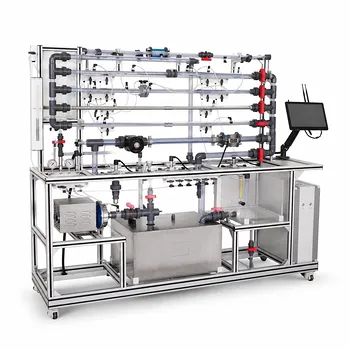
- Multi Pump Fluid Transport Process Piping Unit Operations Training Pilot Plant
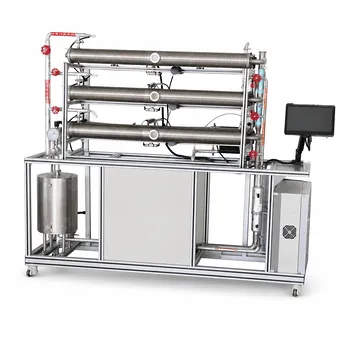
- Three-Tube Heat Transfer Educational Pilot Plant for Unit Operations Training
- Bio-fermentation Ethanol Production Practical Training Unit Operations Pilot Plant
- Constant Pressure Filtration Educational Unit Operations Pilot Plant
- Rising and Falling Film Evaporation Educational Unit Operations Pilot Plant
People Also Ask
- Why distinguish Newtonian & non-Newtonian fluids in pilot plants? Prevent design errors.
- Why is the chemical plant startup schedule crucial? De-risk scale-up with pilot plants.
- When to transition from PID to adaptive control in pilot plants? Key process indicators.
- Why Use PTFE & Hastelloy in Chemical Pilot Plants? Prevent Corrosion & Ensure Safety
- How to study gasification in pilot plants? Compare exit gas composition & efficiency