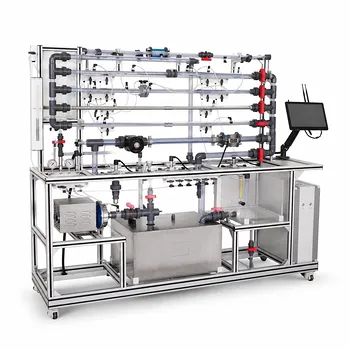
The divergence in process control stems from a fundamental physical state change: homogeneous liquids in synthesis versus heterogeneous powders in formulation. In chemical synthesis, process streams are typically uniform solutions or slurries, so a single-point measurement reliably represents the entire batch and probes rarely foul. Drug product formulation, however, must tame solid blends that segregate, create dead zones, and coat sensors—making representative sampling and real-time control an orders-of-magnitude tougher challenge. Pilot plants dedicated to solids handling directly confront these issues by letting engineers test sampling strategies, debug probe-fouling mechanisms, and implement process analytical technologies (PAT) under realistic but forgiving conditions.
The core challenge is moving from predictable, well-mixed fluid streams to the chaotic, segregation-prone world of powders and granules. Pilot plants serve as an indispensable proving ground where teams learn to master the sampling tactics and PAT tools that prevent blend-uniformity failures when scaling up to full production.
Why a Liquid-Phase Background Misleads in Solids Processing
The Homogeneous Advantage of Chemical Synthesis
API synthesis handles homogeneous liquids or slurries, where agitation easily maintains uniformity. Temperature, pH, and composition at one location reliably mirror the entire vessel. This simplicity allows straightforward in-line spectroscopy and rapid feedback control with little worry about sample integrity or sensor cleanliness.
The Heterogeneous Reality of Formulation
Drug product unit operations flip the script entirely. The active ingredient is mixed with excipients to form highly heterogeneous powders, granules, and compacts. Unlike a clear liquid, these mixtures can segregate by particle size, density, or shape during the very act of transfer or storage. Simply taking a representative sample becomes a statistical and physical challenge that doesn’t exist in synthesis.
When a Routine Sample Turns into a High-Stakes Gamble
In a tumble blender or fluidized bed, dead zones near baffles or walls can trap unmixed pockets. A grab sample from a single location can dramatically over- or under-report the active content, creating false confidence about content uniformity. This sampling bias—virtually absent in homogeneous liquids—can derail a batch’s quality unless systematic, multi-point thief sampling or inline PAT is employed.
Why Real-Time Control Fights Physics at Every Turn
Probe Fouling: The Optical Barrier
Process Analytical Technology such as near-infrared (NIR) or Raman probes is essential for solids, but windows foul relentlessly. Sticky powders from wet granulation or humid drying cling to sensor surfaces, degrading signal quality within minutes. While a liquid-phase probe stays clean effortlessly, solids probes demand air purges, mechanical wipers, or retractable housings—complexities that pilot plants allow teams to design and debug without risking commercial batches.
The Unpredictable Nature of Powder Flow
Powders don’t follow liquid-like hydraulics; they arch, rat-hole, or flood. Mass flow meters that work beautifully for liquids become unreliable, forcing reliance on loss-in-weight feeders and weigh belts whose accuracy hinges on meticulous calibration against the powder’s specific flow properties. A seemingly trivial change in particle size or moisture content can upset the entire control loop—a sensitivity that must be learned hands-on.
Sensing Quality in a Dust Cloud
Inline measurement of blend uniformity, moisture, and granule density requires sensors that survive high-dust environments. Acoustic emission detectors, capacitance probes, and NIR spectrometers can all be used, but they demand expertise in signal-to-noise optimization and chemometric model maintenance. Understanding path-length variations and fouling-induced baseline drift is a skill forged through trial and error at pilot scale, not from a textbook.
How Pilot Plants Turn Chaos into Controllable Knowledge
A Safe Sandbox for Calculated Failure
Specialized solids-handling pilot plants (typically 50–4,000 L) let engineers “fail small” on blenders, granulators, and dryers. Teams can intentionally push a blend to segregation, over-dry a granulation until crusting, or blind a probe without jeopardizing multi-million-dollar production. This risk-tolerant environment accelerates learning about what the physics will actually permit.
Building Intuition Through Physical Process Variables
In a pilot plant, operators directly manipulate impeller speed, liquid binder addition rate, and drying air temperature, then witness the immediate, often counterintuitive, consequences. They discover that higher mixing speed can cause de-mixing rather than better uniformity, or that an aggressive dry cycle creates a hard moisture shell. This hands-on feedback builds a visceral understanding that no simulation can fully replicate.
Embedding PAT in a Realistic Workflow
Pilot plants offer the perfect venue to position probes, test purging strategies, and collect the training data needed for robust NIR or Raman chemometric models. Crucially, the longer analytical turnaround times and limited operating hours at pilot scale mirror real-world constraints, teaching engineers to use data proactively—not just react after an off-line lab result signals a problem.
Simulating the Scale-Up Trap
Scale-up is where most formulation failures erupt. Pilot plants recreate the equipment size discrepancy (a 10 L lab blender vs. a 2,000 L production bin blender) and mode shifts (flexible, sequential setups vs. standardized, parallel operations). Working in this intermediate space forces teams to develop scale-down models that can later diagnose and fix commercial segregation events.
Understanding the Trade-Offs of Pilot Plant Testing
The Limits of Flexible, Sequential Operations
Pilot plants rarely run 24/7, so they miss steady-state behaviors that define true manufacturing. A dryer restarted on Monday morning may have subtle heat-transfer differences from a continuous run, meaning some startup-related variability must be anticipated and engineered out of the commercial process.
The Risk of Over-Troubleshooting Rare Events
It’s easy to pour resources into solving a segregation phenomenon that appears only under extreme pilot-scale conditions but never manifests in the final, larger blender. Without disciplined experimental design, pilot plant data can become a repository of anecdotal fixes rather than a foundation for a robust design space.
The Clearer Path for Synthesis Work
API synthesis pilot plants—with batch reactors, distillation columns, and liquid handling—benefit from the predictability of homogeneous fluids. They require far less PAT investment for anti-fouling. Recognizing this distinction prevents the mistake of over-engineering a synthesis pilot plant for solids problems, and ensures the right tool is used for the right development stage.
Making the Right Choice for Your Development Goal
Identify your core need and align the pilot plant strategy accordingly:
- If your primary focus is API route scouting and synthesis: Use batch reactor-focused pilot plants with liquid-phase PAT (e.g., Raman for reaction monitoring) to optimize yield, purity, and cycle time without the complexities of powder heterogeneity.
- If your primary focus is developing a robust solid dosage form: Invest in a solids-handling pilot plant equipped for blending, wet/dry granulation, and drying. Center your activity on implementing powder-compatible PAT and designing worst-case sampling studies to build a defensible control strategy.
- If your primary focus is building workforce intuition and troubleshooting skill: Expose teams to solids pilot plants early. The messy, hands-on battle with segregation, probe fouling, and unreliable flow is the only way to forge the engineering judgment that prevents commercial formulation failures.
Recognizing that a tablet’s final quality is determined not in the ordered world of liquid synthesis but in the restless, granular reality of mixing and drying is the first step—and pilot plants are the only honest, risk-mitigated arena to master that transformation.
Summary Table:
| Aspect | Chemical Synthesis (Liquids) | Drug Product Formulation (Solids) | Pilot Plant Value |
|---|---|---|---|
| Physical State | Homogeneous liquids & slurries | Heterogeneous powders & granules | Safe testing environment for solid flow |
| Sampling | Easy, representative single-point | Difficult, prone to segregation/bias | Proving ground for multi-point sampling |
| Process Control | Simple inline spectroscopy | Complex PAT (NIR/Raman), probe fouling | Debugs anti-fouling & sensor setups |
| Scale-up Risk | Predictable fluid hydraulics | Unpredictable powder flow & dead zones | Simulates large-scale equipment dynamics |
Bridge the Gap from Lab to Production with LABPARK
Mastering the complexities of process control and powder flow requires hands-on experience and the right equipment. LABPARK provides state-of-the-art Educational and Vocational Unit Operations Pilot Plants in chemical engineering, bioprocess & biotech, and environmental & water treatment.
Designed specifically for universities, research institutes, and enterprises, our pilot plants serve as the ultimate training and testing ground. They empower your team to safely troubleshoot probe fouling, optimize sampling strategies, and master scale-up challenges before moving to commercial production.
Ready to enhance your research and training capabilities? Contact LABPARK today to find the perfect pilot plant solution for your facility!
Related Products
- Natural Product Extraction Unit Operations Training Pilot Plant
- Fixed-Bed Chemical Reaction and Gas Dust Tar Removal Unit Operations Pilot Plant
- Ethyl Acetate Synthesis Unit Operations Pilot Plant for Practical Training
- Methanol Synthesis and Catalyst Performance Evaluation Educational Unit Operations Pilot Plant
- Electrolytic Hydrogen Production Educational Unit Operations Pilot Plant
People Also Ask
- How to Demo Solubility Sensitivity in SFE Pilot Plants? Practical Thermodynamics
- How do pilot plants differentiate physical vs chemical extraction? Enhance Chemical Engineering Training
- How are HTU and NTU applied to determine extraction column height? Guide to Pilot Plant Scaling
- How do fluid transport principles apply to pilot plant configuration? Optimize your unit operations.
- What are the limitations of acentric factor models? Avoid pilot plant errors with polar fluids.