Incomplete mixing is the root cause of deviations from ideal behavior, fundamentally altering the residence time distribution and creating operational effects that cascade into conversion, selectivity, and safety. In a real stirred tank reactor pilot plant, the assumption of instantaneous, uniform mixing breaks down. Fluid elements follow a distribution of paths and residence times, not a single, perfectly mixed state. This creates an RTD curve with a long tail—a phenomenon where a portion of the material spends significantly more or less time in the reactor than the average space time, directly undermining the ideal model’s predictive power.
Real pilot-scale CSTRs rarely achieve perfect mixing. The resulting non-ideal residence time distribution—often characterized by tailing—impacts conversion, selectivity, and the ability to safely scale up, making RTD measurement a central focus in pilot plant studies.
Why Ideal Behavior Fails in Practice
The ideal CSTR is a conceptual model: concentration and temperature are uniform everywhere, and any entering fluid element instantly blends into the whole. Real vessels fall short for several interconnected reasons.
The Illusion of Instantaneous Mixing
Even with vigorous agitation, mixing is never truly instantaneous. In reality, fluid elements follow a spectrum of paths.
Some material may short-circuit from inlet to outlet, bypassing the bulk of the reactor. Other fluid elements may become trapped in stagnant zones or recirculation loops, spending much longer than the mean residence time. This manifests as the characteristic tailing in the RTD curve observed in tracer studies.
Short-Circuiting and Dead Zones
Short-circuiting reduces effective reactor volume. A fraction of the feed exits too quickly, lowering conversion.
Conversely, dead zones—low-velocity regions often near baffles or the vessel wall—act like stagnant pools. They cause tailing because tracer or reactant slowly diffuses out, extending the apparent residence time. Both phenomena degrade the performance the design equation assumes.
Scale-Dependent Mixing Limitations
At pilot scale, impeller design, power input, and fluid properties become critical. Reaching the turbulent, fully mixed regime of an ideal CSTR can be power-intensive or impossible.
The result is a macromixing and micromixing problem. Macromixing governs how fluid packages circulate through the vessel; micromixing governs the final blending at the molecular level. Incomplete micromixing means reagents meet each other on a timescale that influences reaction kinetics, a factor the ideal model ignores.
The Operational Impact of Non-Ideal Behavior
The deviation from ideality isn’t just academic. It directly affects the performance, safety, and scalability of the process being tested.
Impact on Conversion and Selectivity
The ideal CSTR design equation assumes a uniform reaction rate based on the final exit concentration. When tailing occurs, a portion of the reactant leaves too early (low conversion), while another portion stays longer, possibly degrading the product.
For complex reactions, the effect on selectivity can be severe. If a desired intermediate can further react, the long tail in the RTD exposes it to additional reaction time, driving the yield away from the target. Educational pilot plants demonstrate this by comparing measured conversions against the theoretical rectangular area on a 1/r_A versus X_A plot.
Multiple Steady States and Hysteresis
Real CSTRs with exothermic or autocatalytic reactions can exhibit multiple steady states. This is a direct consequence of non-linear kinetics interacting with heat and mass transfer—a reality the ideal model simplifies.
At the same operating parameters, a pilot reactor might settle at a low-conversion, cool state, a high-conversion, hot state, or an unstable intermediate. The boundaries where the number of states changes are bifurcation points. Hysteresis—where the state depends on the path taken to reach the operating condition—creates a control nightmare. Operators must avoid conditions that could trigger a sudden jump to a high-temperature runaway state.
Oscillatory Behavior and Limit Cycles
Beyond steady-state multiplicity, real reactors can enter sustained oscillations even with constant inputs. These limit cycles arise from a Hopf bifurcation, where a pair of complex eigenvalues crosses the imaginary axis.
Observable periodic temperature or concentration oscillations indicate that the reactor is fundamentally unstable. Pilot plant training exposes students to these dynamics, teaching them to identify the conditions where the trace of the system’s Jacobian matrix approaches zero, signaling the onset of oscillation. This directly impacts the design of feedforward control loops and defines safe operational envelopes.
Scale-Up and Model Transferability
A pilot plant’s primary purpose is to generate data for commercial design. If the pilot reactor operates far from ideal mixing, the intrinsic kinetic parameters extracted will be distorted.
When scaling to a larger vessel where mixing patterns differ again, the error compounds. To bridge this gap, engineers conduct tracer experiments to measure the actual RTD. They then build a reactor network model—a combination of ideal CSTRs and plug-flow reactors—that mimics the real performance. This empirical adjustment is a direct cost of non-ideal behavior.
Understanding the Trade-offs
Working with real pilot-plant CSTRs means accepting a series of compromises.
Data Fidelity vs. Operational Simplicity
A perfectly mixed ideal reactor simplifies analysis, but the data carries hidden error if mixing is poor. Conversely, enduring non-ideal mixing and correcting with RTD models yields more accurate kinetics but complicates the data workflow.
In educational settings, the very departure from ideality becomes the lesson. The “imperfect” RTD curve is the point—it teaches students that real engineering is about quantifying and correcting for deviation.
Safety Trade-offs in Exothermic Systems
Operating near the ignition point of an exothermic reaction can maximize conversion but risks runaway. The non-linear dynamics (multiplicity, hysteresis) force a choice: run at a safer, lower-conversion steady state with a large margin from the bifurcation boundary, or push for higher throughput with sophisticated monitoring.
Pilot plants serve as the testbed for these strategies, revealing the real-world behavior of control systems before they are trusted in production.
How to Use This Understanding in Your Pilot Plant Program
The goal dictates how you should approach the inevitable deviations. Rather than fighting the non-ideality, measure it and make it work for your objectives.
- If your primary focus is kinetic parameter estimation: Prioritize tracer-based RTD measurement. Use the results to construct a representative reactor network model (e.g., a CSTR with a dead-zone and bypass stream) before extracting kinetic constants.
- If your primary focus is process safety and controllability: Deliberately map the reactor’s bifurcation behavior. Identify the critical conditions where multiple steady states or limit cycles appear, and define a safe operating window that avoids hysteresis and oscillatory regions.
- If your primary focus is educational demonstration: Design experiments that deliberately contrast ideal predictions with real data. Vary the stirrer speed to show its effect on RTD tailing, and demonstrate how space time impacts conversion in a truly non-ideal vessel.
- If your primary focus is scale-up: Run the pilot reactor across a range of mixing intensities. Compare the RTD at each condition to computational fluid dynamics (CFD) predictions, building confidence in how mixing will scale to the larger unit.
By acknowledging and measuring the RTD, you transform the real CSTR’s imperfections from a source of error into a source of deeper process understanding.
Summary Table:
| Deviation Cause | Physical Mechanism | Operational Impact |
|---|---|---|
| Short-Circuiting | Fluid bypasses the bulk reactor volume directly to the outlet | Reduced effective volume, lower overall conversion |
| Dead Zones | Stagnant, low-velocity regions (e.g., near baffles/walls) | Tailing in RTD curve, extended residence times |
| Incomplete Micromixing | Slow blending at the molecular scale relative to reaction rates | Distorted kinetics, reduced product selectivity |
| Non-Linear Dynamics | Interplay of exothermic reaction kinetics and heat transfer | Multiple steady states, hysteresis, and runaway risks |
Optimize Your Reactor Engineering & Process Scale-Up
Bridging the gap between theoretical CSTR models and real-world reactor dynamics requires robust, high-fidelity equipment. LABPARK provides state-of-the-art Educational and Vocational Unit Operations Pilot Plants in chemical engineering, bioprocess & biotech, and environmental & water treatment.
Designed for universities, research institutes, and enterprises, our pilot systems allow operators to safely map residence time distributions (RTD), study thermal runaway risks, and master reactor kinetics under real operational conditions.
Ready to elevate your laboratory capabilities? Contact LABPARK today to find the ideal pilot plant solution for your educational or research goals!
Related Products
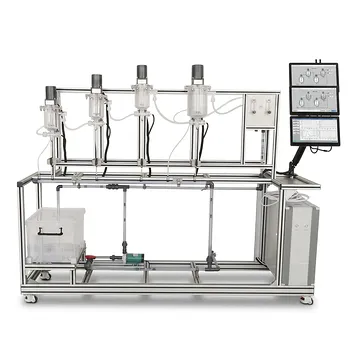
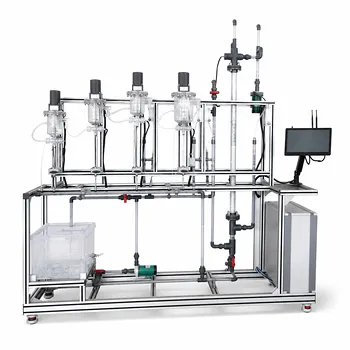
- Multi-Stage Stirred Tanks in Series Residence Time Distribution and Mixing Performance Determination Educational Pilot Plant
- Residence Time Distribution and Reactor Flow Characteristics Determination Educational Pilot Plant
- Gas Phase Mixing and Residence Time Distribution Determination Educational Unit Operations Pilot Plant
- Multi Functional Catalytic Reaction and Reactor Evaluation Educational Unit Operations Pilot Plant
- Multi-Reactor Educational Pilot Plant for Reaction Engineering Unit Operations
People Also Ask
- How does MRF model impeller rotation in CFD? Key Boundary Conditions Explained
- How can a CSTR pilot plant demonstrate reactor staging? Visualize volume savings.
- How does steady-state multiplicity affect the operation and safety of exothermic reactions within a CSTR pilot plant? - Guide
- What parameters to monitor transitioning from Batch to CSTR? Master Pilot Plant Setup
- Why is temperature regulation via a cooling jacket a critical feature in CSTR pilot plants used for laboratory training?