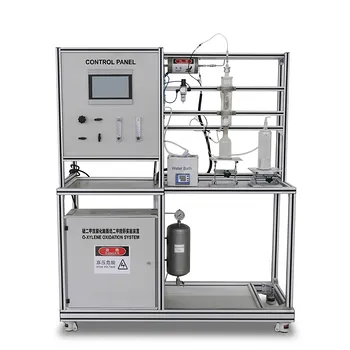
Material balance calculations differ because reactors change chemical composition, while physical separation units primarily redistribute existing species. In distillation, extraction, or filtration, each chemical component is conserved across the unit, even though it may move between phases or outlet streams. In a reactor, reactants are consumed and products are formed according to reaction stoichiometry, so inlet and outlet mole numbers—and sometimes total mass flow on a molar basis—need not be equal.
The central distinction is the presence of reaction source and sink terms. Separation balances track where each existing species goes; reactor balances must also calculate how much of each species is created or consumed through conversion, reaction extent, and stoichiometry.
Why Separation Units Use Component Conservation
Species are redistributed, not transformed
A physical separation changes the distribution of components between streams or phases. For example, distillation may send more of a volatile component overhead, while extraction transfers a solute from one liquid phase to another.
No chemical identity changes are required for the balance. For each nonreacting component, the general steady-state balance is:
[ \text{Input} - \text{Output} = 0 ]
Thus, the amount of component (i) entering the unit must equal the total amount of component (i) leaving it, subject to measurement error and physical losses.
Total molar flow can still change
Although individual species are conserved, the total molar flow in an outlet need not equal the total molar flow at the inlet. This can occur because the streams have different compositions or because material is divided among multiple outlets.
Therefore, the correct approach is to write one independent component balance for each relevant species, rather than assuming that total inlet moles equal total outlet moles.
Splitters are a special case
In an ideal splitter, every outlet has the same composition as the inlet. The unit only divides the flow, so a single overall balance is sufficient; component balances are dependent on that overall balance.
This differs from a separator, where outlet compositions change and independent component balances are generally required.
Why Reactor Balances Require Reaction Terms
Chemical reactions create and consume species
A reactor introduces a source or sink for each species. The general steady-state species balance is:
[ \text{Input} - \text{Output} + \text{Generation} - \text{Consumption} = 0 ]
Using reaction rates, this is often written as:
[ \text{Input} - \text{Output} + \sum_k \nu_{ik} r_k V = 0 ]
where (\nu_{ik}) is the stoichiometric coefficient of species (i) in reaction (k), (r_k) is the reaction rate, and (V) is the reactor volume.
A negative stoichiometric coefficient represents consumption; a positive coefficient represents formation.
Total moles may change
The total number of moles can increase or decrease when the stoichiometry changes the number of molecules. For example, a reaction may consume several moles of reactants while producing fewer moles of product, or the reverse.
Consequently, an overall mole balance cannot generally be used as the sole reactor balance. It does not reveal how individual reactants and products change.
Mass and elements remain conserved
Chemical reactions do not destroy atoms. Therefore, total mass and elemental balances remain valid even when species mole numbers change.
For complex pilot-plant reactions—such as gasification, cracking, or synthesis with unknown side reactions—carbon, hydrogen, oxygen, and sulfur balances can provide reliable constraints without requiring a complete reaction mechanism.
How Reactor Type Changes the Calculation
Plug flow reactors
For a plug flow reactor, the species balance changes along the reactor volume:
[ \frac{dF_j}{dV}=r_j ]
The molar flow of each species must therefore be integrated from the reactor inlet to the outlet using the reaction-rate expressions and operating conditions.
Continuous stirred-tank reactors
For an ideal steady-state CSTR, the contents are perfectly mixed, so the outlet composition equals the reactor composition. The species balance is commonly expressed as:
[ F_{j0}-F_j=-r_jV ]
The calculation directly links feed flow, outlet flow, reaction rate, and reactor volume.
Batch reactors
A batch reactor has no continuous inlet or outlet during the reaction period. Its species balance is time-dependent:
[ \frac{dN_j}{dt}=r_jV ]
The calculation determines how the number of moles of each species changes with time.
Reactors with additional transport effects
Membrane reactors require both reaction and permeation terms:
[ \frac{dF_i}{dV}=r_i+R_i ]
Semibatch reactors may also have changing volume and feed composition, requiring transient balances rather than a simple steady-state equation.
The Variables That Matter in a Reactor Pilot Plant
Stoichiometry
Stoichiometric coefficients define the relative consumption and formation of species. They connect conversion of a limiting reactant to the quantities of products formed and unreacted materials remaining.
Limiting reactant
The limiting reactant constrains the maximum theoretical conversion and product yield. Pilot-plant calculations must identify it before calculating expected outlet compositions.
Conversion and selectivity
Conversion measures how much of a reactant is consumed. Selectivity distinguishes the desired product from competing products formed through parallel or secondary reactions.
A reactor can have high conversion but poor yield if much of the consumed feed forms undesired products.
Reaction extent
For a reaction (k), the reaction extent (\xi_k) provides a convenient way to calculate species changes:
[ n_i=n_{i0}+\sum_k \nu_{ik}\xi_k ]
For multiple reactions, separate extents are needed because each reaction changes the species inventory differently.
Why Pilot-Plant Results Rarely Close Perfectly
The unit may not be at steady state
A calculation based on steady-state assumptions is unreliable if samples are collected during startup, shutdown, changing feed conditions, or transient operation.
Material may accumulate inside the reactor, piping, separator, or receiver. The accumulation term must then be included:
[ \text{Input} - \text{Output} + \text{Generation} - \text{Consumption} = \text{Accumulation} ]
Flow and density measurements introduce error
Pilot-plant flowmeters often measure volume, while material balances require mass or molar flow. Temperature and pressure changes affect density, so using an inappropriate reference density can create an apparent balance discrepancy.
Unmeasured losses and impurities matter
Leaks, evaporation, feed impurities, dissolved gases, deposits, purge streams, and unmeasured side products can all affect closure. These effects are especially important at pilot scale, where small absolute losses may be significant relative to the throughput.
Analytical measurements have uncertainty
Feed and product compositions are obtained from instruments or manual samples with finite accuracy. A small difference between calculated inlet and outlet mass may therefore reflect normal measurement uncertainty rather than a real process failure.
Repeated measurements and statistical error analysis help distinguish random noise from systematic discrepancies.
Understanding the Trade-offs
Overall balances are simple but limited
An overall mass balance is useful for checking whether the process is physically plausible. However, it cannot identify which species were consumed, formed, lost, or mismeasured.
For a reacting system, relying only on total inlet and outlet flow can hide poor conversion, low selectivity, or unrecognized side reactions.
Detailed species balances require more data
Species balances provide the information needed to calculate conversion, yield, and selectivity. They also require reliable stream compositions, flow rates, stoichiometry, and—in many cases—reaction-rate information.
If the analytical data are weak, a more detailed model may create false precision rather than better understanding.
Stoichiometric models can miss real chemistry
A model based on one ideal reaction may fail when intermediates, parallel reactions, catalyst deactivation, or unknown side reactions are present. Element balances are often more robust in such cases because they rely on atomic conservation rather than a complete reaction pathway.
Mass-balance closure is not the same as reactor performance
A balance can close while the process performs poorly. Closure only indicates that measured inputs, outputs, accumulation, and reaction terms are mutually consistent; it does not prove high yield, good selectivity, or optimal operation.
How to Apply This to Your Pilot Plant
The appropriate balance strategy depends on whether the unit changes chemical identities and on the quality of available operating data.
- If your primary focus is a physical separation: Write independent balances for each conserved chemical component, then account for phase splitting, stream distribution, and any accumulation or measured losses.
- If your primary focus is reactor conversion: Use stoichiometry, limiting-reactant analysis, conversion, reaction extent, and reactor-specific mole-balance equations to calculate outlet species.
- If your primary focus is unknown or complex chemistry: Begin with elemental balances and measured stream compositions before introducing detailed reaction mechanisms.
- If your primary focus is pilot-plant data quality: Establish a clear mass or molar basis, verify steady-state operation, correct flow data for operating conditions, and quantify instrumentation and sampling uncertainty.
- If your primary focus is process optimization: Track individual reactants, desired products, by-products, and inert species so that conversion, yield, selectivity, and material losses can be separated.
Understanding whether a unit redistributes species or transforms them is the key to choosing the correct material-balance framework.
Summary Table:
| Unit operation | What happens to species? | Main balance focus |
|---|---|---|
| Physical separation | Existing species are redistributed between streams or phases | Component conservation and phase splits |
| Splitter | Flow is divided without changing composition | Overall flow balance |
| Reactor | Reactants are consumed and products are formed | Species balances with reaction terms |
| Complex reactor system | Reactions may combine with permeation, accumulation, or side reactions | Elemental balances and transient or transport terms |
| Pilot-plant analysis | Measurements may include flow, sampling, impurity, and loss errors | Data quality and balance closure |
Plan More Reliable Pilot-Plant Experiments
Need to evaluate reactor conversion, separation performance, or material-balance closure? Contact LABPARK to discuss your requirements.
LABPARK provides Educational and Vocational Unit Operations Pilot Plants for universities, research institutes, and enterprises, including systems for:
- Chemical engineering reactor and separation studies
- Bioprocess and biotechnology development
- Environmental and water-treatment applications
Our pilot plants help teams investigate stoichiometry, conversion, selectivity, phase separation, process control, and measurement uncertainty with practical, application-focused equipment. Tell us your process, scale, teaching or research objectives, and required operating data so LABPARK can help identify a suitable pilot-plant configuration.
Related Products
- Fixed-Bed Chemical Reaction and Gas Dust Tar Removal Unit Operations Pilot Plant
- Fixed Bed Gas Solid Catalytic Reaction Educational Pilot Plant
- Multi-Reactor Educational Pilot Plant for Reaction Engineering Unit Operations
- Residence Time Distribution and Reactor Flow Characteristics Determination Educational Pilot Plant
- Tubular Reactor Flow Characteristics Determination Educational Unit Operations Pilot Plant
People Also Ask
- When to transition from PID to adaptive control in pilot plants? Key process indicators.
- How do deviations in estimating latent heat impact pilot plant thermal systems? Avoid hardware mis-sizing.
- Why Compare Predicted and Experimental Excess Enthalpy? Key to Accurate Pilot Plant Scale-up
- How to study gasification in pilot plants? Compare exit gas composition & efficiency
- How can unit operations pilot plants demonstrate simultaneous removal of light and heavy impurities? Configure a modular setup