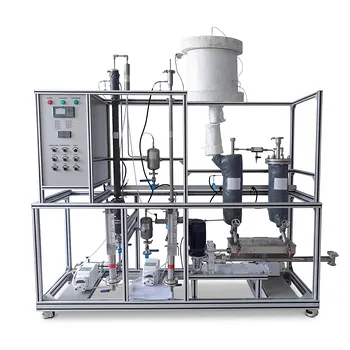
The immediate, non-negotiable reason is simple: a refractory-lined vessel is not an upgrade; it is a survival mechanism. The autothermal reforming (ATR) process generates a combustion zone reaching 2,200 K (1,927°C), a temperature that would instantly compromise any unprotected structural metal. At these temperatures, the pressure vessel’s steel shell would rapidly lose all mechanical integrity, leading to a catastrophic failure if not shielded by a thick insulating layer. This lining is the only barrier between a controlled syngas reaction and an industrial explosion, while also preventing the high-pressure hydrogen from causing severe embrittlement in the steel wall.
The core challenge of ATR reactor design is a fundamental material incompatibility. Steel loses its strength and becomes susceptible to creep long before reaching commercial ATR temperatures. Therefore, the refractory lining is the true structural element against heat, demoting the outer steel shell to a mere pressure boundary. For a research institute, selecting a lab-scale plant means prioritizing a design that does not just insulate heat, but actively maintains a safe, code-compliant temperature gradient from the 2,200 K core to the metal shell.
Why Metal Fails Without Protection
To understand the necessity of the lining, you must first look at what happens to the metal under these reaction conditions. It’s not just melting; it’s a multi-faceted degradation that invalidates standard engineering materials.
The Collapse of Mechanical Strength
A material’s ability to hold its shape against stress vanishes with rising temperature. Tensile strength is not a constant; it is a function of thermal energy. Standard engineering steels experience a dramatic drop-off. A low-carbon steel boasting a tensile strength of 450 N/mm² at room temperature will plummet to just 210 N/mm² at 500°C. By the time the temperature reaches the ATR combustion zone level, that strength is effectively zero. A reactor wall must be designed not for its ambient rating, but for its maximum allowable stress at the operating temperature, a calculation that typically forces a shift away from all standard carbon steels.
The Silent Threat of Creep Deformation
A failure doesn’t always require a sudden burst. Under continuous thermal load and stress, metals exhibit creep, a slow, progressive deformation that changes their physical dimensions permanently. This is not a flaw but a fundamental property of metallurgy under stress at high heat. A reactor component, like a furnace tube, can slowly "grow" and thin out over time, even if the load is below its theoretical yield strength. To resist this, engineering must shift to specialized high-alloy materials with high creep resistance—such as Inconel 600 or Incoloy 800—which are prohibitively expensive and difficult to fabricate for an entire vessel, making the refractory-lined option more practical.
Regulatory Boundaries for Safety
Pressure vessel codes draw a hard line to enforce safety. According to standards like ASME BPV, standard carbon steel plates are prohibited for pressure-bearing use when the design temperature exceeds 482°C (900°F). Above this limit, you are required to switch to killed steel, low-alloy steels, or stainless steels. The ATR process operates hundreds of degrees above even these restrictive limits, placing it in a "no-man's-land" for cost-effective metal shells. The code essentially mandates a thermal management solution like a refractory lining to bring the steel’s temperature down into an approved operating window.
The Dual Role of the Refractory Lining
The lining’s job is more complex than just acting as a thermal blanket. It solves a chemical problem and a mechanical one simultaneously.
Protection Against Hydrogen Attack
The primary reference correctly highlights hydrogen embrittlement as a parallel, insidious threat. At high partial pressures and temperatures, molecular hydrogen dissociates and atomic hydrogen diffuses into the steel matrix. This surface hydrogen, often a product of the very syngas you are trying to create, can react with carbon in the steel to form methane, causing internal decarburization and micro-fissures. The refractory lining acts as a chemical shield, physically separating the high-pressure hydrogen environment from the vulnerable pressure shell.
Maintaining a Safe Wall Temperature
The primary purpose is to create a massive thermal gradient. The hot face of the refractory must withstand 2,200 K without significant erosion, while the cold face against the steel shell must be below the code limit of 482°C. This allows the steel shell to operate in a temperature zone where it retains its certified mechanical strength and ductility, effectively reducing the entire vessel’s cost and extending its lifespan by decades. The shell then only functions as a gas-tight pressure boundary, a job it can do safely.
Picking the Right Lab-Scale Reactor
For a research institute, the goal is not just safety, but data fidelity. Your pilot plant must replicate commercial thermal gradients to yield scalable results, while ensuring a safe learning environment for students.
Prioritizing the Insulation System
Do not be swayed by a simple "refractory-lined" label. You must interrogate the design of the thermal management system. Look for a multi-layer approach. A high-density, high-alumina hot-face refractory might handle the extreme core temperatures, but it should be backed by insulating castables or ceramic fiber modules to step the temperature down efficiently. The design should include calculated thermal models proving that the pressure vessel wall remains at least 50°C below the maximum allowable working temperature for its specific steel grade, not just a generic safety margin.
Material Selection for the Hot Zone
The thermowell, catalyst support structures, and any internal fittings bathing in the 2,200 K combustion zone are critical points of failure. Ensure these internal components are fabricated not from generic stainless steel, but from verified high-alloy, creep-resistant materials. The supplementary references point to alloys like Inconel 600 or Incoloy 800 for high-stress, high-temperature zones. Your reactor’s internal thermowell, which must maintain integrity to provide accurate temperature data, is the single most important component to have constructed from these superalloys.
Understanding the Trade-offs
There is no perfect, one-size-fits-all solution, even with a refractory-lined vessel. An objective technical choice requires acknowledging the downsides.
High Thermal Mass and Slow Dynamics
A refractory-lined reactor has an enormous thermal inertia. This means heating up to a steady state can take hours, and cooling down for a catalyst change can take a full day. For a university research group with limited time, this slow turnaround limits the number of experiments possible per week. A rapid-screening unit is not refractory-lined; by choosing one that is, you are trading throughput for thermal fidelity and safety.
The Risk of Confounding Data
Ceramic linings can contain silica, alumina, or other oxides. At extreme conditions, these can react with steam or byproducts, potentially leaching contaminants or acting as an unintended catalyst support themselves. If your research is on a novel ultra-pure catalyst, the lining’s background reactivity could confound your material balance and selectivity data. The design feature to look for here is a chemically inert secondary barrier or liner that isolates the process chemistry from the structural insulation.
Brittle Failure Modes
Unlike a steel vessel that may leak before it ruptures, a failed refractory lining can spall or crack catastrophically, suddenly exposing the pressure vessel wall. A smart lab-scale plant will not just have a lining, but instrumented lining. Look for designs that incorporate thermocouples embedded within the refractory layers. These sensors provide early warning of hot spots on the steel shell, turning a catastrophic failure mode into a predictable maintenance trigger.
Making the Right Choice for Your Research Goal
Your selection must be dictated by the specific research objective. Safety is a given baseline, so the differentiator is how the design serves your data.
- If your primary focus is catalyst performance screening for commercial scale-up: Insist on a robust refractory lining with a verified thermal gradient that replicates industrial reactors. Scalable kinetics data is impossible without a realistic temperature profile, and the slower turnaround is a necessary price for this accuracy.
- If your primary focus is mechanistic studies and in-situ analysis: Prioritize internal components made from inert superalloys over the thickness of the refractory itself. Demand a chemically clean hot zone with precision instrumentation to avoid data from background reactions or compromised thermowells.
- If your primary focus is running in-house pilot tests for a patent portfolio: Choose a reactor with ASME-compliant material certifications and embedded refractory monitoring. Your data must not only be scientifically sound but also legally defensible, which requires a traceable safety and materials pedigree.
- If your primary focus is student lab safety and operational simplicity: Select a pre-engineered system with a fully integrated, instrumented refractory package and an automated safety shutdown that locks out at a measured wall temperature threshold. The goal here is to prevent any scenario where human error can defeat the thermal protection.
Choosing a lab-scale ATR reactor is a decision to prioritize thermal reality over operational speed, and intrinsic safety over mechanical simplicity. The right pilot plant translates the brutal physics of an industrial process into a controlled, observable, and safe scientific instrument.
Summary Table:
| Feature / Challenge | Technical Detail | Research Importance |
|---|---|---|
| Insulation System | Multi-layer (high-alumina & ceramic fiber) | Maintains shell temperature below code limits |
| Material Selection | Superalloys (Inconel 600 / Incoloy 800) | Resists creep and hydrogen attack in hot zones |
| Refractory Monitoring | Embedded lining thermocouples | Provides early hotspot detection & prevents failure |
| Chemical Inertness | Secondary inert barrier/liner | Prevents catalyst contamination & background reactions |
Accelerate Your Research Safely with LABPARK
Are you looking to equip your laboratory with advanced, high-performance systems? LABPARK provides state-of-the-art Educational and Vocational Unit Operations Pilot Plants in chemical engineering, bioprocess & biotech, and environmental & water treatment. Designed specifically for universities, research institutes, and enterprises, our systems ensure maximum safety, code compliance, and reliable data scaling.
Contact LABPARK today to discuss your custom pilot plant requirements with our specialists!
Related Products
- Steam Methane Reforming Hydrogen Production and Purification Educational Pilot Plant
- Micro-Scale Gas-Solid Catalytic Reaction Educational Pilot Plant
- Methanol Synthesis and Catalyst Performance Evaluation Educational Unit Operations Pilot Plant
- Multi Functional Catalytic Reaction and Reactor Evaluation Educational Unit Operations Pilot Plant
- Fixed Bed Gas Solid Catalytic Reaction Educational Pilot Plant
People Also Ask
- How is carbon deposition controlled in steam reforming? The Critical Role of S/C Ratio
- Why is the steam reforming of methane hindered at elevated pressures in a chemical engineering unit operations pilot plant?
- How does temperature affect syngas equilibrium? Practical limits in steam reforming
- What are the differences between steam reforming and ATR in pilot plants? Key Design Guide
- What thermodynamic principles govern methane reforming in pilot plants? Master equilibrium and coke control.