Thermodynamics says it’s possible. Kinetics says it’s practical.
In environmental and bioprocess pilot plants, the core work revolves around reaction kinetics and catalyst evaluation because many critical reactions are thermodynamically favorable—they have massive equilibrium constants—yet their natural rates are so slow that they never reach that favorable endpoint in a useful timeframe. A pilot plant exists to bridge the gap from “this reaction should work” to “this reaction will work fast enough, at scale, to solve a real-world problem.”
The central takeaway: Thermodynamic equilibrium tells you where a reaction can go, but only kinetics tells you how fast it gets there. Pilot plants don’t abandon thermodynamics—they use it as a starting point, then focus entirely on making a favorable reaction happen on demand by testing catalysts, temperatures, and flow conditions that deliver an acceptable rate and conversion in a real process.
The Thermodynamic Promise vs. the Kinetic Reality
A reaction with a large equilibrium constant ( K ) is, by definition, strongly product-favored. This is the thermodynamic reality you’d read in a textbook. However, thermodynamics is silent on the dimension of time.
Why a Large ( K ) Doesn’t Mean Speed
Many environmental tail-gas reactions—such as converting harmful CO and NO into harmless ( N_2 ) and ( CO_2 )—exhibit enormous ( K ) values. The atoms “want” to rearrange into the products. But the molecular collisions required to break the original bonds have such a high activation energy that, at ambient conditions, the forward reaction essentially does not happen on its own.
This is the core of the disconnect: equilibrium thermodynamics tells you the destination; kinetics reveals whether you’ll arrive in a millisecond, a century, or never. In a practical treatment plant, a reaction that takes days to complete is useless for a stream of exhaust gas passing through a reactor in seconds.
The Kinetic Levers: Catalysts, Temperature, and Flow
Pilot plants focus on the three levers that directly alter the rate:
- Catalysts: Lower the activation energy, providing an alternative pathway that dramatically increases the number of successful collisions per second.
- Temperature: Increases the fraction of molecules that exceed the activation barrier, speeding up reactions—but always with an eye on any adverse equilibrium shifts.
- Space Velocity (flow rate): Defines the contact time between the reactants and the catalyst. The goal is to find the minimum residence time that still achieves the required conversion, which determines the reactor size and practicality of the whole system.
None of these parameters can be calculated from an equilibrium constant alone. They must be measured experimentally under flow conditions.
The Pilot Plant as a Kinetic Observatory
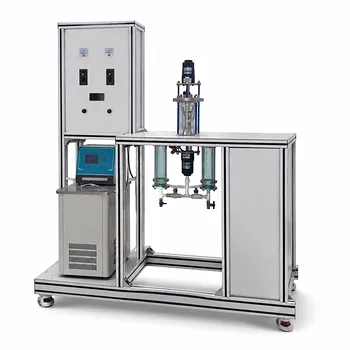
A pilot plant is not a miniature production facility; it is a data-generation platform that simulates the dynamic, flowing reality of an industrial or environmental process. Your question is sharp because it surfaces the exact reason these multi-million-dollar facilities exist.
From Batch Thermodynamics to Continuous Kinetics
A standard thermodynamic measurement might be done in a sealed, stirred vessel at equilibrium. A pilot plant operates continuously, with reactants streaming in and products streaming out. This changes the game completely.
The primary reference highlights that researchers directly measure reaction rates under flow conditions. They evaluate how the rate changes with concentration, temperature, and pressure. Critically, they evaluate catalyst efficiency—not just activity but also selectivity and long-term stability—in an environment that mimics real-world fouling, sintering, or poisoning. An equilibrium constant gives you zero information about whether a catalyst will deactivate in 10 hours or 10,000 hours.
The Role of Space Velocity and Reaction Quotient
A uniquely kinetic concept that dominates pilot-plant studies is space velocity, the volumetric feed rate divided by the catalyst volume. It’s the inverse of contact time. A high space velocity means high throughput but risks low conversion; a low space velocity ensures high conversion but demands a larger, costlier reactor.
Pilot plants optimize this balance. Furthermore, they operate far from equilibrium by continuously sweeping products away. As the supplementary reference describes with ammonia synthesis, removing the product shifts the reaction quotient ( Q ) to be much lower than the equilibrium constant ( K ), providing a continuous thermodynamic driving force that the kinetic rate can exploit. Without the kinetic data to set the removal rate, this principle remains theoretical.
Understanding the Trade-offs and Limitations
Focusing exclusively on kinetics isn’t a magic wand. It introduces its own set of constraints that a pilot plant must navigate, which is why the discipline isn’t simply about “making it faster.”
The Thermodynamic Ceiling Still Exists
No catalyst can drive a reaction beyond its equilibrium limit. If temperature is raised to satisfy kinetics, but that temperature sharply reduces the equilibrium constant (as with ammonia synthesis, where ( K ) drops from ~( 10^5 ) to ( 10^{-4} ) over a 400 K range), you eventually hit a wall where the maximum achievable conversion becomes too low, even if the rate is high. The pilot plant must find the intersection of acceptable rate and acceptable equilibrium yield, not just the fastest rate.
The Risk of Over-Engineering the Catalyst
An obsessive focus on kinetic activity can lead researchers to select catalysts that are brilliantly active in a fresh, clean state but degrade instantly in the real process stream. A pilot plant that prioritizes only initial rate measurements might miss the need to evaluate selectivity (e.g., does it make more ( CO_2 ) or side-products?) and long-term stability. The true objective is a rugged catalyst that delivers a steady, acceptable rate over months, not a record-breaking momentary rate.
Ignoring Mass and Heat Transfer
Pure chemical kinetics (the speed of the reaction on the catalyst surface) is only one piece. At larger scales, the overall rate can be limited by how fast reactants diffuse to the surface (mass transfer) or how efficiently heat is removed (to prevent hot spots and equilibrium penalties). A pilot plant that doesn’t account for these physical steps risks a scale-up disaster, where the beautiful kinetic data from a tiny lab reactor looks nothing like the performance of a full-scale unit.
Making the Right Choice for Your Goal
If you’re designing, operating, or investing in a pilot plant program, the ultimate purpose should dictate where you place your emphasis. Use the following guide to align your focus.
- If your primary goal is to confirm that a novel catalyst can treat a polluted stream at a target flow rate: Measure the reaction rate and required space velocity under continuous flow. The equilibrium constant provides a sanity check, but your entire decision hinges on whether the catalyst can reach 99% conversion in the 2 seconds of contact time your design allows.
- If your primary goal is to find an operating window that balances rate and equilibrium yield: Do not simply push temperature or pressure to maximize kinetics. Map the rate vs. equilibrium conversion curves, as shown in the ammonia synthesis example. Your pilot plant’s job is to identify the optimal temperature range where both are sufficient, not to blindly maximize one.
- If your primary goal is to ensure the economic viability of a large-scale environmental process: Make catalyst stability and selectivity your kinetic metrics of equal weight. A catalyst that gives a spectacular initial rate but must be replaced every week will fail financially. Pilot plant data on long-term deactivation kinetics are the real bridge to a bankable project.
Ultimately, thermodynamics draws the map of the territory, but kinetics and catalyst evaluation are the engine and steering wheel that get you to the destination on time and on budget.
Summary Table:
| Feature | Thermodynamic Equilibrium | Kinetics & Catalyst Evaluation |
|---|---|---|
| Core Focus | Reaction feasibility & maximum yield | Reaction rate, pathways, & practicality |
| Key Metrics | Equilibrium constant ($K$) | Space velocity, activation energy ($E_a$), catalyst stability |
| Role in Scale-Up | Defines theoretical thermodynamic limits | Optimizes residence time, reactor sizing, & economic viability |
Optimize Your Process Scale-Up with LABPARK
Bridging the gap between thermodynamic theory and kinetic reality requires reliable, high-precision equipment. LABPARK provides premium Educational and Vocational Unit Operations Pilot Plants in chemical engineering, bioprocess & biotech, and environmental & water treatment.
Designed specifically for universities, research institutes, and enterprises, our pilot plants empower your team to accurately evaluate catalyst performance, optimize space velocity, and gather critical scale-up data.
Contact LABPARK today to discuss your project requirements and find the ideal pilot plant solution for your laboratory.
Related Products
- Multi Functional Catalytic Reaction and Reactor Evaluation Educational Unit Operations Pilot Plant
- Educational Unit Operations Pilot Plant for Intraparticle Diffusion Effective Factor Measurement
- Methanol Synthesis and Catalyst Performance Evaluation Educational Unit Operations Pilot Plant
- Fixed Bed Gas Solid Catalytic Reaction Educational Pilot Plant
- Internal Circulation Gradient Free Catalytic Reaction Educational Pilot Plant
People Also Ask
- What reaction engineering principles are shown in a catalytic reactor pilot plant? SO2 Oxidation Guide
- How does feed gas flow rate affect catalytic RFR yields? Optimize Pilot Plant Performance
- Why is FTIR integration in catalytic pilot plants important? Real-Time Student Insights
- How to analyze active metal distribution & identify catalyst poisoning in pilot plants? Expert Diagnostic Guide
- How to study catalyst poisoning & regeneration? Master catalytic reaction life cycles.