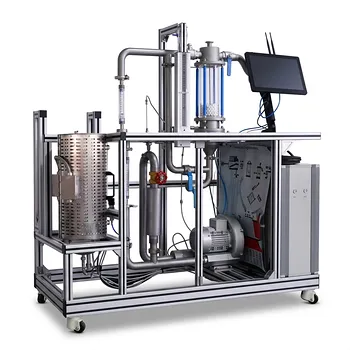
Multi-zone heating and precision temperature control in pilot plants aren't optional extras—they’re a direct consequence of physics. The core reason is the drastically higher surface-area-to-volume ratio of a small-scale unit. This makes the reactor a champion at losing heat to its surroundings, unlike a massive industrial vessel where thermal mass and relatively small surface area help maintain a stable profile. To collect data that actually predicts how a commercial reactor will perform, pilot systems must offset this loss with tightly controlled, multi-zone heating that faithfully recreates the thermal environment of the full-scale operation.
Pilot plants demand precise, zoned thermal management to overcome their inherent heat-loss problem. This is not simply about instrumentation; it is fundamental to obtaining reaction kinetics, selectivity, and heat transfer data that can be scaled up with confidence. Without it, the thermal distortion makes the pilot plant a poor stand-in for the industrial reactor.
The Physics of Scale: Why Small Reactors Bleed Heat
The mismatch between a lab-scale pilot unit and a hulking industrial reactor starts with geometry. Understanding this thermal vulnerability is the first step in seeing why you can’t simply wrap a heating tape around a bench‑top setup and hope for the best.
The Surface-Area-to-Volume Trap
Heat loss is a game of surface area. A pilot plant reactor has a lot of surface relative to its volume. Every square centimeter of that exposed surface is a path for energy to escape, while the volume—the reservoir of thermal mass—is small.
An industrial reactor inverts this ratio. Its volume grows cubically while its surface area grows only squared. It holds a huge thermal reservoir, loses proportionally less heat, and can often run much closer to adiabatic or well-insulated conditions. The pilot plant must be deliberately engineered to mimic that same stable interior, which its geometry naturally resists.
From Heat Loss to Thermal Distortion
Uncontrolled heat loss doesn’t just make the reactor “a bit colder”—it warps the entire temperature profile. A pilot unit without multi-zone management often shows cold ends, hot centers near the heater, and large radial gradients that simply do not exist in the target commercial design.
To replicate the expected commercial temperature distribution, you need multiple independently controlled heating zones and high-quality insulation. Each zone compensates for the local heat sink of the environment, flattening the gradient and giving you a thermal “snapshot” that resembles the large-scale reactor. If you skip this, you are measuring kinetics under a temperature field that your full-scale plant will never see.
Beyond Heat Loss: The Kinetic Imperative for Precision
Once you have overcome the physical heat drain, you face an even more demanding requirement: the chemistry itself demands unwavering thermal accuracy. A degree or two is not a minor detail—it can define whether your data are usable.
The Exponential Sensitivity of Reactions
Reaction rates don’t just increase with temperature; they explode according to an exponential law. The rate constant ( k ) follows the Arrhenius equation ( k = A e^{-E_a/(RT)} ). A small temperature fluctuation changes ( k ) dramatically, altering conversion, selectivity, and heat generation in ways that cascade through your data.
When you are gathering pilot plant data for scale-up, you need kinetic parameters that represent the industrial temperature. If your pilot reactor temperature wobbles, every calculated rate constant becomes suspect. Precision control—via PID loops, heating/cooling jackets, and high-resolution sensors—converts a chaotic thermal landscape into a stable, known reference state.
Accurate Activation Energy Demands Stability
Determining ( E_a ) from experimental data requires a linear relationship between ( \lg k ) and ( 1/T ). This only works if the temperature you record is the true, steady-state temperature at which the reaction actually occurs. A drifting or uneven thermal field injects error into each data point, destroying the straight line and yielding a meaningless activation energy.
Pilot plants equipped with multi-zone precision control allow researchers to hold temperature rock-steady across multiple runs. That ensures the Arrhenius plot you build actually reflects the intrinsic chemistry, not your equipment’s thermal drift.
Multi-step Processes Need Thermal Gradients, Not Uniform Heat
Some processes don’t want a single temperature; they need a carefully choreographed gradient. For example, a fuel-processing sequence might include high-temperature steam reforming, a water‑gas shift stage with a descending temperature profile to optimize thermodynamic CO conversion, and a preferential oxidation step that must stay nearly isothermal to avoid burning hydrogen.
A single heating zone cannot sculpt these delicate thermal ramps. Multi-zone pilot plants—especially those with microchannel or segmented architectures—let you program the exact spatial temperature profile that the industrial cascade demands. This teaches not just heat management, but how to control reaction networks in a way that translates directly to commercial design.
Understanding the Trade-offs: Over-Engineering vs. Under-Engineering the Pilot Plant
Thermal management on a small scale is a balancing act. Both extremes—ignoring heat loss and over-eager compensation—can lead you astray.
The Peril of Simplistic Single-Zone Designs
Relying on a single heater and a thermocouple in the center gives you a false sense of control. The exterior still loses heat, creating a wall‑cooled effect that changes reaction rates near the reactor wall. Your measured conversion might look fine at the pilot scale, but the industrial reactor—which is not wall-cooled in the same way—will behave completely differently. The data become a liability, not a guide.
This is why industrial‑grade pilot skids incorporate multiple independent heating bands, cooling jackets, and thermowells that monitor the actual fluid temperature at several points. It’s the only way to detect and eliminate the hidden thermal gradients that a simple setup conceals.
The Cost of Over-Compensation
Pushing the pilot plant to an unrealistically adiabatic state can be just as misleading. If you insulate and heat so aggressively that the lab unit behaves like a perfectly insulated bomb, you might miss critical heat-transfer limitations that will appear when you scale up. Some industrial reactors deliberately use jacket cooling or interstage heat exchangers; a hyper‑controlled pilot that never experiences a realistic heat flux can give overly optimistic yields and unsafe scale-up predictions.
The goal is not to create the perfect thermal utopia, but to replicate the intended industrial thermal profile, including its intentional heat removal. Multi-zone systems allow you to dial in that profile exactly—whether it is near‑isothermal, adiabatic, or a defined temperature ramp.
Making the Right Choice for Your Scale-Up Goal
The approach to pilot-plant thermal design depends entirely on what you need to learn. A generic setup rarely serves a specific purpose well. Use these guidelines to match your system to your objective.
- If your primary focus is obtaining kinetic parameters for reactor design: Prioritize multi-zone, high-precision temperature control to achieve stable isothermal or programmed‑gradient conditions. This yields clean Arrhenius data and rate equations that scale reliably.
- If your primary focus is studying heat integration and energy efficiency: Design your pilot plant to simulate the actual heat-transfer environment of the commercial reactor—don’t over‑insulate away the heat losses that will be present at scale. Use zoned heaters and coolers to reproduce the expected heat fluxes.
- If your primary focus is scaling up multi-step processes (e.g., fuel processing): Invest in a segmented or microchannel reactor that allows independent temperature control along the flow path. This lets you optimize each reaction step’s thermal window exactly as the commercial train will.
- If your primary focus is educational demonstration of thermal runaway or control strategies: Ensure the pilot plant includes fast-response sensors, accessible PID parameters, and clearly visible temperature zones so students can observe the exponential sensitivity firsthand and learn to manage it safely.
Your pilot plant’s heating system is not just about staying hot—it’s about building a thermal bridge between a small‑scale experiment and a full‑scale reactor. Getting that bridge right is what turns laboratory observations into a plant you can trust.
Summary Table:
| Feature | Pilot-Scale Plants | Industrial-Scale Reactors |
|---|---|---|
| Surface-to-Volume Ratio | Very High (small volume, large surface) | Very Low (massive volume, small surface) |
| Heat Loss | High (bleeds heat rapidly to surroundings) | Low (retains heat, near-adiabatic) |
| Thermal Gradient | Large radial & axial gradients (warped profile) | Flat, stable temperature profile |
| Control Requirement | Multi-zone heating & high-precision PID | Minimal zones, focus on bulk cooling/heating |
Achieve Scale-Up Success with LABPARK Pilot Plants
Bridging the gap between laboratory research and industrial-scale production requires precise, reliable, and expertly engineered systems.
LABPARK provides state-of-the-art Educational and Vocational Unit Operations Pilot Plants in:
- Chemical Engineering (equipped with advanced multi-zone heating and precise temperature control)
- Bioprocess & Biotech
- Environmental & Water Treatment
Whether you are a university training the next generation of engineers, a research institute gathering critical kinetic data, or an enterprise scaling up your process, we deliver the thermal accuracy you need.
Contact LABPARK today to discuss your pilot plant requirements!
Related Products
- Comprehensive Multi-Modal Heat Transfer Unit Operations Pilot Plant for Engineering Training
- Multi-Reactor Educational Pilot Plant for Reaction Engineering Unit Operations
- Multi-Stage Stirred Tanks in Series Residence Time Distribution and Mixing Performance Determination Educational Pilot Plant
- Multi Functional Catalytic Reaction and Reactor Evaluation Educational Unit Operations Pilot Plant
- Dual Mode Heat Transfer Pilot Plant for Unit Operations Training
People Also Ask
- Why is the study of thermal boundary layers and Prandtl numbers critical in heat transfer unit operations pilot plants?
- When is ε-NTU preferred over LMTD in pilot plants? Predict heat exchanger performance without iteration.
- How can a heat transfer pilot plant demonstrate waste heat recovery? Learn to optimize industrial thermal systems.
- What fluid routing rules can heat transfer pilot plants demonstrate? Optimize shell vs. tube design.
- How does cascade control achieve superior disturbance rejection in heat transfer pilot plants?