Knowledge Chemical Engineering Education Why are spiral-wound modules used in organophilic separations rather than dehydration? Explained
Author avatar

Tech Team · LABPARK

Updated 1 month ago

Why are spiral-wound modules used in organophilic separations rather than dehydration? Explained


The short answer: it comes down to permeate volume and material compatibility. In organophilic separations, the organic compounds being removed have relatively high molecular weights, so the vaporous permeate flow is much smaller than in dehydration. This makes pressure losses on the permeate side manageable and allows spiral‑wound modules to work well. For dehydration, the opposite is true: a huge volume of water vapor permeates, causing crippling pressure drop in the narrow spacer channels and attacking the glues and spacers chemically.

The core reason spiral‑wound modules dominate organophilic piloting but struggle with dehydration is twofold: first, the small permeate volumes in organophilic service avoid excessive pressure loss; second, the benign operating conditions (low temperature, low solvent concentration) allow standard polymeric materials to survive. Dehydration flips both factors, making plate modules the reliable choice.

Why Spiral‑Wound Modules Thrive in Organophilic Separations

Low Permeate Volume Minimizes Hydraulic Penalties

The driving physics is straightforward. Organic molecules removed from a solvent‑rich feed are often large and heavy, so the number of moles that cross the membrane per unit time is low.

That means the permeate vapor occupies far less space. A smaller gas flow through the permeate spacer creates only modest frictional pressure loss, even inside the tightly wound channels of a spiral module.

Because the permeate side can tolerate higher back‑pressure, the module’s sealing and collection tube design are never pushed to their limits.

Mild Process Conditions Protect Module Construction

Organophilic separations usually operate at relatively low temperatures and with low concentrations of aggressive solvents in the permeate or retentate.

Standard polypropylene mesh spacers and common epoxy or polyurethane adhesives can hold up under these conditions without swelling, dissolving, or losing bond strength.

As a result, the spiral‑wound format – assembled from flat‑sheet membrane, feed‑spacer, permeate‑spacer, and glued edges – remains chemically and mechanically stable throughout long pilot campaigns.

Proven Durability Mirrors Water‑Treatment Modules

The spiral‑wound architecture was perfected in reverse osmosis, where flat‑sheet composite membranes bonded to nonwoven supports handle high pressures reliably.

That same rugged construction translates well to organophilic applications. The membrane’s support layer prevents deformation, and the glued‑assembly tolerates the differential pressures encountered during start‑up and shutdown.

Thus, pilot plants can use off‑the‑shelf spiral elements with minor customisation – an attractive combination of cost, availability, and performance.

Why Dehydration Applications Expose the Weakness of Spiral‑Wound Modules

High Permeate Volume Creates Unacceptable Pressure Loss

Water is a small, fast‑diffusing molecule. During dehydration, a large volumetric flow of water vapor must race through the narrow permeate‑side spacer of a spiral module.

That flow generates a steep pressure gradient from the membrane surface to the central permeate tube. Much of the energy that should drive separation is lost overcoming friction inside the module, directly eroding both capacity and selectivity.

In a pilot plant, this pressure loss manifests as unstable performance trends and artificially low apparent permeability – making data interpretation nearly impossible.

Chemical Stability Becomes the Limiting Factor

Concentrated solvent streams on the feed side and hot, wet permeate can rapidly degrade the module’s internal components. Standard glues and polymeric spacers soften, swell, or delaminate when exposed to aggressive organic/water mixtures over time.

Even “solvent‑resistant” epoxy sometimes fails because the combination of stress, temperature, and solvency attacks the bonded seams. The result is internal leaks that ruin separation performance and contaminate the permeate.

For pilot‑scale testing, such failures obscure the true membrane behaviour and can require frequent – and costly – module replacement.

Plate Modules Provide a Proven Alternative for Dehydration Pilots

To sidestep these issues, educational and vocational pilot plants specifically designed for dehydration opt for plate‑and‑frame modules instead of spiral‑wound elements.

Plate modules separate feed and permeate channels with robust metallic frames and gasket seals, drastically reducing permeate‑side pressure drop because the flow path is wide and open.

They also eliminate reliance on sensitive adhesives. The membrane is mechanically clamped, allowing the use of ceramic or highly cross‑linked polymeric membranes that withstand harsh dehydration chemistries.

For a pilot plant focused on teaching dehydration fundamentals, this means stable, repeatable data and simpler maintenance, even if the module itself is bulkier.

Understanding the Trade‑offs

While spiral‑wound modules excel for organophilic separations, their performance envelope is narrow when it comes to chemical environment and permeate flow rate. Pushing them into dehydration forces a trade:

  • Permeate pressure loss rises exponentially with vapor flow, eating into your driving force.
  • Material compatibility becomes a risk that is hard to predict from short‑term soak tests.
  • Operational cost can actually climb if frequent module changeouts are needed.

Conversely, plate modules for dehydration are heavier, store less membrane area per volume, and may require higher capital investment – but they deliver the data integrity and longevity a pilot project demands.

Making the Right Choice for Your Pilot Plant Goal

Your module selection must follow the physics and chemistry of the separation, not just equipment familiarity.

  • If your primary focus is organophilic separation: Use spiral‑wound modules. The inherent low permeate volume and tame conditions let you leverage the compact, cost‑effective design without material‑stability headaches.
  • If your primary focus is solvent dehydration: Choose plate‑and‑frame modules. They eliminate the pressure‑loss penalty and chemical‑degradation risks that would otherwise compromise your pilot data and uptime.

Match the module to the process fundamentals, and your pilot plant will give you the clear, reproducible insights you need.

Summary Table:

Feature Spiral-Wound Modules Plate-and-Frame Modules
Best Suited For Organophilic Separations Solvent Dehydration
Permeate Volume & Flow Low volume (minimal pressure drop) High volume (susceptible to pressure drop)
Material Compatibility Moderate (uses glues/polymeric spacers) High (mechanical clamping, no adhesives)
Chemical/Thermal Resistance Limited; prone to swelling/delamination High; tolerates aggressive solvent/water mixtures

Optimize Your Membrane Separation Processes with LABPARK

Choosing the right module configuration is key to securing accurate, reproducible data for your research or training. LABPARK provides state-of-the-art Educational and Vocational Unit Operations Pilot Plants in chemical engineering, bioprocess & biotech, and environmental & water treatment.

We help universities, research institutes, and enterprises design pilot systems that match the physical and chemical demands of their specific applications.

Need expert guidance on selecting the perfect membrane setup? Contact LABPARK today to discuss your project requirements!

Related Products

People Also Ask

Related Products

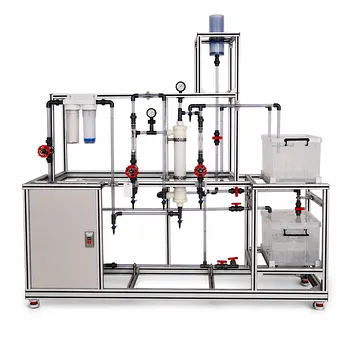
Ultrafiltration Membrane Separation Educational Pilot Plant

Ultrafiltration Membrane Separation Educational Pilot Plant

This ultrafiltration membrane separation educational pilot plant enables undergraduate students to process PVA solutions, study hollow fiber membrane dynamics, and perform quantitative analysis with spectrophotometry for hands-on learning of unit operations and industrial maintenance and membrane cleaning protocols.

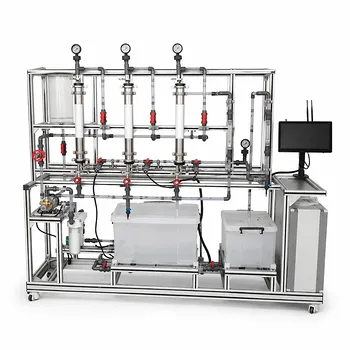
Multifunctional Membrane Separation Educational Pilot Plant with Ultrafiltration, Nanofiltration, Reverse Osmosis

Multifunctional Membrane Separation Educational Pilot Plant with Ultrafiltration, Nanofiltration, Reverse Osmosis

An integrated laboratory bench-scale membrane separation system for higher education engineering labs combining Ultrafiltration, Nanofiltration, and Reverse Osmosis processes. Features industrial PLC control with touch-screen HMI, transparent piping, and academic assessment software. Ideal for chemical and environmental engineering curricula.

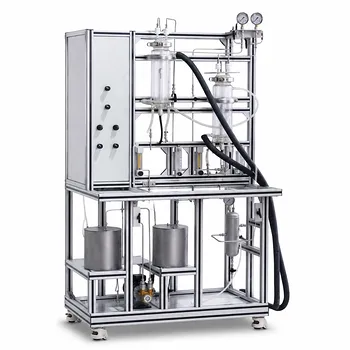
Multi Functional Membrane Crystallization Educational Unit Operations Pilot Plant

Multi Functional Membrane Crystallization Educational Unit Operations Pilot Plant

Integrated bench-scale membrane crystallization pilot plant for engineering education. Provides hands-on training in advanced separation technologies, combining membrane distillation crystallization and process intensification. Features variable scaling vessels, industrial-grade flow control, and interactive digital data acquisition. Customizable for university labs.

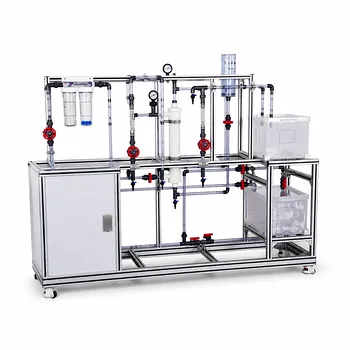
Multi-Functional Membrane Separation Educational Pilot Plant for Unit Operations Lab

Multi-Functional Membrane Separation Educational Pilot Plant for Unit Operations Lab

The Multi-functional Membrane Separation Educational Unit Operations Pilot Plant is an integrated bench-scale laboratory system designed for teaching undergraduate engineering education. It features Ultrafiltration, Nanofiltration, and Reverse Osmosis modules in a compact, mobile unit for practical hands-on learning.

Hollow Fiber Ultrafiltration Membrane Separation Educational Pilot Plant

Hollow Fiber Ultrafiltration Membrane Separation Educational Pilot Plant

Explore our hollow fiber ultrafiltration membrane separation educational pilot plant for hands-on learning of industrial ultrafiltration processes, flux analysis, fouling mitigation, and process control. Compact, customizable, and built for engineering labs.

Photocatalytic Membrane Separation and Degradation Unit Operations Pilot Plant

Photocatalytic Membrane Separation and Degradation Unit Operations Pilot Plant

Bench-scale pilot plant integrating photocatalytic degradation with membrane separation for engineering education. Study advanced oxidation, microfiltration, and hybrid processes using industrial sensors. Features safety light-blocking curtain, low-noise compressor, and durable stainless-steel construction.

Alkaline Membrane Water Electrolysis Educational Pilot Plant Unit Operations Training System

Alkaline Membrane Water Electrolysis Educational Pilot Plant Unit Operations Training System

Hands-on educational pilot plant for alkaline membrane water electrolysis hydrogen production, integrating unit operations training with industrial PLC control, real-time data logging, customizable design, durable 316L stainless steel construction, explosion-proof safety, and modern 5G connectivity for university laboratories.

Rising and Falling Film Evaporation Educational Unit Operations Pilot Plant

Rising and Falling Film Evaporation Educational Unit Operations Pilot Plant

Hands-on educational pilot plant for studying rising and falling film evaporation, flow regimes, and heat transfer. Customizable for university labs with industrial instrumentation and data acquisition. Enables comparative evaluation of evaporation modes and energy efficiency.

Natural Product Extraction Unit Operations Training Pilot Plant

Natural Product Extraction Unit Operations Training Pilot Plant

Integrated natural product extraction pilot plant for chemical engineering training bridges theory and industrial practice with modular extraction and evaporation/concentration units, hybrid touchscreen and manual control, realistic process simulation, and self-contained softened water and vacuum utilities.

Supercritical High-Gravity Flash Evaporation Educational Unit Operations Pilot Plant

Supercritical High-Gravity Flash Evaporation Educational Unit Operations Pilot Plant

Bench-scale integrated teaching system for advanced separation and mass transfer, combining supercritical high-gravity flash evaporation with heating, chemical reaction, and material collection, featuring modular design, Stainless Steel 316L construction, transparent visualization, touchscreen control, and safety systems for chemical engineering education.

High-Gravity Emulsification and Mass Transfer Educational Pilot Plant

High-Gravity Emulsification and Mass Transfer Educational Pilot Plant

This integrated educational pilot plant utilizes rotating packed bed technology to demonstrate high-gravity emulsification and mass transfer, providing engineering students with hands-on experience in process intensification and unit operations through a modular, customizable design with digital monitoring.

Educational Unit Operations Pilot Plant for Intraparticle Diffusion Effective Factor Measurement

Educational Unit Operations Pilot Plant for Intraparticle Diffusion Effective Factor Measurement

Designed for chemical engineering university labs, this pilot plant allows hands-on determination of catalyst particle intraparticle diffusion effective factors and gas-solid reaction kinetics using a fixed-bed tubular reactor with industrial touchscreen control, bridging theory and practical reactor design.

Ethyl Acetate Synthesis Unit Operations Pilot Plant for Practical Training

Ethyl Acetate Synthesis Unit Operations Pilot Plant for Practical Training

Modular and customizable pilot plant for ethyl acetate synthesis practical training. Integrates esterification reaction, liquid-liquid extraction, neutralization, and sieve-plate distillation unit operations. Bridging theory and real-world industrial processes. Designed for university chemical engineering labs

Multi-Functional Drying Educational Unit Operations Pilot Plant

Multi-Functional Drying Educational Unit Operations Pilot Plant

Versatile multi-functional drying educational unit operations pilot plant integrating tunnel, fluidized bed, and spray drying. Enables hands-on study of drying curves, psychrometry, and gas-solid separation for chemical engineering curriculum in higher education labs.

Dual-Mode Rectification Pilot Plant for Practical Training Unit Operations

Dual-Mode Rectification Pilot Plant for Practical Training Unit Operations

Industrial-scale dual-mode rectification pilot plant for chemical engineering practical training. Features real-material and simulated-material operation modes, sieve-plate column with sight glasses for visual observation of hydrodynamics, and customizable SCADA control for safe, hands-on learning of unit operations and mass transfer.

Constant Pressure Filtration Educational Unit Operations Pilot Plant

Constant Pressure Filtration Educational Unit Operations Pilot Plant

Hands-on educational pilot plant for constant pressure filtration. Classic plate and frame filter press allows students to study kinetics, determine specific cake resistance, perform cake washing and evaluate washing rates. Ideal for chemical engineering curriculum. Mobile, customizable, safety-compliant design.

Multi-Reactor Educational Pilot Plant for Reaction Engineering Unit Operations

Multi-Reactor Educational Pilot Plant for Reaction Engineering Unit Operations

Integrated bench-scale educational pilot plant for chemical engineering teaching featuring fixed bed fluidized bed and stirred tank reactors with web-based digital twin controls and safety interlocks for hands-on unit operations and reaction engineering comparative studies in one compact system.

Multi-Functional Special Distillation Educational Pilot Plant

Multi-Functional Special Distillation Educational Pilot Plant

Versatile multi-functional special distillation pilot plant for chemical engineering education. Supports continuous, vacuum, azeotropic, reactive, extractive distillation. Transparent glass columns enable real-time visual observation of hydrodynamics and separation processes.

Three-Tube Heat Transfer Educational Pilot Plant for Unit Operations Training

Three-Tube Heat Transfer Educational Pilot Plant for Unit Operations Training

Three-tube heat transfer pilot plant for studying convective heat transfer enhancement and condensation. Allows comparison of smooth, corrugated, turbulent tubes, verifying empirical correlations. Ideal for chemical engineering education with safety and closed-loop steam recovery.

Multi Functional Catalytic Reaction and Reactor Evaluation Educational Unit Operations Pilot Plant

Multi Functional Catalytic Reaction and Reactor Evaluation Educational Unit Operations Pilot Plant

Bench-scale educational pilot plant for catalytic reaction and reactor evaluation, integrating fixed bed, fluidized bed, and stirred tank reactors. Students compare reactor designs, evaluate catalysts, and study reaction kinetics and hydrodynamics. Perfect for unit operations labs in chemical engineering curricula.


Leave Your Message