Here's the simple reason: in an absorption column, the total flow of the phase that loses or gains solute changes from top to bottom, while the flow of the inert carrier remains perfectly constant. By expressing concentrations as mass ratios (kg solute/kg inert) or mole ratios (mol solute/mol inert), you lock your denominator to this unchanging baseline. This turns the mass balance into a simple linear relationship you can solve without recalculating total flow rates at every point, making it the standard calculation method in pilot‑plant experiments.
In absorption, the inert‑carrier flow is a rock‑solid reference point that never changes along the column. Mass ratios and mole ratios anchor every calculation to that constant, transforming what could be a messy, iterative material balance into a straightforward linear operating‑line equation.
Why the Total Flow Rate Keeps Changing
Absorption moves one species (the solute) from a gas into a liquid. The gas phase loses mass, and the liquid phase gains it. If you measure concentration as a mass fraction (kg solute per kg of total solution in that phase), the denominator—the total mass flow of that stream—shrinks or swells from one end of the column to the other. That means the same numerical mass fraction at two different heights does not represent the same absolute amount of solute transfer, so you constantly have to recalculate total flows to close the material balance.
In pilot‑plant work, where you’re measuring data at multiple sample points to validate models, this becomes a headache. Every new data point forces you to re‑compute the total mass or molar flow before you can plug it into the design equations, creating a cascade of corrections that obscure the clean physics of the column.
The Inert‑Carrier Concept Gives You a Fixed Foundation
What doesn’t change? The flow of everything that isn’t the solute. In a typical absorption task—say, scrubbing CO₂ from air with water—the dry air on the gas side and the pure water on the liquid side are considered inert carriers. Their mass flow rates (or molar flow rates) stay nearly constant from column inlet to outlet because they don’t participate in the mass‑transfer reaction. By defining concentrations relative to this inert core, you create a variable that moves with the solute but whose denominator never wavers.
Mass Ratios and Mole Ratios in Practice
A mass ratio (X) in the liquid phase is kg solute per kg of inert liquid carrier; a mole ratio (Y) in the gas phase is mol solute per mol of inert gas. These are often written with an overbar or capital letters specifically to signal “on an inert‑free basis.” Because the inert flow (L_s) or (G_s) is constant, the product (L_s \times X) instantly tells you the absolute mass of solute, and the change in that product gives the amount transferred with no need to correct for a drifting total flow.
The Operating Line Becomes Linear and Effortless
The power of this approach crystallizes in the operating line, the equation that links gas‑phase and liquid‑phase compositions across any height of the column. Written on a mole‑ratio basis for the gas and liquid inert streams, the material balance simplifies to:
[ G_s (Y_{\text{in}} - Y_{\text{out}}) = L_s (X_{\text{out}} - X_{\text{in}}) ]
Here (G_s) and (L_s) are the constant inert molar flows. Because they don’t change with column height, the equation gives you a straight line on an (X)–(Y) diagram. If you used mole fractions instead, the terms would involve total flows that vary with (X) and (Y), making the operating line curved and forcing you to solve a system of equations at each stage.
In a pilot‑plant experiment, students and engineers need to quickly verify results and fit models. A straight operating line drawn from just two end‑point measurements immediately tells you whether the column is operating efficiently—no iterative calculations, no recalibrating flow at every sample port.
Understanding the Trade‑offs
Choosing ratios over fractions isn’t without a small cost in interpretability. Outside the lab, people often think in mass or mole fractions because they directly add up to 1 and match product specifications. When you present results to a plant operator or a customer, you’ll usually convert back to fractions. But for the engineering analysis phase, the trade‑off is clear: you accept a little more conversion work at the beginning and end in exchange for dramatically simpler math throughout the core calculation.
What You Gain
- Linearity: Material balance plots become straight lines, making equilibrium‑stage determination quick and visual.
- Robustness to temperature swings: Although mass fractions are also temperature‑independent (unlike molar concentrations), the ratio approach additionally uncouples the calculation from total‑flow fluctuations, which are a bigger source of error in absorption pilot plants.
- Transparent error detection: Because the inert flow is physically constant, any significant drift in a derived inert‑flow value across samples immediately flags a mass‑balance or measurement error.
What You Must Watch
- Forgetting the inert basis: Mixing mole ratios with mole fractions in the same calculation is a classic student mistake. Always use a distinct notation ((X), (Y)) and double‑check that you aren’t accidentally feeding a fraction into a ratio‑based equation.
- Non‑ideal systems: When the inert carrier itself has a small solubility or reacts, the “constant” assumption weakens. In such cases, a corrected inert basis or more complex models may be needed—but for the vast majority of pilot‑plant absorption exercises, the assumption holds well enough.
Making the Right Choice for Your Pilot‑Plant Analysis
How you structure your calculations depends on what you’re optimizing for during the experiment.
- If your primary focus is rapid, repeatable material balances: Use mass or mole ratios from the very first data log. Define your inert carrier, calculate (L_s) and (G_s) once, and then every new sample point simply updates (X) or (Y) without touching the flow terms.
- If your primary focus is comparing results to a commercial specification sheet: Keep the inert‑based parameters for internal calculation, but build a small conversion step (using simple dilution formulas) to report final outlet mass or mole fractions—this keeps your workflow fast while still speaking the end user’s language.
- If your primary focus is teaching the fundamentals: Explicitly walk students through the same calculation in both frameworks. The moment they see the curved operating line from fractions versus the straight line from ratios, the pedagogical value locks in permanently.
The whole point is to stop fighting moving targets. When you anchor your calculations to the one thing you know won’t change, absorption analysis stops being a numerical puzzle and becomes a clear, straight‑line path from raw data to a validated mass balance.
Summary Table:
| Feature | Mass/Mole Ratios (Inert Basis) | Mass/Mole Fractions (Total Basis) |
|---|---|---|
| Denominator | Constant (inert carrier flow) | Variable (total phase flow) |
| Operating Line | Linear (straight line) | Non-linear (curved) |
| Calculation Complexity | Low (no iteration needed) | High (requires iterative calculations) |
| Primary Application | Engineering design & data analysis | Product specifications & reporting |
Optimize Your Chemical Engineering Lab with LABPARK
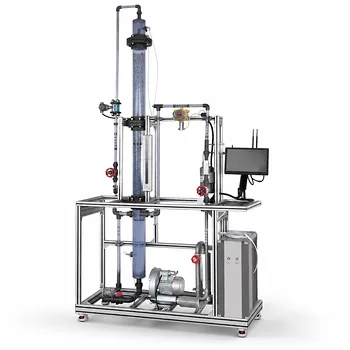
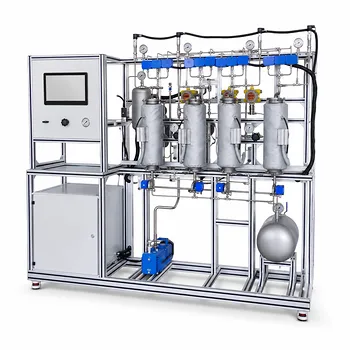
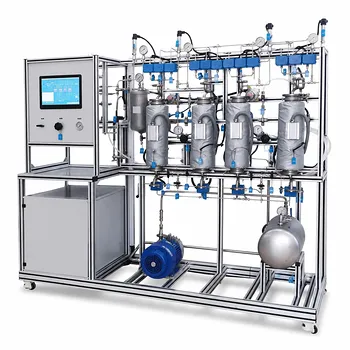
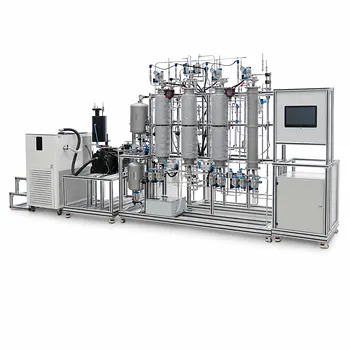
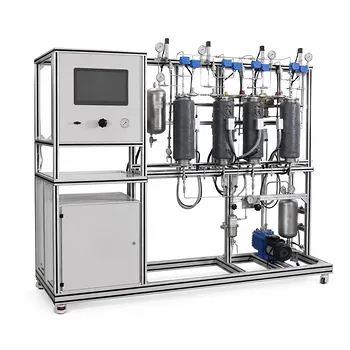
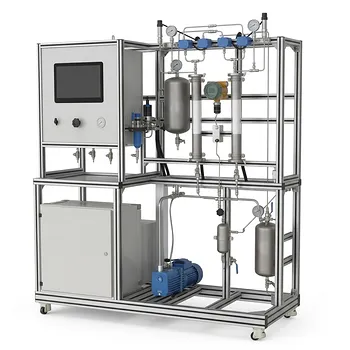
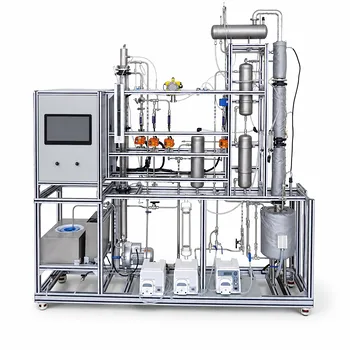
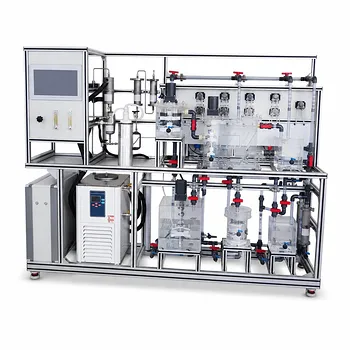
Are you looking to enhance hands-on learning and research efficiency in absorption and mass transfer? LABPARK provides premium Educational and Vocational Unit Operations Pilot Plants in chemical engineering, bioprocess & biotech, and environmental & water treatment. Designed specifically for universities, research institutes, and enterprises, our pilot plants bring complex theoretical calculations to life with robust, real-world systems.
Contact us today to find the perfect pilot plant solution for your institution!
Related Products
- Multimodal Absorption and Desorption Pilot Plant for Unit Operations Training
- Packed Bed Absorption Educational Unit Operations Pilot Plant
- Dual-Mode Gas Absorption and Desorption Unit Operations Training Pilot Plant
- Carbon Dioxide Adsorption and Capture Educational Unit Operations Pilot Plant
- Absorption and Desorption Educational Unit Operations Pilot Plant
People Also Ask
- How do predictive thermodynamic models integrate into pilot plants? Bridging Theory and Practice
- Which cross-validation strategy should be selected for pilot plant time-series & batch data? Avoid Data Leakage
- How can process control schemes be configured to teach basic and advanced control?
- Why Use Center Points in Process Analyzer Calibration? Key Benefits Explained
- How does polyphosphate hydrolysis affect scale and corrosion in pilot plants? Essential Monitoring Guide