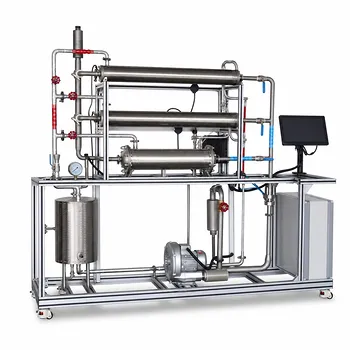
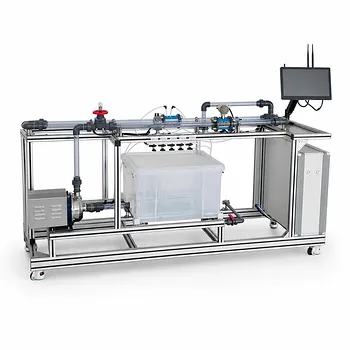
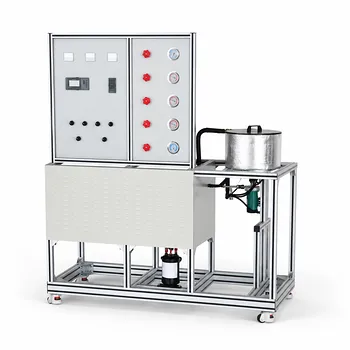
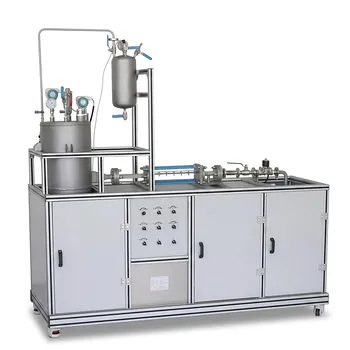
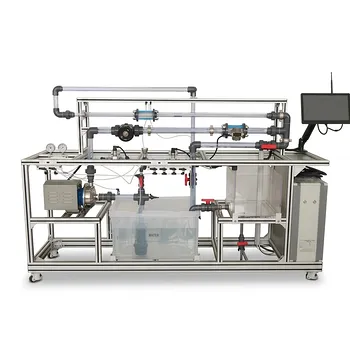
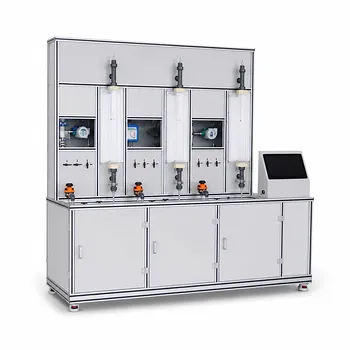
The immediate answer is clear: Heat transfer energy density and specific power are the defining metrics for a microchannel condenser's ability to pack exceptional thermal performance into an extremely small and lightweight package—precisely what makes a modular laboratory pilot plant practical, flexible, and educationally valuable.
In modular lab pilot plants, bench space and portability are scarce resources. Heat transfer energy density (>10 W/cm³) and specific power (>5000 W/kg) capture a condenser's capacity to reject massive heat loads from a tiny volume and mass. These metrics directly translate to a compact, reconfigurable system that still mimics industrial-scale condensation behavior, making them the non-negotiable design cornerstones for any benchtop facility.
What These Metrics Actually Mean
Heat Transfer Energy Density: The Compactness of Thermal Duty
Heat transfer energy density expresses the amount of heat a condenser can handle per unit volume (often exceeding 10 W/cm³ in microchannel designs).
It answers the question: How much cooling can I fit into this benchtop unit?
In a pilot plant, where every cubic centimeter of bench or fume hood space counts, this volumetric metric determines whether the system can keep up with the required heat rejection without ballooning in size.
Specific Power: The Weight Efficiency of Rapid Heat Removal
Specific power represents the heat duty per unit mass (often surpassing 5000 W/kg).
It tells you how much structural support, mounting hardware, and dead weight you’re adding to a modular setup.
For pilot plants that are frequently reconfigured, moved between experiments, or stacked in racks, weight directly impacts operator safety, ease of modification, and overall system agility.
Why These Metrics Are Central to Modular Lab Plant Design
Enabling True Benchtop Scalability
Industrial distillation and condensation columns are large because conventional shell-and-tube exchangers require significant surface area and volume.
Microchannel condensers collapse that physical volume by exploiting microscale flow paths, where the high surface-area-to-volume ratio drastically enhances heat transfer coefficients.
This means you can replicate the condensation duty of a much larger industrial unit on a benchtop, without safety hazards from oversized equipment or the need for dedicated utility rooms.
Supporting Rapid Reconfiguration and Educational Flexibility
A modular plant isn’t static. Components get swapped, rearranged, or repurposed to study different process configurations.
A condenser with high energy density and specific power can be easily moved, repositioned, or integrated into a new flow loop by a single researcher.
This agility is particularly vital in teaching labs, where the same equipment must serve multiple undergraduate experiments—from determining the overall heat transfer coefficient ($U$) to analyzing fouling factors over time.
Reflecting the Physics That Matter for Thermal Metrics
The supplementary insight from classical heat transfer analysis shows that the overall heat transfer coefficient ($U_o$) depends on a chain of resistances:
$$\frac{1}{U_o} = \frac{1}{h_o} + \frac{1}{h_{od}} + \frac{d_o \ln(d_o/d_i)}{2 k_w} + \frac{d_o}{d_i}\frac{1}{h_{id}} + \frac{d_o}{d_i}\frac{1}{h_i}$$
Microchannel geometries attack the convective resistances ($h_i$, $h_o$) head-on.
Their small hydraulic diameters push flow into higher Reynolds numbers and thinner boundary layers, producing exceptionally large film coefficients.
When the dominant resistances shrink, the required transfer area $A$ for a given $Q$ plummets—and that’s the very essence of high energy density and specific power. By measuring these metrics, students and researchers directly witness how microscale design compresses the thermal resistance network.
Understanding the Trade-offs
While the numbers are impressive, prioritizing only energy density and specific power without considering their trade-offs can lead to problems in a modular setting.
Pressure Drop Penalty
Microchannels produce high heat transfer coefficients, but at the cost of elevated frictional pressure drop.
In a benchtop plant, this means your pumps may need to work harder, raising parasitic energy consumption and potentially requiring larger utility connections—undoing some compactness gains.
The design challenge is to balance the compactness benefit against the pressure-drop penalty for the specific fluids and flow rates you’ll be using.
Sensitivity to Fouling and Plugging
Microscale passages, while thermally superb, are inherently more prone to blockage from particulates or precipitate than larger tubes.
In a teaching lab where fluid cleanliness isn’t always perfect, the fouling factors ($h_{od}$, $h_{id}$) can spike quickly, degrading the same energy density you selected the condenser for.
A robust filtration strategy and regular monitoring become essential, adding a layer of operational complexity that is part of the educational value but a practical headache if ignored.
Manufacturing Precision and Cost
Achieving durable microchannel geometries with tight tolerances demands advanced fabrication techniques, which can increase per-unit cost relative to simple tube-in-tube exchangers.
For a modular pilot plant aiming for a low total system cost, this trade-off requires evaluating whether the space savings justify the higher component price.
Making the Right Choice for Your Goal
- If your primary focus is minimizing benchtop footprint: Prioritize heat transfer energy density above all. A condenser with >10 W/cm³ lets you integrate high-duty condensation into even the most space-constrained modular skid.
- If your primary focus is system portability and ease of reconfiguration: Select a unit with exceptionally high specific power (>5000 W/kg). Lightweight components make tool-free repositioning and rapid experimental changeovers a reality.
- If your primary focus is educational demonstration of thermal resistance concepts: Choose a microchannel condenser with accessible instrumentation ports so you can measure inlet/outlet conditions and calculate $U_o$ and film coefficients, directly illustrating how microscopic geometry collapses the resistance terms in the classic $1/U_o$ equation.
- If your primary focus is long-term robustness with minimal maintenance: Look for designs that offer a practical trade-off—slightly lower energy density but wider channels that resist fouling, and pair them with appropriate upstream filtration to protect performance over months of student use.
When used wisely, heat transfer energy density and specific power transform a microchannel condenser from a mere component into the key that unlocks a truly compact, flexible, and instructionally powerful modular pilot plant.
Summary Table:
| Metric | Definition | Target Value | Key Benefit |
|---|---|---|---|
| Heat Transfer Energy Density | Heat rejection duty per unit volume | > 10 W/cm³ | Maximizes space efficiency for benchtop setups |
| Specific Power | Heat rejection duty per unit mass | > 5000 W/kg | Enhances system portability and ease of reconfiguration |
Elevate Your Lab with LABPARK Pilot Plants
Are you looking to optimize your chemical engineering, bioprocess, or environmental water treatment setups? LABPARK delivers advanced Educational and Vocational Unit Operations Pilot Plants tailored for universities, research institutes, and enterprises. Our solutions integrate high-performance microchannel condensers to guarantee maximum heat transfer efficiency within a compact, modular design.
Contact LABPARK today to discover how we can enhance your research and training capabilities!
Related Products
- Three-Tube Heat Transfer Educational Pilot Plant for Unit Operations Training
- Comprehensive Heat Transfer Coefficient Determination Educational Unit Operations Pilot Plant
- Rising and Falling Film Evaporation Educational Unit Operations Pilot Plant
- Orifice and Venturi Flowmeter Calibration Educational Pilot Plant for Fluid Mechanics Laboratory
- Constant Pressure Filtration Educational Unit Operations Pilot Plant
People Also Ask
- When is ε-NTU preferred over LMTD in pilot plants? Predict heat exchanger performance without iteration.
- How to Verify Air-Side Heat Transfer Coefficient with a Pilot Plant? Practical Lab Guide
- Why is emissivity critical in heat transfer pilot plants? Bridge the Gap Between Theory & Industrial Design
- How can a heat transfer pilot plant demonstrate waste heat recovery? Learn to optimize industrial thermal systems.
- How does transitioning to a multi-shell heat exchanger affect required area? Optimize pilot plant design.