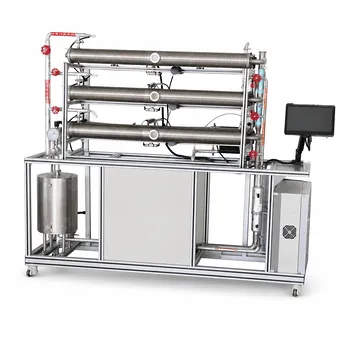
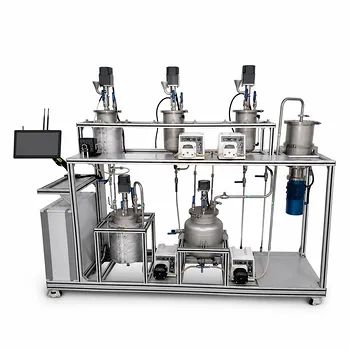
The sensitivity of your reaction to backmixing is not a minor detail—it’s a fundamental property of its kinetic order. In a reactor pilot plant, backmixing directly reduces conversion, but the penalty is far from uniform. A second-order reaction suffers a dramatically more severe loss in conversion than a first-order reaction when both are subjected to the same degree of non-ideal mixing at an identical space time. This divergence is a critical empirical lesson, revealing that the kinetic rate law itself dictates a process’s robustness to poor flow characteristics.
The conversion penalty of backmixing is a direct and predictable function of the reaction order. While first-order kinetics are remarkably robust to mixing imperfections, second-order reactions are acutely penalized. Pilot plant experiments demonstrate this by quantifying the steep drop in conversion as flow deviates from plug-flow ideality, confirming that achieving near-plug-flow behavior is of paramount practical importance for higher-order systems.
Quantifying Backmixing: The Engineer’s Compass
The degree of backmixing is not a qualitative feeling; it is a measurable quantity defined by the Peclet number (Pe) . This dimensionless group serves as the definitive diagnostic tool for characterizing flow in a tubular reactor pilot plant.
The Peclet Number as a Measure of Ideality
The Peclet number expresses the ratio of convective transport to dispersive (backmixing) transport. A high Pe signifies that convective flow dominates, pushing the fluid forward. A low Pe indicates that axial dispersion is the primary driver of movement.
Visualizing the Extremes: From CSTR to PFR
By varying the flow rate, a pilot plant can operate across a spectrum of mixing conditions. As Pe approaches infinity, the reactor’s behavior converges to the ideal plug-flow reactor (PFR) with zero backmixing. When Pe approaches zero, the content is perfectly stirred, and the reactor models a continuous stirred-tank reactor (CSTR) .
The Kinetic Link: Why Reaction Order Amplifies the Problem
The reason backmixing is a critical parameter is its direct and unequal impact on conversion, governed entirely by the reaction’s rate law. The difference in sensitivity between a first- and second-order reaction is a direct consequence of their mathematical relationship with concentration.
First-Order Reactions: Linear and Forgiving
A first-order rate law depends linearly on reactant concentration. Because of this proportionality, the average reaction rate in a mixed environment is identical to the rate at the average concentration. The mixing history of the fluid element does not matter; you can calculate its final conversion knowing only the residence time distribution (RTD) and batch kinetics.
Second-Order Reactions: Non-Linear and Unforgiving
A second-order rate law is proportional to the square of the concentration. This non-linearity is the source of its sensitivity. When a fluid element backs up and mixes with a lower-concentration zone, the reaction rate plummets far more steeply than it would in a first-order scenario. The dilution is disproportionately devastating, as the squared function amplifies the impact of local concentration drops.
Beyond Large-Scale Flow: The Nuance of Mixing History
While the Peclet number describes the bulk distribution of residence times, a deeper, molecular-level effect further penalizes higher-order reactions. This is the distinction between macro-mixing and micro-mixing.
Macro-Mixing vs. Micro-Mixing
Macro-mixing refers to the large-scale movement of fluid elements through the reactor, defining the vessel's residence time distribution. Micro-mixing describes the molecular-scale blending of these fluid elements with their surroundings. For a first-order reaction, these two states produce the exact same conversion.
The Micro-Mixing Penalty for Second-Order Systems
For any reaction with an order greater than one, micro-mixing introduces a measurable conversion penalty compared to macro-mixing alone. The molecular-level blending of a high-concentration element into a spent, lower-concentration zone permanently destroys its reaction potential, reducing the overall rate below what the RTD would predict. This reveals that segregation, not mixing, favors higher-order kinetics on the smallest scales.
Understanding the Trade-offs
The empirical clarity gained from a pilot plant is powerful, but ignoring the practical limits and potential misinterpretations can lead to flawed scale-up strategies.
The Trap of RTD-Only Analysis
A common pitfall is assuming the RTD tells the full story. For second-order reactions, two reactors with an identical macro-mixing profile can yield different conversions if their micro-mixing characteristics differ. Relying solely on the Peclet number is insufficient for designing reactions where the order is greater than one; the method of feed pre-mixing becomes integral to performance.
The Pressure Drop vs. Plug Flow Conflict
Achieving a high Peclet number typically requires high flow velocities or specialized internal packing. This directly increases pressure drop and energy consumption. The major design trade-off is accepting a controlled degree of backmixing to save on operating cost versus forcing near-plug-flow to maximize the conversion of a valuable, higher-order reactant.
How to Apply This to Your Pilot Plant Strategy
Your experimental approach must be dictated by the kinetic nature of the reaction you are studying. The pilot plant’s value lies not just in gathering data, but in challenging your assumptions about flow ideality.
- If your primary focus is teaching fundamental kinetics: Deliberately run the same first-order reaction at low and high flow rates. The resulting, near-identical conversions will robustly prove that mixing state is irrelevant for $n=1$, isolating the concept perfectly.
- If your primary focus is scaling up a second-order process: Your data will show an acute sensitivity to the Peclet number. The key takeaway is not just to measure the conversion drop-off, but to physically investigate how feed injection strategies and micro-mixing control can recover lost yield.
- If your primary focus is reactor model validation: You must decouple macro- and micro-mixing effects. Use a first-order tracer to map the RTD independent of reaction, and only then apply a second-order test reaction to quantify the micro-mixing penalty.
By letting the kinetic order dictate your interpretation of backmixing data, you transform the pilot plant from a simple data source into a definitive arbiter of your reaction’s scalability.
Summary Table:
| Feature / Parameter | First-Order Reactions ($n = 1$) | Second-Order Reactions ($n = 2$) |
|---|---|---|
| Rate Law Dependence | Linear on concentration ($r = kC_A$) | Non-linear/Squared concentration ($r = kC_A^2$) |
| Sensitivity to Backmixing | Low (Forgiving, rate matches average concentration) | High (Severe penalty due to non-linear dilution) |
| Micro-mixing Effect | No impact (determined solely by macro-mixing/RTD) | High penalty (molecular blending lowers reaction potential) |
| Key Pilot Plant Focus | Residence Time Distribution (RTD) mapping | Peclet number optimization & feed pre-mixing design |
Optimize Your Reaction Engineering Research and Teaching with LABPARK
Are you looking to demonstrate critical chemical kinetics principles or scale up complex processes? LABPARK provides state-of-the-art Educational and Vocational Unit Operations Pilot Plants in chemical engineering, bioprocess & biotech, and environmental & water treatment for universities, research institutes, and enterprises.
Our systems allow you to:
- Effectively study residence time distributions (RTD) and model Peclet numbers.
- Provide students and researchers with hands-on experience in macro- and micro-mixing phenomena.
- Validate scale-up strategies with reliable, industry-grade instrumentation.
Equip your laboratory with the tools to master reaction engineering. Contact us today to discuss your project requirements!
Related Products
- Fixed-Bed Chemical Reaction and Gas Dust Tar Removal Unit Operations Pilot Plant
- Fixed Bed Gas Solid Catalytic Reaction Educational Pilot Plant
- Multi-Reactor Educational Pilot Plant for Reaction Engineering Unit Operations
- 100L Continuous Loop Hydrogenation Educational Unit Operations Pilot Plant
- Fluidized Bed Gas Solid Catalytic Reaction Educational Pilot Plant
People Also Ask
- When to transition from PID to adaptive control in pilot plants? Key process indicators.
- How do deviations in estimating latent heat impact pilot plant thermal systems? Avoid hardware mis-sizing.
- Why Compare Predicted and Experimental Excess Enthalpy? Key to Accurate Pilot Plant Scale-up
- How to study gasification in pilot plants? Compare exit gas composition & efficiency
- Why Use PTFE & Hastelloy in Chemical Pilot Plants? Prevent Corrosion & Ensure Safety