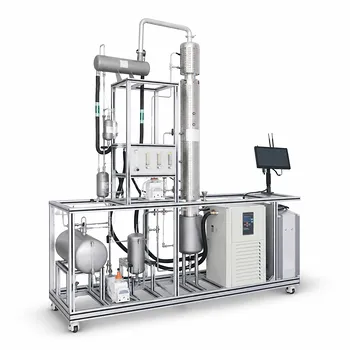
The most effective way to teach hazard mitigation is not through theory, but through guided, hands‑on simulation of process deviations. Instructors can use unit operations pilot plants to safely recreate conditions that lead to high exotherms and gas evolution, then demonstrate the layered defenses—dosing control, cooling strategies, venting systems, and safety interlocks—that prevent catastrophic outcomes. Students learn to connect reaction kinetics to equipment design, interpret real‑time data, and implement corrective actions, all without the risk of an industrial‑scale incident.
Vocational training with pilot plants transforms abstract hazard concepts into visceral understanding. The core takeaway: Instructors demonstrate mitigation by allowing students to witness controlled “near‑misses”—failed cooling, runaway dosing, or blocked vents—and then apply the primary reference’s tools (dosing rate limits, cooling margin, vent sizing, nitrogen inerting) to stabilize the system. This builds muscle memory for safe operation and a proactive safety mindset.
Turning Hazards Into Lessons: The Pilot Plant Approach
The Educational Power of a Pilot Plant
Pilot plants bridge the gap between benchtop chemistry and full‑scale manufacturing. They replicate industrial fluid dynamics, heat transfer, and reaction kinetics at a reduced severity that still demands respect.
Students collect real‑time temperature, pressure, and concentration data under controlled conditions. This empirical data lets them fit reaction rate equations and validate kinetic models without gambling on a plant‑size runaway. The instrumented environment—automatic dosing pumps, integrated gas scrubbers, emergency relief systems—provides a safety net that encourages exploration of “what if” scenarios that would be unthinkable in production.
Demonstrating Mitigation of High Exotherms
When the adiabatic temperature rise exceeds 50 °C, a seemingly benign reaction can escalate into a thermal runaway. The pilot plant allows instructors to walk students through the three lines of defense.
Dosing Rate and Feed Control
Students first run a reaction with a slow, controlled feed rate, observing how the cooling system easily maintains the setpoint. The instructor then asks them to deliberately increase the dosing rate—without altering the cooling—and the temperature begins to climb. This direct causal link teaches that dosing rate is the primary knob for managing instantaneous heat generation. Trainees learn to match feed rate to the reactor’s heat removal capacity, not just the recipe.
Cooling System Response and Operating Margins
A jacketed reactor circulates tempered water; its flow rate and inlet temperature define the available cooling power. Instructors guide students to calculate the maximum cooling duty and then operate near that limit, deliberately reducing jacket flow until the reactor temperature starts to drift upward. By restoring full cooling before an alarm triggers, students internalize the concept of operating margin—the distance between normal operation and the point of no return. Simulating a complete cooling water failure while the reaction is exothermic (with an immediate automatic quench or dump as backup) demonstrates how quickly the margin is consumed and why safety interlocks must act in seconds.
Emergency Shutdown and Automatic Safeguards
Once students have felt the temperature rise, instructors activate the pilot plant’s automatic safety system. They show how a high‑temperature sensor can trigger a cold‑water quench, stop the feed, or open a depressurization valve. Trainees then practice writing the logic, setting thresholds, and verifying that the response time is faster than the runaway acceleration. This hands‑on programming of interlocks makes safety a design task, not a theoretical afterthought.
Demonstrating Mitigation of Gas Evolution Hazards
Uncontrolled gas generation can over‑pressurize a vessel or create flammable atmospheres. Pilot plants make these risks tangible through metered venting and inerting demonstrations.
Linking Gas Formation Rate to Venting Capacity
Students monitor the reactor pressure and a downstream flow meter while intentionally driving a gas‑producing reaction (e.g., a neutralization that generates CO₂ or a decomposition that releases nitrogen). By varying the catalyst concentration or temperature, they observe how the peak gas evolution rate changes. They then compare this rate to the relief valve’s nameplate capacity. An undersized vent—simulated by partially closing a valve downstream—leads to a pressure spike, while a properly sized relief seamlessly opens and closes. This exercise cements the principle that venting capacity must be matched to reaction kinetics, not just calculated from a worst‑case inventory.
Nitrogen Inerting and Flammability Control
Where evolved gases might be flammable, students learn to use a nitrogen purge to keep oxygen below the limiting concentration. The pilot plant’s oxygen analyzer provides a live reading. Instructors run the reaction first with air present, then inert the headspace with nitrogen and repeat the run, showing that the lack of oxygen prevents ignition even if a spark were introduced (via a controlled static discharge demonstration). Trainees also routinely measure grounding continuity, directly linking the primary reference’s engineering controls—nitrogen purging, grounding for static electricity, and monitoring flammability limits—to a safer operating state.
Scrubbing and Containment for Toxic Gases
For reactions that generate toxic byproducts, pilot plants integrate gas scrubbers. By introducing a tracer gas into the reactor exhaust, students measure scrubber breakthrough and learn that scrubbing is an active barrier that must be monitored. A simulated scrubber failure—bypassing the packing—demonstrates how quickly a toxic cloud could form, reinforcing the need for real‑time pH, pressure, and flow sensors on the outlet.
Building a Proactive Safety Mindset with HAZOP
A pilot plant is an ideal physical case study for a Hazard and Operability study. Instructors partition the plant into nodes (reactor feed, jacket system, vent header) and ask students to apply guide words like “No Flow” or “More Pressure.”
When students identify “No Cooling” as a cause of high exotherm, they are then challenged to test that scenario on the actual pilot plant—safely bypassing the cooling interlock under strict supervision. Observing the real temperature rise and the speed at which the automatic system must react transforms a HAZOP worksheet into a lived experience. This approach also teaches downtime risk and consequence economics: by calculating the Dow Fire & Explosion Index for the same setup, students connect hazard severity to financial impact, a lesson that sticks far longer than any lecture.
Understanding the Trade‑offs
No educational tool is perfect. The controlled environment of a pilot plant can breed overconfidence if students assume industrial reactors behave identically. Mixing times and heat‑transfer coefficients do not scale linearly; a cooling failure at 10 L may unfold in seconds, while the same failure at 10 m³ could give operators minutes to react—or, in the case of highly exothermic systems, still only seconds. Instructors must constantly draw these scaling distinctions.
Furthermore, not all hazards can be safely demonstrated. Highly toxic or explosive reactions demand such extensive engineered safeguards that the learning value is lost. Programs must select chemicals and reactions that offer a meaningful hazard without crossing an unacceptable safety threshold. There is also a cost and complexity barrier: a well‑instrumented pilot plant with gas scrubbers, safety interlocks, and data acquisition is not available everywhere, which can limit access to hands‑on sessions. If overused as a substitute for fundamental theory, students may emerge capable of running the pilot plant but unable to design a safety system from first principles.
Making the Right Choice for Your Training Goal
Every vocational program balances time, resources, and learning objectives. Choose your focus based on what your students will actually face in their careers.
- If your primary focus is operator competency in emergency response: Prioritize hands‑on simulations of cooling failure, runaway dosing, and gas release events. Require students to practice emergency procedures under time pressure, using the same interlocks and quench systems they would encounter in industry.
- If your primary focus is process design and scale‑up: Emphasize kinetic data collection, vent sizing calculations, and operating‑margin analysis. Let students derive the maximum safe dosing rate from temperature‑rise data and then validate it on the pilot plant, building the quantitative backbone of process safety.
- If your primary focus is building a safety culture and hazard recognition: Integrate HAZOP studies and Dow F&EI calculations directly into every experimental run. Make the identification of a hazard node, its safeguard, and its residual risk a mandatory pre‑lab deliverable, so hazard thinking becomes second nature.
By embedding hazard mitigation into every experimental run, instructors equip students with the instincts and knowledge to prevent disasters before they begin.
Summary Table:
| Hazard Type | Educational Demonstration | Key Mitigation Strategies |
|---|---|---|
| High Exotherms | Runaway dosing, cooling water failure, temperature drift | Dosing rate control, cooling margin optimization, automatic quench/interlocks |
| Gas Evolution | Over-pressurization, toxic gas release, flammable atmosphere | Vent sizing verification, nitrogen inerting, gas scrubbing & containment |
Enhance Process Safety Training with LABPARK
Bridge the gap between safety theory and hands-on practice. LABPARK provides premium Educational and Vocational Unit Operations Pilot Plants in chemical engineering, bioprocess & biotech, and environmental & water treatment for universities, research institutes, and enterprises. Our systems feature advanced automated safeguards, real-time monitoring, and modular designs that allow students to safely simulate and mitigate hazards like high exotherms and runaway gas evolution.
Equip your students with real-world operational competency—contact us today to find the perfect pilot plant solution for your lab!
Related Products
- Carbon Dioxide Hydrogen Methanol Synthesis Educational Unit Operations Pilot Plant
- Multi-Reactor Educational Pilot Plant for Reaction Engineering Unit Operations
- Ethyl Acetate Synthesis Unit Operations Pilot Plant for Practical Training
- Multi Pump Fluid Transport Process Piping Unit Operations Training Pilot Plant
- Natural Product Extraction Unit Operations Training Pilot Plant
People Also Ask
- How do temp & pressure affect methanol synthesis pilot plants? Optimize equilibrium and catalyst performance.
- Why is a purge system necessary when operating a gas recirculation loop in a methanol synthesis pilot plant? (Guide)
- Why do modern methanol pilot plants operate at lower pressures? Catalyst & Feed Requirements Explained
- What are the operational requirements for catalyst activation? Safe Methanol Pilot Plant Operation
- Why is the chemical plant startup schedule crucial? De-risk scale-up with pilot plants.