The core problem is a fundamental mismatch in assumptions. Standard linear experimental designs operate on the premise that the relationship between your control factors (like temperature, pressure) and the response is a straight line, or at least a simple polynomial curve with parameters that are just coefficients. This assumption fails spectacularly for chemical reaction kinetics.
Kinetic models, such as those based on the Arrhenius equation or Langmuir-Hinshelwood mechanisms, are inherently non-linear. In these systems, a parameter like activation energy doesn't just multiply a variable; it sits inside an exponent. This broken assumption means standard designs optimized for a linear world won't efficiently explore the complex, curved surfaces of a kinetic response.
The inadequacy of standard linear designs for kinetic studies stems from a broken assumption of parameter linearity. The solution is to embrace iterative, computer-generated "optimal designs" that are tailored to the specific non-linear model you're trying to build, using initial parameter guesses as a starting point to find the most informative experimental conditions.
The Fatal Flaw of Applying Linear Thinking to a Non-Linear World
The very definition of a non-linear model reveals why standard designs are often a step backward from trial and error.
The Mathematics of Failure is Built-In
A model is formally non-linear if at least one of its first derivatives with respect to a parameter is a function of that parameter itself. Consider a simple Arrhenius rate constant, k = A * exp(-Ea/RT). The derivative with respect to the activation energy, Ea, still contains Ea. This self-dependence means the shape of the response surface is curved and its contours are unknown before you even start.
Standard factorial or response surface designs assume the parameter effects are additive and their local sensitivity is constant. They are designed to optimally position points on a flat plane, but you are trying to map a rollercoaster. A design that is mathematically optimal for a straight-line model can be spectacularly bad at pinpointing the sharpest bend on a kinetic curve.
The Experimental Consequence: A Map with No Landmarks
The practical consequence is a dangerous type of blindness. A standard design might routinely measure effluent gas composition at the reactor outlet. This approach is highly insensitive to the internal reaction path. When a reactor nears complete conversion, the final composition is locked in by thermodynamics and the initial feed, not by the intermediate kinetic steps you're trying to decipher. You collect data, but that data lacks the power to distinguish between a correct model and a fundamentally flawed one. To truly validate a model, your experimental design must target measurements that reveal the internal dynamics—the axial and radial temperature profiles and intermediate species concentrations that serve as highly sensitive tests of the physical-chemical truth.
Architecting an Experiment for the Non-Linear Reality
Since the optimal experimental design depends on the very parameters you don't yet know, a sequential, learning-based strategy is non-negotiable.
Start with Locally Optimal and Bayesian Designs
The journey begins with a single step based on your best current knowledge. The "locally optimal" design strategy accepts this circular dependency. You take initial parameter estimates from literature, chemical intuition, or preliminary quantum calculations to construct a model's anticipated shape. A computer algorithm then finds the specific combination of temperature, concentration, and space velocity that would give you the most statistically powerful data if those initial guesses were perfectly correct.
A more robust and systematic approach is to adopt a Bayesian framework. Instead of a single shaky guess, you define a prior distribution for each parameter, representing its plausible range. The algorithm then designs an experiment to maximally reduce the uncertainty across this entire distribution, not just at a single point. This process is then repeated sequentially: run the experiment, update the model parameters to get a posterior distribution, and use this new knowledge to design the next, even more informative run.
The Critical Role of Global Sensitivity Analysis
Relying on one set of initial values for your design is a house of cards. This is why Global Sensitivity Analysis (GSA) must be a foundational step.
Standard gradient-descent methods used in model calibration, like Levenberg-Marquardt, are notorious for swan-diving into a local optimum based on a poor initial guess. GSA prevents this by stress-testing your model across the entire parameter space. You define realistic upper and lower bounds for each parameter and then sample thousands of combinations from that space. For each sample, you calculate a scalar metric of sensitivity, like the integral of the absolute sensitivity profile over time. Averaging these metrics reveals which parameters consistently dominate the model's behavior, irrespective of the starting values. This tells you where to focus your experimental firepower for a globally reliable fit.
A Unified Strategy for Pilot Plant Studies
Success is not about choosing one technique, but about orchestrating them into a coherent, iterative loop.
Validate Through Internal, Not Just Exit, Analysis
Your design must break the black-box nature of a reactor. Equip your pilot plant to measure internal axial and radial profiles of temperature and gas composition. These profiles are the high-resolution fingerprints of the chemical and physical processes occurring inside, providing the data richness needed to differentiate between a homogeneous and heterogeneous model.
Confront Quasi-Equilibrium with Disciplined Modeling
Pilot plant observations often don't match idealized thermodynamic predictions. Intermediate species may persist, and phases can become supersaturated due to kinetic barriers. Your experimental and modeling strategy must account for this. If you know a certain phase forms too slowly, selectively exclude it from your thermodynamic equilibrium calculation when comparing it to your pilot plant data. This allows you to model the true quasi-equilibrium state and correctly predict design parameters like residence time.
Manage Physical Constraints with Blocking
The physical reality of a pilot plant—batch-to-batch catalyst variations or ambient temperature swings—introduces noise that can obliterate subtle kinetic effects. If your equipment has limited capacity, use blocking techniques. By grouping runs into homogeneous blocks and intentionally aliasing high-order, unimportant interactions with block effects, you can still cleanly estimate the primary factor effects like temperature and catalyst load without physical variability tainting your kinetic parameter estimates.
How to Design Your Pilot Plant Kinetic Study
The best strategy depends entirely on your primary objective and your starting point.
- If your primary focus is discriminating between potential reaction mechanisms: Design experiments sequentially using a D-optimal criterion with the candidate models. Use internal concentration and temperature profile measurements to create highly discriminating data that can falsify one model in favor of another.
- If your primary focus is precise parameter estimation with high prior uncertainty: Start with a Global Sensitivity Analysis to identify the dominant parameters, then use a Bayesian sequential design strategy. This systematically reduces uncertainty across the entire plausible parameter space, preventing costly experimental dead-ends.
- If your primary focus is building a practical model for scale-up predictions: Ensure your experimental matrix, even if designed optimally, is augmented to explore the boundaries of your intended operating window. Validate the model by predicting and measuring the behavior of a confirmatory run at a condition not used during calibration.
An optimal design is not a static recipe found in a textbook; it is a dynamic, learning process that your experimental strategy must become.
Summary Table:
| Feature | Linear Experimental Designs | Non-Linear/Optimal Designs |
|---|---|---|
| Core Assumption | Constant sensitivity; additive parameter effects | Parameter-dependent sensitivity (non-linear) |
| Suitability for Kinetics | Low (fails on curved/Arrhenius surfaces) | High (optimized for complex kinetic curves) |
| Data Collection | Often limited to exit composition | Captures internal profiles (axial & radial) |
| Optimization Method | Fixed factorial/response surface matrices | Iterative, Bayesian, & Global Sensitivity Analysis |
Optimize Your Kinetic Research with LABPARK
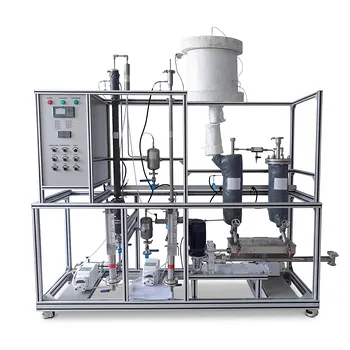
Validating non-linear kinetic models requires precision engineering and reliable experimental data. LABPARK provides advanced Educational and Vocational Unit Operations Pilot Plants in chemical engineering, bioprocess & biotech, and environmental & water treatment.
Specifically tailored for universities, research institutes, and enterprises, our pilot plants enable accurate internal profiling and data collection to successfully validate complex reaction kinetics.
Bridge the gap between model and reality—contact our experts today to discuss your pilot plant needs!
Related Products
- Fixed Bed Gas Solid Catalytic Reaction Educational Pilot Plant
- Multi Pump Fluid Transport Process Piping Unit Operations Training Pilot Plant
- Carbon Dioxide Hydrogen Methanol Synthesis Educational Unit Operations Pilot Plant
- Ethyl Acetate Synthesis Unit Operations Pilot Plant for Practical Training
- Natural Product Extraction Unit Operations Training Pilot Plant
People Also Ask
- How do reactor pilot plants safely study gas-solid reactions? Master kinetics with thermal & flow control.
- How does the Mears criterion evaluate transport resistance? Key Guide to Intrinsic Kinetics
- Why is a multibed configuration necessary for exothermic reactions? Optimize your pilot plant trajectory.
- Fluidized vs. Fixed Bed Reactors: Comparing Heat & Complexity in Pilot Plants
- What are the differences between pseudohomogeneous and heterogeneous models in pilot plants?