The entire integrity of your crystallization process hinges on a single thermodynamic detail. In chemical engineering process design, distinguishing between enantiotropic and monotropic polymorphs is critical because the stability relationship directly dictates the temperature window in which your desired crystal form can survive. Monotropic systems have one polymorph that is thermodynamically stable across all temperatures up to the melt, while enantiotropic systems possess a transition temperature where the stability order reverses. If this distinction is ignored during scale-up or piloting, a correctly grown crystal can spontaneously transform into an undesired, unstable phase—radically altering solubility, dissolution rate, and final product quality.
The core takeaway is that enantiotropic systems introduce a temperature-dependent “switch” in polymorph stability, while monotropic systems do not. Failing to map that switch during process development means you risk designing an operation that consistently produces the wrong crystal form. The entire goal of a robust crystallization process—delivering identical product performance batch after batch—hinges on respecting this thermodynamic boundary.
The Thermodynamic Foundation of Polymorph Stability
Before you can control a crystallization, you must first understand which solid form is genuinely the lowest-energy arrangement at your operating conditions.
Gibbs Free Energy and the Stability Ranking
Every polymorph has a distinct Gibbs free energy at a given temperature and pressure. The form with the lowest free energy is thermodynamically stable; all others are metastable and can potentially convert over time. Process design is essentially about navigating this energy landscape to trap the desired form permanently.
Enantiotropy vs. Monotropy: A Clear Distinction
In a monotropic relationship, one polymorph remains the lowest-energy form right up to its melting point. Even near the melt, the relative stability never flips—the rank is fixed. For the process engineer, this means the thermodynamic target never changes with temperature. An enantiotropic relationship is fundamentally different. There exists a transition temperature ((T_t)) below which Form A is stable and above which Form B becomes stable. Crossing this temperature line in your crystallizer will invert the thermodynamic driving force, potentially triggering a rapid, uncontrollable conversion to the new stable phase.
Why Process Design Cannot Ignore This Distinction
When teaching or researching crystallization unit operations, the consequences of mixing up these two relationships become immediately tangible in a pilot plant. A design that works perfectly for a monotropic compound can fail catastrophically for an enantiotropic one.
The Risk of Unwanted Phase Transformation
If you unknowingly operate an enantiotropic system on the wrong side of its transition temperature, your product will not stay as the intended polymorph. It will begin converting, often via a solvent-mediated mechanism, into the thermodynamically favored form. This changes the crystal size distribution, blocks filters, and yields a chemically identical but structurally different drug or material. In a pilot plant, this failure mode is irreversible once it starts.
Impact on Solubility, Dissolution, and Bioavailability
Polymorphs of the same molecule can exhibit drastically different solubilities. The metastable form often exhibits higher solubility, which might be desirable for a fast-dissolving pharmaceutical—but that advantage vanishes if it converts to the stable form during storage or processing. Conversely, accidentally producing a metastable form when the stable one is required can lead to unexpected dissolution shifts and compromised bioavailability. Distinguishing enantiotropy from monotropy allows you to predict whether a solubility advantage can be maintained or will inevitably drive a conversion.
Processability Differences: Filtering, Washing, Drying
The physical state of the solid directly dictates unit operation efficiency. Crystalline solids are generally far easier to filter, wash, and dry than amorphous material. However, even among crystals, an enantiotropic transition can generate a new crystal habit that is less filterable or produces fines that blind the filter cloth. Recognizing the polymorphic relationship helps you anticipate and avoid such downstream bottlenecks.
Experimental Determination in Pilot Plants
The pilot plant is not just a scaled-down version of production; it is the definitive arena where you answer the enantiotropy-vs-monotropy question.
Determining Transition Temperatures and Stability Windows
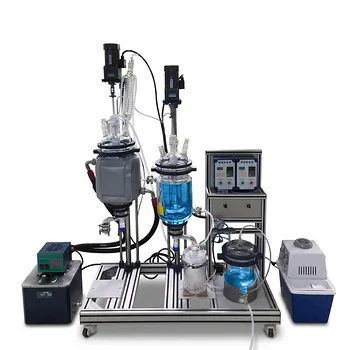
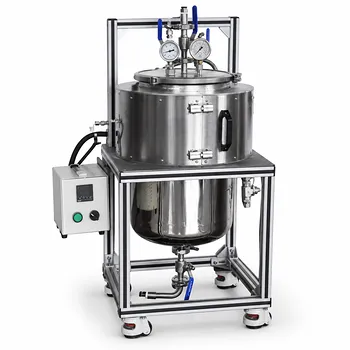
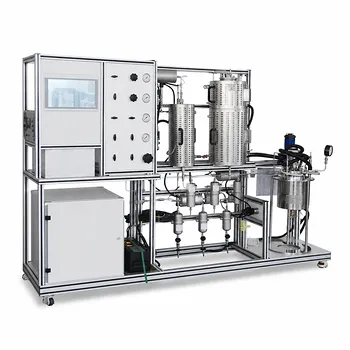
Using crystallization unit operations pilot plants, students and researchers can run systematic temperature-cycling experiments. By measuring the temperature at which a suspension of one polymorph transforms into the other over time, you can map the transition point. This hands-on study turns an abstract thermodynamic concept into a process control boundary. Once the transition temperature is known, the safe operating window for the desired form becomes an explicit design parameter.
Optimizing Cooling Rates and Supersaturation Profiles
Even when you stay within the correct temperature window, kinetics can temporarily favor the wrong form. Enantiotropic systems demand precise control over cooling rates and supersaturation to ensure nucleation and growth of the target polymorph before it crosses into a region where the other form becomes stable. Pilot plants allow you to test these dynamic strategies, building the kinetic safeguards that make the thermodynamic stability useful.
Understanding the Trade-offs
While the enantiotropic/monotropic distinction is a cornerstone of design, it presents practical challenges and is not the only lens through which to view polymorphism.
Measurement Challenges and Kinetic Traps
Identifying a transition temperature is not always straightforward. Slow transformation kinetics or competing metastable phases can confuse experimental measurements. You may misclassify a system as monotropic simply because the transition is too sluggish to observe within the pilot plant’s residence time. This false confidence can then lead to a shelf-life failure months after production, when the conversion finally occurs.
Pressure as a Hidden Variable
Most discussions focus on temperature, but pressure also shifts polymorph stabilities. An enantiotropic relationship observed at ambient pressure in the lab might behave monotropic under the elevated pressures of a spray dryer or high-pressure crystallizer. Ignoring this variable can undermine a design that appeared robust at the bench scale.
Over-Reliance on Thermodynamics Without Kinetic Consideration
Thermodynamic stability defines the eventual endpoint, but kinetic factors govern what you actually produce. A kinetically trapped metastable form can persist for years if the energy barrier to conversion is high enough, even if it is monotropic relative to the stable form. Teaching the distinction means also teaching students to ask not just “which form is more stable?” but “how fast will it convert under my operating conditions?”
Making the Right Choice for Your Process Design
Applying this knowledge starts with matching your development approach to your primary objective. The following decision paths can guide both teaching and industrial research.
- If your primary focus is teaching foundational principles: Use enantiotropic systems that exhibit clear, reproducible transition temperatures. They vividly demonstrate how thermodynamics directly dictates process boundaries, making abstract Gibbs free energy curves concrete.
- If your primary focus is scaling up a known compound: Commission a pilot plant study to map the stability domain of the desired polymorph before ever setting the commercial-scale crystallizer’s temperature profile. Treat the transition temperature like a safety limit—never operate within a margin of it.
- If your primary focus is discovering a new polymorph or optimizing solubility: Employ differential scanning calorimetry and solubility prediction tools to quickly screen whether the relationship is enantiotropic or monotropic. This lets you decide if you can exploit a metastable form kinetically or must design for the always-stable phase.
Respecting the energy landscape of your molecule turns crystallization from an art into a defined, repeatable unit operation. When you know whether your system is enantiotropic or monotropic, you move from hoping the right form appears to engineering its consistent birth.
Summary Table:
| Feature | Enantiotropic Polymorphs | Monotropic Polymorphs |
|---|---|---|
| Thermodynamic Stability | Reverses at transition temperature ($T_t$) | One form is stable at all temperatures |
| Transition Temp ($T_t$) | Yes (stability flips above/below $T_t$) | No transition temperature exists |
| Process Design Focus | Strict temperature window control | Kinetic control & supersaturation profiles |
| Scale-up Risk | Phase conversion if $T_t$ is crossed | Slow conversion of metastable forms |
Master Crystallization Scale-Up with LABPARK Pilot Plants
Bridge the gap between thermodynamic theory and practical chemical engineering. LABPARK provides advanced Educational and Vocational Unit Operations Pilot Plants in chemical engineering, bioprocess & biotech, and environmental & water treatment.
Designed specifically for universities, research institutes, and enterprises, our systems enable students and researchers to map phase behaviors, optimize crystallization profiles, and prevent costly process failures.
Ready to elevate your training and research capabilities? Contact us today to find the ideal pilot plant solution for your lab!
Related Products
- Multi Functional Membrane Crystallization Educational Unit Operations Pilot Plant
- Potassium Salt Thermal Dissolution and Crystallization Separation Educational Unit Operations Pilot Plant
- Multi-Modal Distillation Unit Operations Training Pilot Plant
- General Purpose Cosmetics Production Unit Operations Training Pilot Plant
- Two-Dimensional Fluidization Hydrodynamics Educational Pilot Plant for Unit Operations Training
People Also Ask
- What key membrane characteristics are needed for MD? Optimize Your Pilot Plant
- How Batch vs Continuous Configuration Affects Distillation Pilot Plant Versatility & Footprint
- What are the advantages of membrane separation pilot plants? Energy-saving process intensification.
- How can crystallization pilot plants analyze kinetics' impact on product purity?
- How can a membrane pilot plant demonstrate industrial NF? Food & Textile Applications