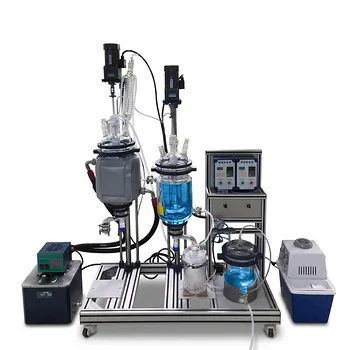
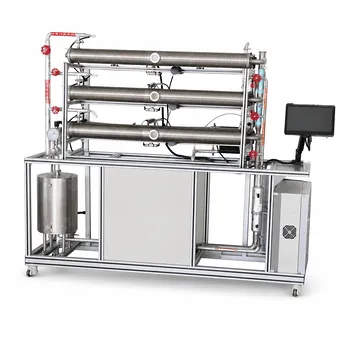
The single most powerful tool for linking crystallization kinetics to final product purity is the pilot plant. By systematically manipulating cooling profiles, agitation speeds, and seeding protocols, crystallization pilot plants allow researchers to directly observe how crystal growth and nucleation rates influence impurity entrapment. Instead of guessing what happens at scale, you can measure the exact kinetic conditions that produce consistently high-purity solids.
Purity in crystallization is not just a thermodynamic limit—it’s a kinetic outcome. A pilot plant decouples supersaturation, mixing, and nucleation effects, letting you map the precise operating window where orderly crystal growth outpaces destructive inclusion formation.
The Kinetic Battle: Growth vs. Nucleation
The fundamental driver of purity loss is how a crystal is born and grows. Understanding this competition explains why pilot plant experiments are indispensable.
Why Supersaturation Becomes the Swing Variable
Supersaturation is the thermodynamic driving force, but it creates two competing kinetic paths. A high level of supersaturation triggers massive, rapid nucleation, producing millions of tiny, poorly formed crystals. These small crystals and agglomerates physically entrap mother liquor and dissolved impurities inside the lattice, creating internal contamination that no downstream washing can remove.
Controlled, lower supersaturation favors crystal growth. Growth allows lattice planes to build in an orderly fashion, effectively rejecting impurities and solvents at the advancing crystal surface. The pilot plant lets you steer the system away from runaway nucleation and into the growth-dominated regime where purity is built into every crystal.
Designing Experiments in a Crystallization Pilot Plant
Crystallization pilot plants are designed to give you absolute control over the kinetic levers that dictate purity. Every variable can be isolated, logged, and linked to a purity outcome.
Precise Control of Cooling Profiles
Cooling rate directly controls supersaturation generation. A jacketed crystallizer with programmable temperature ramps allows you to test slow linear cooling versus more advanced cubic-cooling profiles that maintain a constant supersaturation. By sampling crystals at different points in the cooldown and measuring purity (e.g., via a melting point apparatus), you identify the critical cooling rate beyond which inclusions skyrocket.
Agitation: Balancing Homogeneity and Shear
Pilot plant agitators let you precisely vary tip speed and impeller design. Moderate, uniform agitation suspends the crystal bed, ensuring each crystal sees the same local supersaturation and growth opportunity. However, excessive agitation introduces high shear that damages crystals and creates secondary nucleation—a source of fines that trap impurities. Pilot trials that map purity as a function of power per unit volume reveal the hydrodynamic sweet spot that prevents settling without sacrificing structural integrity.
Seeding to Suppress Spontaneous Nucleation
Seeding is the most elegant kinetic tool for purity. By adding a known mass of carefully milled, high-purity seed crystals at the right moment, you consume supersaturation on the seed surface through controlled growth. The pilot plant is the only place where you can test the exact seed loading, particle size, and addition temperature needed to completely suppress primary nucleation. This erases the kinetic pathway for impurity entrapment, delivering near-theoretical purity.
Measuring the Purity Payoff
The analysis doesn’t stop at the crystallizer; the pilot plant’s integrated workflow provides immediate, quantitative feedback on kinetic decisions.
A melting point determination is a rapid, high-sensitivity indicator. Pure solids yield a sharp, narrow melting range; any kinetic entrapment of impurities depresses the onset and widens the range. Inline process analytical technology (PAT), such as focused beam reflectance measurement (FBRM) or Raman spectroscopy, can track crystal size and form in real time, linking a specific cooling profile to the exact moment inclusions form. The plant’s filtration and washing modules then let you distinguish intrinsic purity (built during growth) from extrinsic purity (removed by washing the cake).
Understanding the Trade-offs
No crystallization process is optimized on purity alone. The pilot plant illuminates the practical boundaries.
Purity vs. Yield: The Supersaturation Tightrope
Driving supersaturation to near-zero levels yields the purest crystals but leaves valuable product in solution. Conversely, crashing the system with rapid cooling traps impurities but captures more mass. Pilot plant data allows you to construct a Pareto front—showing exactly how much yield you must sacrifice to gain one percent more purity—enabling a rational business decision.
Scale-Up Pitfalls: When Hydrodynamics Compromise Purity
The controlled mixing you achieve in the pilot plant does not automatically translate to full manufacturing scale. Pilot trials that deliberately test poor mixing zones (e.g., larger-scale simulations with longer blend times) reveal whether your kinetic advantage collapses when mass‑transfer limitations create local hotspots of high supersaturation. This early warning allows you to design an agitation system for the commercial unit that preserves the growth‑dominant environment.
Making the Right Choice for Your Goal
Use your pilot plant not as a single-run demonstrator, but as a kinetic mapping engine. Your experimental campaign should align with your ultimate priority.
- If your primary focus is maximum purity: Prioritize shallow cooling curves and a well-characterized seed strategy. Let the pilot plant define the lowest temperature ramp rate that justifies the cycle time, and lock in the seed age and loading that eliminates nucleation entirely.
- If your primary focus is balancing throughput and quality: Use the pilot plant to find the inflection point on the purity-vs-cooling-rate curve. Operate just at the edge of growth-dominated kinetics to push yield without entering the inclusion zone.
- If your primary focus is robust, scalable design: Run mixing‑related failure scenarios in the pilot plant to quantify how purity degrades at prolonged blend times. Build your commercial-scale operating window around these kinetic limits to ensure that the purity you observe in the pilot plant is genuinely scale‑independent.
A crystallization pilot plant transforms purity from a black-box outcome into a deliberate, measured function of the kinetic path you choose.
Summary Table:
| Kinetic Parameter | Pilot Plant Control Strategy | Direct Impact on Product Purity |
|---|---|---|
| Supersaturation | Programmed temperature ramps & cubic cooling | Limits rapid nucleation; prevents solvent and impurity entrapment. |
| Agitation & Shear | Controlled tip speed & optimized impeller design | Ensures local homogeneity while preventing crystal damage and secondary fines. |
| Seeding Protocol | Optimized seed loading, size, and addition point | Consumes supersaturation via orderly growth; completely suppresses primary nucleation. |
Optimize Your Crystallization Processes with LABPARK
Ready to bridge the gap between crystallization kinetics and final product purity? LABPARK designs and manufactures high-performance Educational and Vocational Unit Operations Pilot Plants tailored for chemical engineering, bioprocess & biotech, and environmental & water treatment.
Whether you are a university training the next generation of chemical engineers, a research institute mapping complex kinetic profiles, or an enterprise scaling up production with minimal impurity entrapment, our pilot plants deliver the precise control you need.
Why Partner with LABPARK?
- Precision Control: Achieve highly accurate temperature ramps, agitation speeds, and seeding protocols to match real-world production conditions.
- Seamless Scale-Up: Test mixing-related failure scenarios and kinetic limits to prevent costly setbacks at commercial scale.
- Tailored Solutions: Get robust, educational, and research-grade systems configured to your specific curriculum or R&D goals.
Take control of your crystallization kinetics today. Contact our team of experts to discover how LABPARK pilot plants can enhance your research and training capabilities!
Related Products
- Multi Functional Membrane Crystallization Educational Unit Operations Pilot Plant
- Potassium Salt Thermal Dissolution and Crystallization Separation Educational Unit Operations Pilot Plant
- Multi-Modal Distillation Unit Operations Training Pilot Plant
- Dual-Mode Rectification Pilot Plant for Practical Training Unit Operations
- Multi-Reactor Educational Pilot Plant for Reaction Engineering Unit Operations
People Also Ask
- What key membrane characteristics are needed for MD? Optimize Your Pilot Plant
- Why is the measurement of bubble point, dew point, and vapor pressure critical when operating distillation pilot plants?
- How Batch vs Continuous Configuration Affects Distillation Pilot Plant Versatility & Footprint
- How can energy balance equations for condensers & reboilers be validated experimentally? Guide
- How to demonstrate MBR fouling & cleaning? Hands-On Environmental Engineering Training