Here’s the core insight: In pilot-plant studies of catalyst activation and deactivation, Extended X-ray Absorption Fine Structure (EXAFS) directly reveals the local atomic architecture of active sites—interatomic distances, coordination numbers, and disorder—around a specific element, even in non-crystalline, highly dispersed materials. Unlike surface-averaging techniques such as XPS or Auger spectroscopy, which can only infer structural changes from composition or oxidation-state shifts, EXAFS provides a quantitative, element-specific fingerprint of the immediate neighborhood of the atom, turning what is often an indirect deduction into a direct measurement.
Understanding the true local structure is not about surface composition—it’s about exactly how many atoms surround your active metal, at what distance, and how disordered that arrangement is. EXAFS answers those questions with precision no conventional surface tool can match, making it indispensable for diagnosing catalyst activation failures or deactivation mechanisms in chemical engineering pilot plants.
The Fundamental Gap: Composition vs. True Local Structure
Surface analysis tools only tell you what’s there, not how it’s arranged
Techniques like X-ray Photoelectron Spectroscopy (XPS), Auger electron spectroscopy, or Ion Scattering Spectroscopy (ISS) excel at measuring the average elemental composition and chemical states of the outermost layers. When a catalyst deactivates, XPS readily detects trace poisons like sulfur and reports whether palladium has reduced to metal or remained oxidized. However, these data point only to a change in surface chemistry.
They do not measure how many oxygen atoms bind to a platinum center, how far those bonds stretch, or whether the metal cluster has rearranged from a flat raft into a three-dimensional particle. Those geometric details define catalytic activity.
EXAFS fills the gap by quantifying the atomic neighborhood
Extended X-ray Absorption Fine Structure works by scanning X-ray absorption just above an element’s absorption edge. The ejected photoelectron scatters off neighboring atoms, producing oscillations that encode interatomic distances, coordination numbers, and mean-square disorder (Debye-Waller factor). Because the signal originates from a specific absorption edge, EXAFS is inherently element-specific—you can look at nickel in a Ni-Mo catalyst without interference from the molybdenum or the alumina support.
That makes EXAFS fundamentally different. Instead of asking “is there carbon on the surface?” you can ask “has the nickel atom lost its nearest sulfur neighbor after regeneration, and what distance did it move to?”
Why EXAFS Excels at Capturing Activation and Deactivation Dynamics
No long-range order required: it works on highly dispersed clusters
Catalyst active sites in pilot plants are often small metal clusters or isolated atoms on a high-surface-area oxide. They lack the long-range order needed for X-ray diffraction. EXAFS ignores crystallinity—it probes only the first few coordination shells around the absorbing atom. This makes it perfect for following activation protocols where a salt precursor transforms into a small metal particle, or for tracking sintering (particle growth) that deactivates supported metals.
Quantitative bond-length precision down to 0.01 Å
During activation, a subtle expansion or contraction of metal-metal bonds can signal a change from a metallic to a carbidic or sulfided phase. EXAFS delivers interatomic distances accurate to about 0.01 Å for subsequent shells. This level of detail lets you correlate structural metrics directly with catalytic turnover frequency, something no surface-averaging tool can do.
Coordination numbers reveal cluster size and poisoning
A drop in coordination number (roughly ±20% accuracy) immediately tells you whether the average metal particle grew (decreased dispersion) or whether a poisoning element like sulfur directly bonded to the active metal, reducing its free coordination sites. XPS might see the poison; EXAFS quantifies how many poison atoms sit next to the metal, revealing the true extent of site blockage.
Disorder measurements uncover surface mobility
The mean-square relative displacement (σ²) extracted from EXAFS reflects both thermal vibration and static structural disorder. A spike in the disorder factor during reaction can indicate that adsorbates are creating a more mobile, fluxional surface layer—a precursor to sintering or phase segregation—well before it manifests in bulk composition.
Understanding the Trade-offs: Practical Constraints of EXAFS in Pilot-Plant Research
Synchrotron access defines feasibility
To obtain high-quality EXAFS spectra quickly, you typically need the continuous, intense X-ray beams of a synchrotron radiation facility. Conventional laboratory X-ray sources can be used, but counting times become so long that in-situ activation studies under realistic flow conditions become impractical. Pilot-plant researchers must plan beamtime campaigns carefully, which limits the technique’s routine use.
It averages over all absorbing atoms
EXAFS delivers a bulk-averaged coordination environment for the chosen element. If your catalyst contains a mixture of small metallic nanoparticles and isolated cations, the resulting coordination numbers and distances are a weighted average. You lose the ability to distinguish separate phases directly, unless you combine EXAFS with complementary tools like XPS (for oxidation states) or electron microscopy (for spatial heterogeneity).
Alternative technique: EXELFS offers spatial resolution
For samples where spatial variation is critical—such as across a single catalyst pellet—extended electron energy loss fine structure (EXELFS) inside a transmission electron microscope can provide both local structure and nanoscale spatial resolution. But EXELFS demands thin samples and often suffers from poorer signal-to-noise, making EXAFS the go-to for high-precision quantification.
It does not replace surface-sensitive diagnostics
During pilot-plant troubleshooting, XPS remains invaluable for rapidly surveying surface poisons and for quantifying changes in oxidation state that directly inform regeneration protocols. EXAFS is not a quick survey tool; it is a deep structural probe best deployed when you already have a hypothesis about the geometric or coordinative change causing deactivation.
How to Apply This to Your Catalyst Characterization Strategy
Matching the problem to the technique
- If your primary focus is identifying trace surface poisons and oxidation-state shifts: Use XPS as a rapid survey. It tells you what elements are present on the surface and in which chemical states, guiding regeneration decisions.
- If your primary focus is quantifying the exact bonding distance or coordination number around a specific metal after activation or deactivation: Use EXAFS. It gives you direct structural metrics—interatomic distances, coordination numbers, disorder—that correlate with catalyst performance.
- If your primary focus is resolving spatial heterogeneity across a single deactivated particle: Consider EXELFS in an electron microscope. It combines local structure with high spatial resolution, though data quality may be lower than synchrotron EXAFS.
- If your primary focus is building a structure–activity model for a non-crystalline, highly dispersed catalyst: Make EXAFS the centerpiece. Pair it with XPS for oxidation state and surface composition, then use the structural parameters to interpret kinetic data from the pilot plant.
By directly measuring the atomic neighborhood of your active metal, EXAFS transforms catalyst deactivation diagnosis from a detective game into a precise measurement—giving you the hard numbers needed to design more robust activation procedures and longer-lasting catalysts.
Summary Table:
| Tool | Primary Measurement | Structural/Spatial Resolution | Best Used For |
|---|---|---|---|
| EXAFS | Local atomic neighborhood (interatomic distances, coordination number, disorder). | Element-specific, sub-angstrom accuracy (0.01 Å), no long-range order needed. | Quantifying active site restructuring, sintering, and direct bonding of poisons. |
| XPS / Surface Tools | Surface elemental composition and oxidation/chemical states. | Surface-averaging (top few layers). | Rapid surveying of surface poisons and tracking overall oxidation state shifts. |
| EXELFS | Local atomic structure with spatial resolution. | Nanoscale spatial resolution within TEM, lower signal-to-noise. | Resolving spatial structural heterogeneity across a single catalyst particle. |
Scale Your Catalyst & Chemical Engineering Research with LABPARK
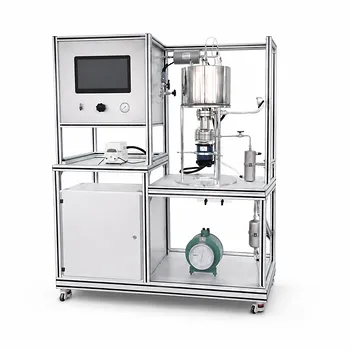
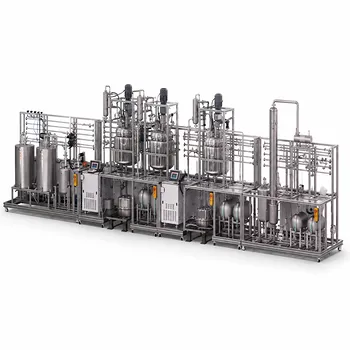
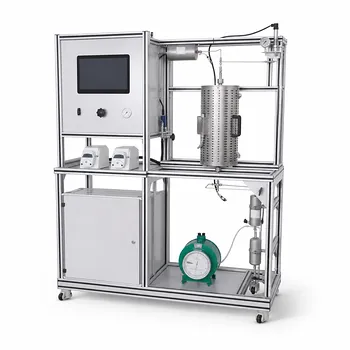
To effectively study catalyst activation, deactivation, and reaction kinetics, you need robust and scalable systems. LABPARK provides state-of-the-art Educational and Vocational Unit Operations Pilot Plants in chemical engineering, bioprocess & biotech, and environmental & water treatment.
Designed specifically for universities, research institutes, and enterprises, our pilot plants deliver the reliability, precision, and safety required to bridge the gap between lab-scale discovery and industrial application.
Ready to elevate your research or training capabilities? Contact LABPARK today to find the perfect pilot plant solution for your facility!
Related Products
- Fixed Bed Gas Solid Catalytic Reaction Educational Pilot Plant
- Methanol Synthesis and Catalyst Performance Evaluation Educational Unit Operations Pilot Plant
- Carbon Dioxide Hydrogen Methanol Synthesis Educational Unit Operations Pilot Plant
- Fixed-Bed Chemical Reaction and Gas Dust Tar Removal Unit Operations Pilot Plant
- Residence Time Distribution and Reactor Flow Characteristics Determination Educational Pilot Plant
People Also Ask
- How do reactor pilot plants safely study gas-solid reactions? Master kinetics with thermal & flow control.
- How does the Mears criterion evaluate transport resistance? Key Guide to Intrinsic Kinetics
- Fluidized vs. Fixed Bed Reactors: Comparing Heat & Complexity in Pilot Plants
- Why is a multibed configuration necessary for exothermic reactions? Optimize your pilot plant trajectory.
- How is the friction factor determined for fixed-bed pilot plants? Select the best pressure drop correlation.