The very first decision in your distillation simulation—before you draw a single stage or set a feed stream—is the choice of numerical algorithm. For a multi-component column in a unit operations pilot plant, that choice boils down to this: use the Bubble Point (BP) method for narrow-boiling, non-polar or weakly polar mixtures, and switch to the Sum Rates (SR) method for wide-boiling mixtures (especially absorbers, strippers, or extractors). Picking the wrong method doesn’t just slow you down; it can cause your simulation to oscillate wildly and never converge, wasting precious pilot-plant time.
Your algorithm must mirror the physics you’re trying to simulate. BP methods shine when composition changes dictate temperatures and the boiling range is tight. SR methods dominate when temperature swings are massive but internal flow rates stay relatively constant—the hallmark of wide‑boiling separations.
The Bubble Point Method: Pinpoint Precision for Ideal Mixtures
When It Works Best
The BP method is the go‑to algorithm for narrow‑boiling, non‑polar or weakly polar systems. In these mixtures, the boiling points of all components are clustered together, so the temperature changes only gradually from tray to tray. This makes the bubble‑point equation a stable, fast‑converging anchor for the simulation.
The Underlying Math
BP is a decoupled MESH solver. It first solves the material‑balance (M) and phase‑equilibrium (E) equations using a tridiagonal matrix algorithm to get new liquid compositions on every tray. Then it calls a bubble‑point calculation to update each tray temperature: it finds the temperature where the sum of liquid mole fractions times the K‑values equals 1.0 (ΣKX = 1.0). For ideal mixtures, K depends only on T and P, so this single‑loop iteration converges in a few passes.
When BP Breaks Down
The method loses its grip in two situations.
- Wide‑boiling feeds: The extreme temperature profile makes the composition‑based temperature updates highly sensitive, often causing severe oscillations or outright divergence.
- Highly polar, non‑ideal mixtures: Now K is a strong function of composition (through activity coefficients). The bubble‑point equation requires nested iterations—an inner loop adjusting liquid mole fractions and an outer loop adjusting temperature. Without advanced Newton‑Raphson techniques (using 1/T as the independent variable), convergence slows to a crawl.
The Sum Rates Method: Taming Wide‑Boiling Chaos
Designed for Temperature Swings
The SR method was built for absorbers, strippers, and extractors—processes where the feed components span a huge boiling range. In these columns, vapor‑liquid flow rates stay relatively constant from stage to stage, while the temperature changes dramatically. SR exploits that physics.
How It Works Differently
Instead of using relative volatilities to lock in temperatures, SR treats flow rates as the stable variable. It uses sum‑rate equations to calculate total vapor and liquid flows, then applies a Newton‑Raphson correction to find the stage temperatures that satisfy the energy balance. By decoupling in the opposite way from BP, it avoids the dangerous feedback loop that destroys convergence on wide‑boiling problems.
Why It Excels Where BP Fails
Because SR focuses on flow‑rate consistency, it dampens the oscillations that plague BP when tray temperatures vary wildly. The Newton‑Raphson method for temperature updates further linearises the problem, delivering rapid, stable convergence even for feeds with 200‑°C boiling‑point spreads.
Understanding the Trade‑offs
No single algorithm is perfect for everything. You must weigh the following:
- BP’s simplicity is its strength and its weakness. For an ideal, narrow‑boiling hydrocarbon mixture (e.g., a debutanizer), BP gives you an answer in seconds. Apply it to a wide‑boiling glycol absorber and the simulation will fail.
- SR adds robustness at a computational cost. For a tight‑boiling column where flows vary more than temperatures, SR may converge slower or require tighter initial estimates. It’s unnecessary overhead for the problem BP was designed to handle.
- The “grey area” of non‑ideal narrow‑boiling mixtures (think ethanol‑water) sits awkwardly. BP can still work if you enable the Newton‑Raphson 1/T solver and provide a good initial temperature profile. SR isn’t appropriate here because flows are not the dominant variable. Expect more simulation‑tuning effort.
- Pilot‑plant reality matters. Many simulation tools default to BP. If you blindly accept that default for a steam‑stripping column, you will waste hours chasing a convergence failure—time you cannot afford on a live unit operations pilot plant.
Making the Right Choice for Your Pilot Plant Simulation
Apply these concrete decision rules before you start your simulation run.
- If your primary focus is a narrow‑boiling, non‑polar mixture (e.g., light hydrocarbons): Use the BP method. It converges quickly and accurately, letting you spend your time on physical data analysis rather than numerical gymnastics.
- If your primary focus is a wide‑boiling separation like an absorber, stripper, or extractor: Switch to the SR method immediately. Don’t even attempt a BP solve; the algorithm is fundamentally mismatched to your physics.
- If your primary focus is a narrow‑boiling but highly polar system (e.g., azeotropic distillation): Start with the BP method, but confirm your simulator uses a robust Newton‑Raphson temperature update with 1/T as the variable. Prepare high‑quality initial temperature guesses and expect to monitor convergence closely.
- If your primary focus is a mixed‑boiling‑range column with both wide and narrow sections: Always choose SR for the overall column, as the wide section will dominate the convergence behaviour.
Align the algorithm with the chemistry, and your pilot‑plant simulation becomes a reliable guide—not a frustrating bottleneck.
Summary Table:
| Feature | Bubble Point (BP) Method | Sum Rates (SR) Method |
|---|---|---|
| Best For | Narrow-boiling, non-polar/weakly polar mixtures | Wide-boiling mixtures (absorbers, strippers, extractors) |
| Boiling Range | Tight (clustered boiling points) | Wide (large temperature spans) |
| Core Variable | Bubble-point equation (temperature via compositions) | Sum-rate equations (flow rates via energy balance) |
| Strengths | Fast, simple, and accurate for ideal systems | Highly stable; prevents convergence oscillations in wide feeds |
| Weaknesses | Fails or oscillates on wide-boiling/highly polar feeds | Computational overhead; slower for tight-boiling systems |
Optimize Your Chemical Engineering Lab with LABPARK
Transitioning from numerical simulations to physical pilot plant operations requires precise equipment. LABPARK provides industry-leading Educational and Vocational Unit Operations Pilot Plants in chemical engineering, bioprocess & biotech, and environmental & water treatment tailored for universities, research institutes, and enterprises.
Our advanced pilot plant systems enable you to:
- Validate Process Models: Test and verify distillation algorithms (like BP and SR) with real-world, physical data.
- Accelerate Practical Research: Bridge the gap between computer-aided design and operational reality.
- Train Future Engineers: Empower students and researchers with hands-on experience on industrial-grade equipment.
Ready to elevate your laboratory and research capabilities? Contact LABPARK today to find the perfect pilot plant solution for your institution.
Related Products
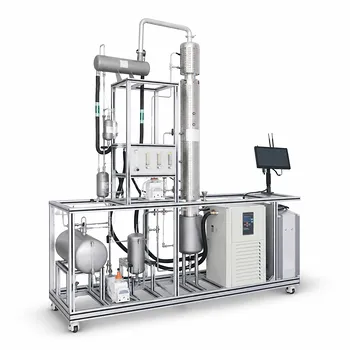
- Multi-Modal Distillation Unit Operations Training Pilot Plant
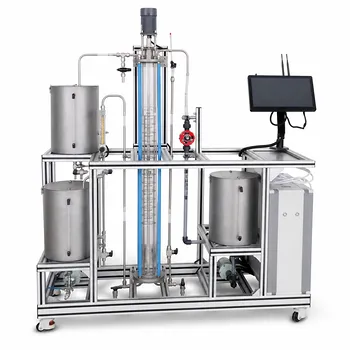
- Multi-Functional Special Distillation Educational Pilot Plant
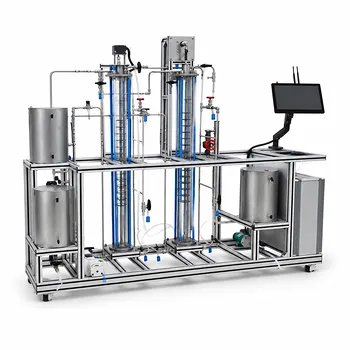
- Continuous Sieve-Plate Distillation Pilot Plant for Unit Operations Laboratory Education
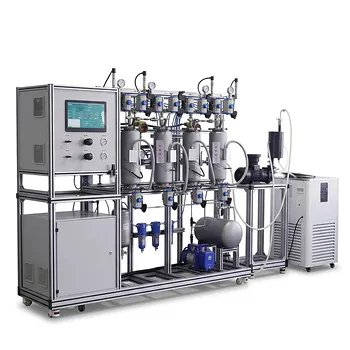
- Continuous Batch Extractive Distillation Educational Pilot Plant
- Dual-Mode Rectification Pilot Plant for Practical Training Unit Operations
People Also Ask
- How can energy balance equations for condensers & reboilers be validated experimentally? Guide
- What are the primary reflux ratio control strategies? Master Distillation Unit Operations
- Why is vacuum operation capability an essential feature for a distillation unit operations pilot plant? Unlock Efficiency
- How does catalyst water concentration affect distillation pilot plant design? Key separation train choices.
- How can real-time carbon number prediction improve distillation pilot plants? Optimize control.