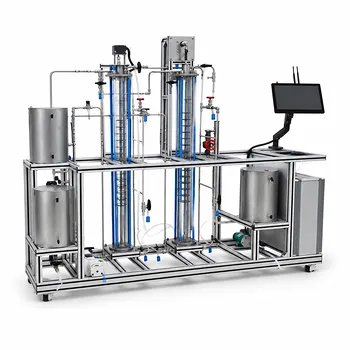
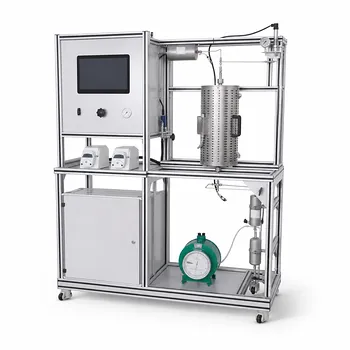
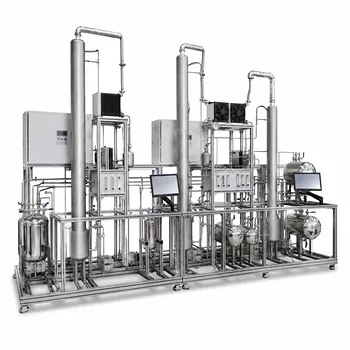
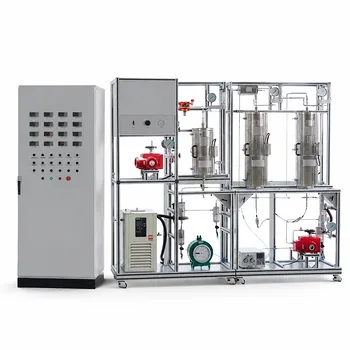
For equilibrium-limited esterification or transesterification reactions, a reactive distillation column delivers a decisive advantage: it continuously removes one product from the reaction zone, breaking the chemical equilibrium and driving conversion far beyond what a separate batch reactor + distillation sequence can achieve. This single-column approach also eliminates intermediate hold and transfer steps, dramatically reduces energy consumption, and intensifies the entire process into one vessel. The core trade-off is that it works only when the relative volatilities of reactants and products match the column’s operating window—and when your piloting goal aligns with continuous, steady-state operation.
The central benefit is equilibrium displacement through in-situ product separation. By coupling reaction and separation inside one column, reactive distillation keeps the reactor at non-equilibrium conditions, yielding higher product per pass while lowering both capital and energy costs. However, that advantage demands careful alignment of reaction kinetics, vapor–liquid behavior, and catalyst packing—factors that make a traditional batch reactor + distillation setup more flexible for small-scale, multi-purpose, or highly variable pilot experiments.
Why Equilibrium-Limited Reactions Demand Reactive Distillation
Overcoming the Thermodynamic Ceiling
Esterification and transesterification are classic equilibrium reactions. In a standard batch reactor, conversion stalls as products accumulate and the reverse reaction kicks in.
Adding a separate distillation column after the batch is a sequential fix—you cannot shift the equilibrium during the reaction itself.
Reactive distillation changes the game.
The column strips away a volatile product (often water or a light alcohol) right at the point of formation. This dynamic Le Chatelier’s displacement pushes the overall conversion well past the thermodynamic limit of the batch reactor.
Yield Gains Without Exotic Chemistry
By continuously pulling out the product, you increase the effective forward reaction rate.
The result is a higher overall yield from the same raw materials, often eliminating the need for a large excess of one reactant.
In pilot trials for ethyl acetate or biodiesel (methyl esters), a reactive distillation column consistently outperforms the yield of a batch reactor + downstream column—simply because the equilibrium is never allowed to settle in.
Process Intensification and Reduced Unit Operations
One Vessel Does the Work of Two
A conventional pilot setup for esterification might include a jacketed batch reactor, a transfer system, and a packed distillation column to purify the crude mixture.
A catalytic distillation column merges reaction and separation into a single unit operation.
This consolidation eliminates:
- Post-reaction hold tanks
- Transfer lines and intermediate cleaning
- Secondary distillation startups and shutdowns
Fewer unit operations mean fewer places for contamination, product loss, and piloting bottlenecks.
Higher Throughput in a Smaller Footprint
Because the reaction and separation happen simultaneously, the reactor volume is used far more efficiently.
Continuous reactive distillation often yields a higher space-time yield than an equivalent batch cycle, allowing you to process more material per hour in a smaller pilot plant footprint.
For a university or R&D pilot hall, that translates to more experiments or scale-up data per square meter.
Energy Efficiency and Thermal Integration
Reaction Heat Directly Powers Separation
Esterification and transesterification are typically mildly exothermic.
In a reactive distillation column, that heat of reaction is immediately used to vaporize liquid mixtures inside the column.
This integration results in a near-isothermal operation where energy input is reduced.
Instead of first heating a batch reactor, then cooling the mixture, then reheating it in a reboiler, the column’s thermodynamic cycle captures and reuses reaction energy in one go.
Lower Utility Costs Across the Pilot Campaign
The energy savings are not marginal.
By avoiding the repeated heating and cooling cycles of a batch process, a reactive distillation column cuts overall steam and coolant demand significantly.
For a long pilot campaign, this directly reduces operating costs and carbon footprint.
Understanding the Trade-offs
No configuration is universally superior. The batch reactor + standard distillation column combination retains critical advantages that can make it the right choice for certain piloting missions.
Flexibility When Feedstocks or Purity Goals Change
A batch distillation unit is inherently more flexible.
You can run different recipes, handle varying feed compositions, and separate a multicomponent mixture into multiple high-purity cuts in a single sequence.
If your pilot plant needs to test a wide variety of raw materials or switch between ester products daily, a batch reactor with a separate column is far simpler to reconfigure.
Handling Small Volumes and Solids
Batch setups excel with low-volume, high-value experiments.
They also tolerate materials that might contain solids or fouling components better than a packed catalytic column designed for countercurrent vapor-liquid flow.
The Strict Operating Window of Reactive Distillation
Reactive distillation works only when the reaction kinetics and the vapor-liquid equilibrium overlap at practical temperatures and pressures.
If the catalyst requires a temperature that is too high for efficient distillation, or if the relative volatilities do not separate the product from the reaction zone well, the integrated column loses its advantage.
Catalyst packing and column hydraulics add another layer of complexity.
You must carefully choose catalyst shape and loading to avoid flooding while maintaining enough liquid holdup for the reaction to proceed. This is a non-trivial design and maintenance challenge at pilot scale.
Making the Right Choice for Your Pilot Plant Goal
Your decision between a reactive distillation column and a batch reactor with standard distillation should hinge on the primary purpose of your pilot program.
- If your primary focus is maximizing yield and demonstrating full process intensification: Choose the reactive distillation column. It shows the highest achievable conversion, lowest energy use, and smallest equipment count—ideal for proving a scaled-down commercial concept.
- If your primary focus is teaching fundamental unit operations or handling a highly variable feedstock portfolio: A batch reactor with a separate distillation column is the more practical and flexible platform. It allows students or researchers to run multiple separations and reaction times independently, learning dynamic process control hands-on.
- If your primary focus is bridging lab data to commercial scale for a continuous process: The continuous reactive distillation column gives you direct scalability insights—steady-state temperature profiles, catalyst lifetime under countercurrent flow, and mass transfer data—that a batch setup simply cannot provide.
- If your primary focus is producing small, high-purity samples of multiple different esters: The batch configuration’s ability to fractionate a multicomponent mixture sequentially, without rebuilding the column, makes it the operationally superior choice.
Ultimately, the right pilot plant is the one that matches your experimental agenda. Choose reactive distillation when chemistry and thermodynamics align with your process goals; choose batch reactor + distillation when flexibility and broad learner exposure take priority.
Summary Table:
| Feature | Reactive Distillation Column | Batch Reactor + Standard Distillation |
|---|---|---|
| Equilibrium Shift | Continuous in-situ separation breaks equilibrium limits | Separated after reaction; limited by batch equilibrium |
| Equipment Footprint | Single integrated vessel (reaction + distillation) | Multiple units (reactor, hold tanks, separate column) |
| Energy Efficiency | High (utilizes reaction heat directly) | Moderate (repeated heating and cooling cycles) |
| Operational Flexibility | Low (narrow operating window & catalyst constraints) | High (easy to change feedstocks and recipes) |
| Best For | Proving continuous commercial scale-up & high yields | Multi-purpose R&D and teaching fundamental operations |
Optimize Your Process Scale-Up with LABPARK
Are you looking to equip your facility with advanced process engineering systems? LABPARK designs and manufactures high-performance Educational and Vocational Unit Operations Pilot Plants across chemical engineering, bioprocess & biotech, and environmental & water treatment.
Whether you need a cutting-edge continuous reactive distillation column to demonstrate process intensification or a flexible batch reactor setup for multi-purpose research, we provide custom solutions tailored for universities, research institutes, and enterprises.
Contact LABPARK today to consult with our engineers and find the perfect pilot plant configuration for your goals!
Related Products
- Continuous Sieve-Plate Distillation Pilot Plant for Unit Operations Laboratory Education
- Ethyl Acetate Synthesis Unit Operations Pilot Plant for Practical Training
- Multi-Modal Distillation Unit Operations Training Pilot Plant
- Multi-Functional Special Distillation Educational Pilot Plant
- Dual-Mode Rectification Pilot Plant for Practical Training Unit Operations
People Also Ask
- How to select the right activity coefficient model (Wilson, NRTL, UNIQUAC) for distillation pilot plants?
- How does catalyst water concentration affect distillation pilot plant design? Key separation train choices.
- What are the primary reflux ratio control strategies? Master Distillation Unit Operations
- Why is vacuum operation capability an essential feature for a distillation unit operations pilot plant? Unlock Efficiency
- How can real-time carbon number prediction improve distillation pilot plants? Optimize control.