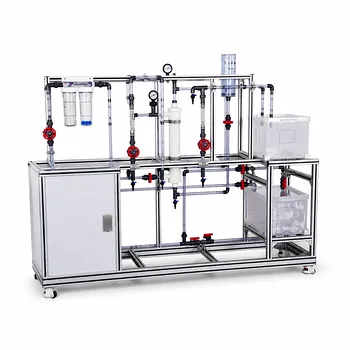
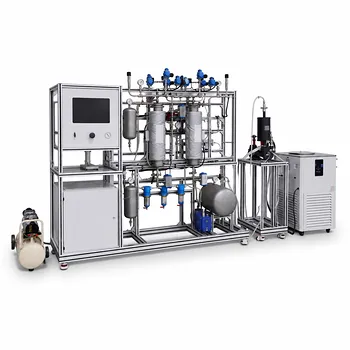
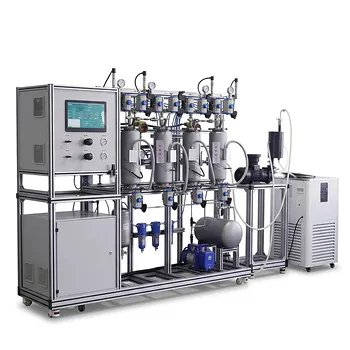
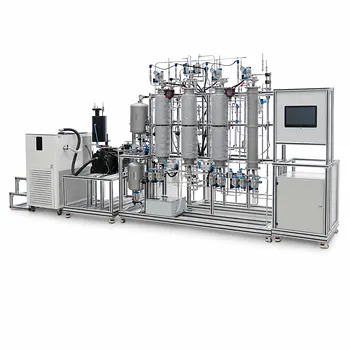
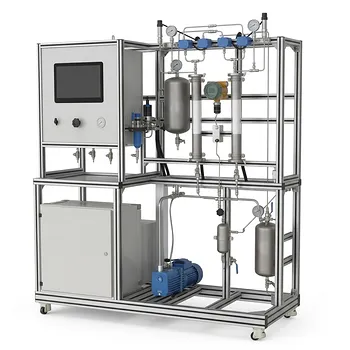
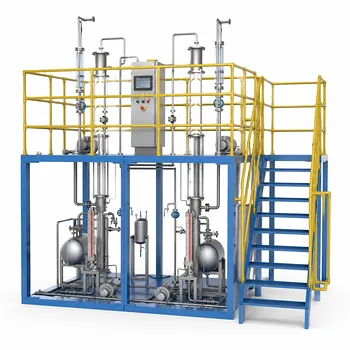
The core architectural divergence between spiral-wound and hollow-fiber modules dictates their suitability for different educational tasks. Spiral-wound modules are built from flat-sheet membranes wrapped around a central permeate collection tube, with mesh spacers creating distinct feed and permeate channels for primarily axial flow. Hollow-fiber modules, on the other hand, are self-supporting, high-pressure vessels packed with thousands of hair-like fibers, offering significantly greater surface area density and the unique ability to explore multiple flow configurations like cocurrent, countercurrent, or crossflow in a single system.
The decision is not about which module is technically superior, but which philosophy of learning you want to embed in your pilot plant. Spiral-wound modules offer a clear, cost-effective model of industrial nanofiltration and reverse osmosis, while hollow-fiber modules provide an unmatched platform for exploring the nuances of mass transfer, pressure drops, and process intensification in high-pressure gas separation.
Decoding the Core Design Architectures
The physical structure of each module creates its operational personality, influencing everything from flow dynamics to maintenance protocols.
The Spiral-Wound Approach: A Balanced Industrial Workhorse
This design uses flat-sheet membranes glued on three sides to form a leaf, which is then wrapped around a central perforated tube. A feed spacer creates an open channel for axial flow, while a thinner permeate spacer channels the purified fluid spirally inward.
This geometry delivers a moderate packing density, typically in the range of 650 to 1,600 m²/m³. It represents a balanced compromise, offering a substantial membrane area in a compact footprint without the extreme sensitivity to fouling seen in denser designs. In an educational context, its visual, layered construction makes it intuitive for students to understand the principles of crossflow filtration and concentrate polarization.
The Hollow-Fiber Advantage: Maximizing Surface Area and Pressure
Hollow-fiber modules approach the problem differently. They consist of a bundle of self-supporting, hair-like fibers potted at one or both ends inside a pressure vessel. Feed can be introduced on the shell side or directly into the bore of each fiber.
This self-supporting nature eliminates the need for separate spacers and permits extraordinarily high packing densities, achieving up to approximately 10,000 m²/m³. Crucially, this cylindrical geometry lends itself to withstanding very high transmembrane pressures, making it the default choice for industrial membrane gas separation processes like hydrogen recovery and nitrogen generation.
Why Flow Configuration is a Performance Lever
The way fluids move through and around the membrane dramatically changes the separation efficiency. This is where the two modules diverge most sharply in educational value.
The Hollow-Fiber Flexibility: Mastering Driving Force
The primary reference highlights that hollow-fiber modules enable students to study different flow configurations easily. You can align the feed and permeate streams to be cocurrent, countercurrent, or crossflow, and switch between shell-fed or bore-fed operation.
This is a critical pedagogical advantage. Countercurrent flow, for a gas separation, maintains a more consistent partial pressure difference along the entire fiber length, achieving higher product purity and recovery than cocurrent flow. A hollow-fiber pilot plant allows students to run both configurations with the same module and observe this thermodynamic principle in real-time, quantifying the performance difference it makes.
The Spiral-Wound Constraint: Fixed Hydraulics
A spiral-wound module’s flow path is largely fixed by its geometry. Feed flows axially through the spacer-packed channel, and permeate spirals to the center. This effectively creates a quasi-crossflow pattern with a significant pressure drop on the feed side.
While this limits the flow configurations you can explore, it provides a direct, industry-relevant model for understanding the pressure drop and concentration polarization limitations central to designing multi-stage reverse osmosis plants. In an educational setting, the lesson is not about flexibility, but about managing the inherent hydraulic trade-offs of a high-volume, flat-sheet configuration.
The Unspoken Reality: Operational Trade-offs
A module’s performance on a spec sheet does not guarantee success in a teaching lab. The practical demands of maintenance and robustness often decide the true long-term value.
Fouling Sensitivity and Pretreatment Demands
The extreme packing density of hollow-fiber modules is also their greatest vulnerability. Narrow feed channels are highly susceptible to clogging by particulates and can be notoriously difficult to clean. This is why industry demands strict feed pretreatment for these systems, targeting a Silt Density Index often below 3.
Spiral-wound modules, while still requiring pretreated feed, are generally more forgiving. Their larger, open feed channels can tolerate a slightly higher fouling index, meaning a student’s minor error in solution preparation is less likely to catastrophically and permanently foul the module. From a laboratory manager’s perspective, this translates to reduced maintenance headaches and lower consumable costs.
Membrane Replacement and Maintenance
When a membrane fails or is irreversibly fouled, the recovery path differs dramatically. A single hollow-fiber module is a sealed unit; the individual fibers cannot be replaced. A blockage or tear often requires the entire potted bundle to be discarded.
The consequence is that a hollow-fiber pilot plant, while a superior simulator for high-performance processes, demands careful supervision and meticulous cleaning protocols. A spiral-wound module, while also typically replaced as a whole element, represents a lower-stakes investment for a teaching laboratory where operational mistakes are a core part of the learning process.
Making the Right Choice for Your Educational Mission
Your choice of module should be a direct reflection of your curriculum’s core learning objectives. Use these goal-oriented guidelines to map the technology to your needs.
- If your primary focus is simulating high-pressure industrial gas separation (e.g., CO2 capture, hydrogen recovery): Choose a hollow-fiber system to teach the principles of process intensification, the impact of countercurrent flow on driving force, and the critical need for feed pretreatment.
- If your primary focus is training on standard water treatment and desalination technologies: Choose a spiral-wound pilot plant as the definitive, cost-effective model for understanding crossflow filtration, recovery rates, and anti-scalant strategies in reverse osmosis and nanofiltration.
- If your primary focus is advanced research and dynamic experiment flexibility: The hollow-fiber module's ability to switch between bore-fed and shell-fed configurations and multiple flow patterns makes it the superior platform for generating publishable data on mass transfer coefficients and concentration polarization.
By aligning the module's inherent design logic with your specific pedagogical or research outcomes, you transform the pilot plant from a simple piece of equipment into a profound, long-term partner in discovery.
Summary Table:
| Feature | Spiral-Wound Module | Hollow-Fiber Module |
|---|---|---|
| Packing Density | Moderate (650 to 1,600 m²/m³) | Very High (Up to 10,000 m²/m³) |
| Flow Configurations | Fixed (Quasi-crossflow) | Flexible (Cocurrent, Countercurrent, Crossflow) |
| Operating Pressures | Moderate | High to Very High |
| Fouling Sensitivity | Moderate (More forgiving, easier to clean) | High (Requires strict feed pretreatment) |
| Best Educational Use | Water treatment, RO, and desalination | High-pressure gas separation (CO2, H2) |
Elevate Your Chemical Engineering Laboratory with LABPARK
Are you looking to equip your lab with high-performance, industry-relevant training systems? LABPARK provides premium Educational and Vocational Unit Operations Pilot Plants in chemical engineering, bioprocess & biotech, and environmental & water treatment.
We help universities, research institutes, and enterprises bridge the gap between theory and practice by offering customizable pilot plants that simulate real-world industrial processes. Whether you need to demonstrate the dynamics of hollow-fiber gas separation or spiral-wound water purification, LABPARK delivers robust, safe, and highly educational systems tailored to your curriculum.
Contact LABPARK today to discuss your laboratory specifications and get a tailored solution for your department!
Related Products
- Multi-Functional Membrane Separation Educational Pilot Plant for Unit Operations Lab
- Multifunctional Membrane Separation Educational Pilot Plant with Ultrafiltration, Nanofiltration, Reverse Osmosis
- Ultrafiltration Membrane Separation Educational Pilot Plant
- Photocatalytic Membrane Separation and Degradation Unit Operations Pilot Plant
- Gas-Solid Heterogeneous Separation Demonstration Educational Unit Operations Pilot Plant
People Also Ask
- What are the key differences in membrane configurations? Choose the Right Unit Operations Pilot Plant
- How Do Pervaporation, Vapor, and Gas Permeation Differ in Pilot Plants? Key Comparison
- What are the advantages of membrane separation pilot plants? Energy-saving process intensification.
- Pervaporation vs. Vapor Permeation: Handling Suspended Solids in Membrane Pilot Plants
- How do PEI, PVDF, and PSU membranes compare in pilot plants? Find the best fit.