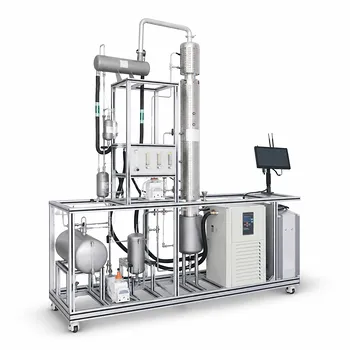
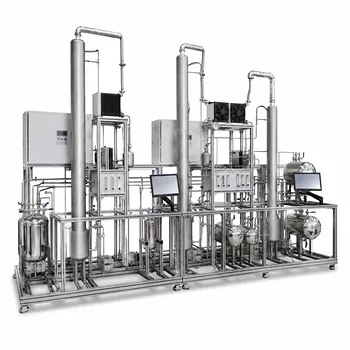
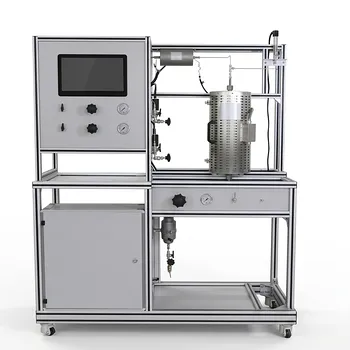
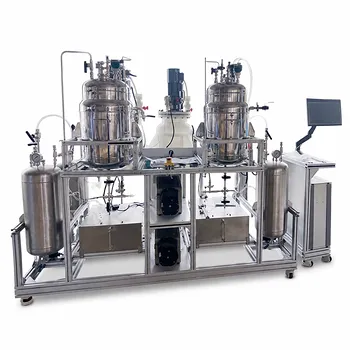
Selecting a distillation pilot plant is ultimately a choice about what you want your students to see, measure, and understand. The key factor that determines the column type is your educational objective—specifically, which mass transfer principles you need to demonstrate. That decision directly controls whether you build the pilot plant around plate (trayed) columns or packed columns, each offering a distinct set of hands-on learning experiences around efficiency, hydrodynamics, and thermal equilibrium.
The core driver isn’t a technical specification; it’s pedagogy. Trayed columns turn the column into a transparent stage-by-stage laboratory where students can visually diagnose flooding, weeping, and entrainment. Packed columns shift the focus to continuous-contact principles, pressure drop, and the critical concept of HETP. For maximum learning, modular systems that let you interchange these internals give the richest, most complete educational value.
Matching Column Type to Learning Objectives
A distillation pilot plant is not just a scaled-down industrial unit—it’s a teaching instrument. Every component, from the internals to the sensors, must be chosen to illuminate a specific set of chemical engineering concepts. The primary reference confirms that the column type “determines which mass transfer principles can be demonstrated.” This means your first question must be: what do I want my students to take away?
Plate Columns: A Window into Multi-Stage Operations
Trayed columns are the go‑to choice when the curriculum demands visual, stage-by-stage contact. Students can look through sight glasses and watch the froth on each tray, instantly connecting theory to physical reality.
- Observing hydrodynamics becomes immediate. Phenomena like weeping (liquid leaking through the tray), entrainment (liquid carried up with the vapor), and flooding (column overload) turn from textbook definitions into tangible events.
- This visual feedback reinforces plate efficiency calculations. By sampling liquid and vapor between actual trays, learners grasp why real stages deviate from theoretical equilibrium.
- Because trayed columns are easy to clean and inspect, they align well with student labs where regular maintenance and component accessibility are critical.
Packed Columns: Mastering Continuous Contact and Efficiency Metrics
When the goal is to understand continuous mass transfer and the factors that control separation performance, packed columns take the lead. Here the learning shifts from visible stages to internal, distributed processes.
- The central concept is HETP (Height Equivalent to a Theoretical Plate). Using a packed column, students can vary packing type or bed height and directly measure how HETP changes—a direct application of efficiency theory.
- These columns excel at demonstrating low pressure drop and absorption behaviors. Lower liquid holdup and reduced ΔP become tangible when comparing a packed bed to a trayed alternative under the same boil-up rate.
- Packed columns also introduce limitations: students see how incomplete wetting at low liquid loads reduces transfer efficiency, reinforcing the importance of hydraulic design.
The Role of Modularity: Maximizing Hands-On Experience
The supplementary references strongly suggest that the best educational pilot plants go beyond a single column type. Modular, interchangeable internals (or dual-column setups) allow a single investment to cover the entire spectrum. Students can swap sieve trays for structured packing, then run the same mixture and quantify the differences in efficiency, pressure drop, and flooding behavior. This comparative capability embeds the trade-offs directly into their thinking.
Understanding the Trade-offs and Practical Limitations
No column type is perfect. The choice you make will inevitably trade some learning objectives against practical considerations like cost, ease of use, and operational envelope.
Cost, Maintenance, and Operational Constraints
- Packed columns often have higher initial packing material costs and are not recommended for fluids containing suspended solids or substances that polymerize. Fouling or clogging hinders both learning and maintenance.
- Plate columns generally offer lower equipment cost and are easier to clean and inspect. This makes them forgiving in a teaching environment where spills, dirt, and frequent start‑shutdown cycles occur.
Visualization vs. Efficiency
- Trayed columns give unmatched visual access but typically come with a higher pressure drop per theoretical stage. The trade‑off is a less efficient use of vertical height—students see more but may need a taller column for the same separation.
- Packed columns can achieve higher separation efficiency in a shorter height, but the internals are hidden. Learners must rely on temperature profiles and composition sampling rather than direct observation, which requires a more mature analytical approach.
The Critical Role of Instrumentation and Reflux Control
Regardless of column type, the primary reference highlights that a comprehensive pilot plant must include temperature sensors at multiple stages and an adjustable reflux ratio. This is non‑negotiable for student learning. The sensors allow energy balance and equilibrium verification; the reflux control directly teaches the fundamental trade‑off between purity and throughput. Without them, even the best column becomes a black box.
Making the Right Choice for Your Lab’s Curriculum
Your final selection isn’t about which column is “better”—it’s about which one most faithfully delivers the lessons you’ve designed. Use the following goal-based guide to align hardware with educational outcomes.
- If your primary focus is visual, stage-by-stage hydrodynamics: Choose a trayed column with generous sight glasses. It will make flooding, weeping, and plate efficiency calculations tangible for students.
- If your primary focus is continuous mass transfer, pressure drop, and HETP analysis: Select a packed column with interchangeable packing beds. This lets students explore height‑based efficiency and low‑ΔP operation.
- If your primary focus is a holistic, comparative curriculum: Invest in a modular pilot plant that supports both tray and packed internals, or install two smaller columns side by side. The direct A/B comparisons will cement understanding of design trade-offs.
- If your primary focus is low maintenance and high operational flexibility in a teaching lab: A trayed column’s ease of cleaning and wide operating elasticity often makes it the more practical baseline.
Every sensor, every sight glass, and every tray or packing section is a chance to turn an abstract equation into a lived experiment. Choose the column type that puts your learning objectives at the center, and the equipment will teach as powerfully as any lecture.
Summary Table:
| Column Type | Primary Educational Focus | Key Concepts Taught | Pros & Cons |
|---|---|---|---|
| Plate (Trayed) | Stage-by-stage operations & visual hydrodynamics | Plate efficiency, weeping, entrainment, flooding | Pros: Visual feedback, easy to clean Cons: Higher pressure drop |
| Packed | Continuous mass transfer & separation efficiency | HETP (Height Equivalent to a Theoretical Plate), pressure drop | Pros: Higher efficiency in less height Cons: Internals hidden, prone to fouling |
Build a World-Class Chemical Engineering Lab with LABPARK
Equipping your laboratory with the right distillation pilot plant is key to transforming abstract equations into hands-on student learning. LABPARK designs and delivers premium Educational and Vocational Unit Operations Pilot Plants tailored for universities, research institutes, and enterprises.
We specialize in high-quality, customizable systems for:
- Chemical Engineering (including flexible, modular distillation units with interchangeable trayed and packed columns)
- Bioprocess & Biotech
- Environmental & Water Treatment
Ready to enhance your curriculum or research capabilities? Contact our engineering specialists today to design the perfect pilot plant solution for your lab!
Related Products
- Continuous Sieve-Plate Distillation Pilot Plant for Unit Operations Laboratory Education
- Multi-Functional Special Distillation Educational Pilot Plant
- Continuous Batch Extractive Distillation Educational Pilot Plant
- Multi-Modal Distillation Unit Operations Training Pilot Plant
- Electrolyte Distillation Purification and Formulation Educational Pilot Plant
People Also Ask
- How can real-time carbon number prediction improve distillation pilot plants? Optimize control.
- Why is vacuum operation capability an essential feature for a distillation unit operations pilot plant? Unlock Efficiency
- What are the primary reflux ratio control strategies? Master Distillation Unit Operations
- How to select the right activity coefficient model (Wilson, NRTL, UNIQUAC) for distillation pilot plants?
- How does catalyst water concentration affect distillation pilot plant design? Key separation train choices.