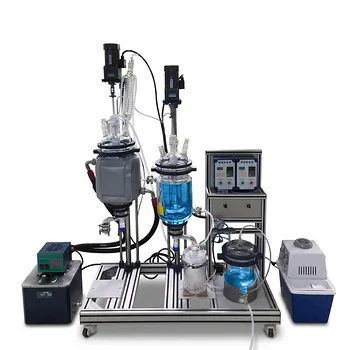
Scaling up a batch crystallizer doesn't just make it bigger—it fundamentally changes your ability to control temperature. As the vessel volume increases, the heat transfer area-to-volume ratio (A/V) drops dramatically, which severely limits the system's capacity to remove or add heat quickly. This directly undermines your ability to impose the precise cooling profiles needed to maintain constant supersaturation, the controlling variable that dictates crystal size, purity, and polymorphic form.
While a larger crystallizer delivers more product, its shrinking A/V ratio makes temperature control sluggish and prone to overshoot. The consequence is not just slower cooling—it's a permanent shift in the dynamic relationship between your jacket setpoint and the actual process conditions inside the reactor, forcing you to rethink your control strategy from first principles.
The Geometric Reality of Heat Transfer on Scale-Up
Why the Ratio Drops as You Grow
Heat removal depends on surface area (the vessel jacket or internal coils), while the heat that must be removed—sensible heat and the exothermic heat of crystallization—scales with the liquid volume.
For a cylindrical vessel, doubling the linear dimensions increases the surface area by a factor of four, but the volume by a factor of eight. Consequently, the A/V ratio falls roughly as 1/L, where L is the characteristic length.
A small lab crystallizer might have an A/V of 9.5 m⁻¹. By the time you reach a pilot scale, this can plummet to 2.6 m⁻¹. That’s a three- to fourfold reduction in the specific heat transfer surface.
Less Wall, More Resistance
The reduced ratio means the limiting heat transfer coefficient—the overall resistance from jacket to process fluid—now applies to a much smaller area per unit volume.
Even if you maintain the same jacket temperature differential, the maximum possible heat flux per unit volume drops proportionally. The bulk liquid temperature cannot respond as fast as the controller commands, introducing a significant time delay and a larger steady-state offset.
How the Declining Ratio Disrupts Process Control
Supersaturation Drifts Out of Your Control Window
In a batch cooling crystallization, you control supersaturation—the thermodynamic driving force for nucleation and growth—by carefully lowering the bulk temperature.
With a high A/V ratio at lab scale, a small change in jacket temperature quickly adjusts the bulk temperature, allowing you to follow a linear or optimal cooling curve almost perfectly.
As A/V shrinks, the bulk temperature lags behind the jacket setpoint. The controller may call for further cooling to catch up, risking jacket temperatures that create sub-cooling at the vessel wall. This local, uncontrolled supersaturation spike triggers unwanted secondary nucleation, producing fines that degrade product quality and complicate downstream processing.
Temperature Runaway Becomes a Real Threat
Crystallization is exothermic. When heat generation from crystal growth or nucleation exceeds the system's removal capacity, the bulk temperature can rise instead of fall.
At lab scale, the generous A/V can handle this heat spike without a noticeable blip. At scale, the same heat release per unit volume now faces a constricted heat transfer bottleneck. The result is a positive feedback loop: the temperature rise increases supersaturation locally, accelerating growth or triggering nucleation, which releases more heat, and the cycle escalates.
In sensitive systems, this runaway can shift the product to an undesired polymorph or, in extreme cases, cause safety issues when solvent boiling points are approached.
Polymorphic Purity and Crystal Form Hang in the Balance
Thermodynamic and kinetic factors govern which polymorph crystallizes. The cooling trajectory—both the rate and the local temperature gradients—defines the pathway.
A sluggish, hard-to-control temperature profile caused by low A/V can push the system into a metastable polymorph's stability region in an uncontrolled manner. You might obtain a mixture of forms, or the kinetic product may dominate, even though your process was designed for the thermodynamic form. Since polymorphic form directly affects bioavailability, solubility, and mechanical properties, this loss of control is not an academic concern; it’s a commercial risk.
Understanding the Trade-offs: When Simple Control Strategies Fail
The Illusion of Fast Jacket Response
A common pitfall is to run the jacket at a much colder temperature to compensate for slow bulk cooling. This creates a large temperature gradient across the wall, driving the internal film temperature far below the bulk.
While the average temperature continues to drop, the wall region experiences severe, transient supersaturation. You might measure a “well-behaved” bulk temperature, but the crystal population tells a different story—high fines, agglomeration, and polymorphic impurities.
Heat Addition Is Just As Compromised
Not every crystallization is a pure cooling process. Some require a dissolution step, a heat-aging hold, or a temperature-controlled ripening phase.
The same reduced A/V hinders heating just as much as cooling. Achieving a rapid temperature increase for a dissolution soak becomes impossible, limiting your ability to fine-tune particle morphology through thermal cycling.
Semi-Batch Operation Mitigates But Doesn't Eliminate the Constraint
One powerful workaround is semi-batch operation: adding reactant or antisolvent at a controlled rate rather than dosing everything at once. This reduces the instantaneous heat generation rate, aligning it with the available heat removal capacity.
However, semi-batch does not change the underlying A/V ratio. It simply shifts the heat duty profile over time. If your crystal growth is highly exothermic and you must maintain tight supersaturation control, you will still hit the wall imposed by the limited surface area.
External Heat Exchangers—Adding Complexity for Control
Installing an external circulation loop with a dedicated heat exchanger can decouple cooling from vessel geometry, effectively raising the system A/V.
This approach introduces new challenges: pumping rates must be high enough to ensure good mixing, but excessive shear can damage crystals. Fouling in the exchanger becomes a maintenance burden, and the extra volume changes the residence time distribution. You trade geometric simplicity for improved heat transfer at the cost of more process complexity and potential contamination points.
Making the Right Choice for Your Scale-Up Strategy
How you respond to the declining A/V ratio depends entirely on your process goals and constraints. Here is a goal-oriented roadmap:
-
If your primary focus is tight polymorphic control and consistent particle size: Prioritize modeling the heat transfer limitation from the very beginning of development. Include the scale-up vessel geometry in your crystallization kinetic model and simulate the lag between jacket and bulk temperature. Then design a cooling curve that a realistic jacket controller can actually deliver, even if that means a slower overall batch cycle.
-
If your primary focus is maximizing throughput while avoiding runaway: Adopt a semi-batch or controlled dosing strategy to flatten the heat release profile. Combine it with a control scheme that uses a model-predictive approach or cascade control (bulk temperature as primary, jacket temperature as secondary) to avoid excessive wall subcooling.
-
If your primary focus is retrofitting an existing large-scale vessel with poor A/V: Investigate whether an external recirculation heat exchanger can be economically justified. Simulate the trade-off between increased cooling capacity and the risk of attrition or fouling. Sometimes, optimizing the jacket’s utility system (e.g., switching from single-phase to a boiling fluid) can improve heat transfer coefficients enough to compensate, without adding external equipment.
-
If your primary focus is educating new engineers about scale-up risks: Use the A/V drop as the central teaching case. Show them the real data—how a cooling profile that worked beautifully in a 1 L flask fails in a 50 L pilot vessel—and help them develop the habit of running dynamic scale-up simulations that couple the energy balance to the crystallization kinetics.
The shrinking heat transfer area-to-volume ratio is not just a geometric curiosity; it is the single most important physical change that destabilizes your control over crystallizer temperature and supersaturation on scale-up. By recognizing it early and embedding its constraints into your design and control philosophy, you transform an inherent weakness into a known, manageable challenge.
Summary Table:
| Scale-Up Challenge | Impact on Process Control | Mitigation Strategy |
|---|---|---|
| Dropping A/V Ratio | Sluggish temperature response & control lag | Cascade control & dynamic kinetic modeling |
| Localized Supersaturation | Unwanted secondary nucleation & high fines | Controlled cooling profiles; avoid over-cooling jacket |
| Exothermic Heat Release | Thermal runaway & polymorphic impurity | Semi-batch dosing to spread heat load |
| Poor Cooling Capacity | Limits throughput & product quality | External recirculation heat exchangers |
Master Chemical Engineering Scale-Up with LABPARK
Bridging the gap between laboratory research and industrial production requires hands-on experience with realistic unit operations. LABPARK provides premium Educational and Vocational Unit Operations Pilot Plants in chemical engineering, bioprocess & biotech, and environmental & water treatment for universities, research institutes, and enterprises.
Our state-of-the-art pilot systems help students and researchers simulate real-world heat transfer limitations—such as dropping A/V ratios—enabling them to master process control, crystallization kinetics, and scale-up dynamics in a controlled environment.
Ready to equip your laboratory with industry-grade training systems? Contact LABPARK today to explore our pilot plant solutions!
Related Products
- Multi Functional Membrane Crystallization Educational Unit Operations Pilot Plant
- Potassium Salt Thermal Dissolution and Crystallization Separation Educational Unit Operations Pilot Plant
- Multi-Reactor Educational Pilot Plant for Reaction Engineering Unit Operations
- Dual-Mode Rectification Pilot Plant for Practical Training Unit Operations
- Multi-Modal Distillation Unit Operations Training Pilot Plant
People Also Ask
- Control Crystallization Pilot Plant Secondary Nucleation: 4 Key Adjustments
- Why is precise temperature control critical in crystallization pilot plants? Key to Scale-Up Success
- What key factors should be considered when configuring a crystallization unit operations pilot plant?
- What are the benefits of integrating online PAT tools like ATR-FTIR into crystallization unit operations pilot plants?
- How to use crystallization pilot plant agitation speed to identify diffusion vs reaction growth?