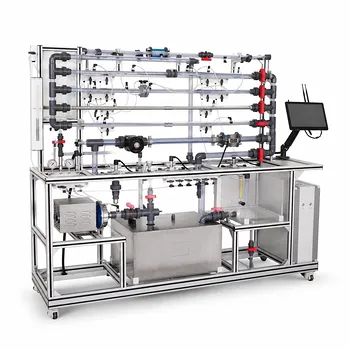
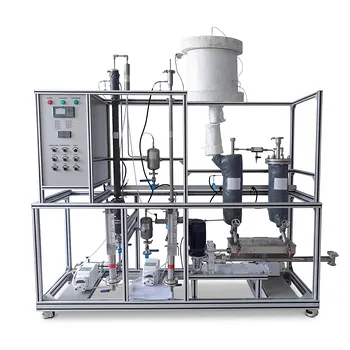
Online chemical price databases are a convenient starting point—but they can be dangerously misleading for pilot plant cost estimation. The prices you see on supplier websites almost always reflect small-batch, spot-sales for high-purity laboratory or pharmaceutical grades. To generate a realistic budget for a chemical engineering pilot plant, you must adjust these figures downward to approximate bulk industrial procurement, or—if your process genuinely demands that purity—explicitly account for the resulting premium in your operational costs.
The core challenge is that online databases show retail-level, high-grade chemical prices. A credible pilot plant estimate requires converting these to bulk commercial-scale costs, factoring in the real purity requirements of your process, and adding a contingency buffer for price volatility and supply chain uncertainties.
The Critical Gap Between Online List Prices and Pilot Plant Reality
Lab-Grade Prices Are Not Industrial Bulk Prices
The primary reference for any cost estimator must be reality: online supplier databases display what a researcher pays for a one-kilogram bottle of analytical-grade reagent. Industrial production buys the same molecule by the ton under long-term contracts, at a fraction of the unit price. Leaving online prices unadjusted can inflate your raw material cost projection by an order of magnitude, potentially killing a viable project at the feasibility stage.
Purity Premiums: When High-Grade Chemicals Are a Necessity
Not all pilot plants simulate commodity chemical production. If your process requires USP, cGMP, or ultra-high-purity materials, the lab-grade price you see online may actually be closer to the truth. However, you must still distinguish between spot purchases and the lower price achievable through even a modest repeat order commitment. The key is to consciously choose whether your estimate reflects a high-purity premium or a scaled-down bulk price—never mix the two unconsciously.
Accounting for Price Volatility and Budget Contingencies
The Hidden Cost of Price Fluctuations
Chemical prices are not static. Databases offer a snapshot, but raw materials like catalysts, specialty metals, or intermediates can see significant swings over the weeks or months of a pilot campaign. Supplementary costing standards for pilot plants explicitly advise including a contingency reserve—as high as 50% for technically uncertain, highly customized projects—to absorb these shifts. When you pull a price from an online source, add a volatility buffer that reflects the material’s historical instability.
Location Factors in a Global Supply Chain
Online databases may quote prices ex-works from a baseline region, like the US Gulf Coast. If you are sourcing chemicals internationally for your pilot plant, you must apply a location factor. A locally sourced material from a region with lower manufacturing costs could carry a factor as low as 0.6, while importing the same chemical to a high-cost location might push the factor to 1.26. Tariffs, freight, and import duties can make the landed cost deviate sharply from the database headline number.
Understanding the Trade-offs
The Risk of Crippling Overestimation
Deflating an online price too aggressively or blindly applying a “bulk discount” can strip away genuine cost drivers. A mismatch between assumed and actual purity could lead to unexpected quality failures during the pilot run, requiring expensive rework or a second material purchase. The cost of a failure often outweighs the initial savings.
The Danger of Budget-Blowing Underestimation
Conversely, ignoring the need to deflate or using the online price as-is for a commodity-grade scale-up creates a fantasy budget. The resulting economic analysis will look hopelessly uncompetitive, and if the estimate is used to secure funding, the operational budget will be exhausted before the pilot campaign concludes. This often forces mid-run design compromises that invalidate the scale-up data.
How to Build a Defensible Estimate for Your Pilot Plant
Every pilot plant has a unique risk profile. Use these goal-based guidelines to turn an online price into a budget-ready number.
- If your primary focus is early-stage economic feasibility: Start with the online price, then apply an industry-standard deflation factor for bulk procurement. Validate the factor with at least one direct inquiry to a distributor or toll manufacturer.
- If your primary focus is a high-purity, specialty chemical process: Retain a significant portion of the online lab-grade premium. Secure volume-discount quotes even at the pilot scale and budget for the higher cost of qualification batches.
- If your primary focus is international or multi-regional sourcing: Apply validated location factors to every line item. Build a small currency hedge or a contingency line (10–20%) to cover exchange rate movements between the database snapshot and your purchase order.
- If your primary focus is a highly novel, technically uncertain catalyst or reagent: Use the highest plausible unit cost from the database and protect the budget with a customized contingency near 50%. The price of a critical material that fails to perform is the cost of the pilot itself.
A credible pilot plant starts not with a single number, but with a consciously chosen pricing philosophy that bridges the gap between an online listing and industrial reality.
Summary Table:
| Cost Factor | Database Limitation | Recommended Adjustment |
|---|---|---|
| Scale & Volume | Displays retail, lab-grade prices | Apply bulk deflation factor |
| Purity Grade | Lacks distinction for USP/cGMP | Match process purity specs |
| Price Volatility | Static price snapshots | Add 10% to 50% contingency buffer |
| Location & Logistics | Ex-works baseline pricing | Apply location & shipping factors |
Optimize Your Scale-Up with LABPARK's Custom Pilot Plants
Accurate cost estimation is just the first step in a successful pilot campaign. LABPARK designs and manufactures state-of-the-art Educational and Vocational Unit Operations Pilot Plants tailored for universities, research institutes, and enterprises. Whether you specialize in chemical engineering, bioprocess & biotech, or environmental & water treatment, our pilot plants are engineered to deliver reliable, scalable data to minimize your operational risks.
Ready to take your process from the lab to commercial scale? Contact LABPARK today to discuss your pilot plant requirements with our engineering experts!
Related Products
- Fixed Bed Gas Solid Catalytic Reaction Educational Pilot Plant
- Carbon Dioxide Hydrogen Methanol Synthesis Educational Unit Operations Pilot Plant
- Ethyl Acetate Synthesis Unit Operations Pilot Plant for Practical Training
- Natural Product Extraction Unit Operations Training Pilot Plant
- Green Anhydrous Ethanol Refining Practical Training Pilot Plant
People Also Ask
- How do reactor pilot plants safely study gas-solid reactions? Master kinetics with thermal & flow control.
- How does the Mears criterion evaluate transport resistance? Key Guide to Intrinsic Kinetics
- Fluidized vs. Fixed Bed Reactors: Comparing Heat & Complexity in Pilot Plants
- Why is a multibed configuration necessary for exothermic reactions? Optimize your pilot plant trajectory.
- What are the differences between pseudohomogeneous and heterogeneous models in pilot plants?