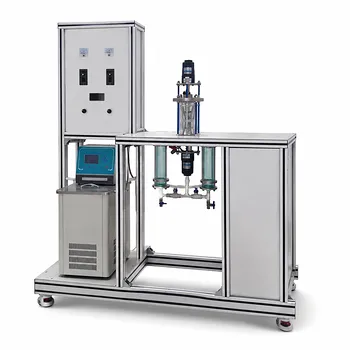
Model selection for liquid-liquid extraction hinges on one unassailable truth: you must choose an activity coefficient model that explicitly captures phase splitting—typically NRTL or UNIQUAC—and then rigorously validate its predictions against multicomponent pilot-plant extraction data. Static simulations, no matter how sophisticated, are blind without the real distribution coefficients your pilot unit provides.
The core of reliable LLE modeling isn’t finding a mythical “perfect” equation; it’s the discipline of forcing your chosen model to confront physical reality. Use NRTL or UNIQUAC as your foundation, estimate parameters with UNIFAC only as a temporary crutch, and then lock in accuracy by regressing and confirming those parameters against pilot-plant tie-lines before you ever attempt scale-up.
Why Model Selection Is Critical for LLE
The Sensitivity of LLE Predictions
Liquid-liquid equilibrium calculations are extraordinarily sensitive. A tiny error in a binary interaction parameter can flip a prediction from complete miscibility to a sharp phase split—turning a designed extraction column into either an empty shell or an emulsified disaster. You cannot afford a model that is merely “good enough” for VLE.
The Danger of VLE-Only Parameter Fitting
Most default databank parameters come from vapor-liquid equilibrium regressions. Those parameters carry zero information about mutual solubility limits. Using VLE-only values to predict LLE is a fundamental mismatch that almost guarantees large errors in distribution coefficients and required stage counts.
Selecting the Right Thermodynamic Framework
The Activity Coefficient Approach for Liquid Phases
For the liquid-liquid mixtures at the heart of extraction, equations of state alone are rarely sufficient. Local-composition activity coefficient models—specifically NRTL and UNIQUAC—explicitly model excess Gibbs energy, enabling them to predict both phase compositions and the existence of a miscibility gap. The Wilson equation, while excellent for homogenous mixtures, cannot predict liquid-phase splitting in its standard form and must be strictly avoided.
Using UNIFAC When Data Is Scarce
When no mixture-specific data exists, the UNIFAC group contribution method provides a first estimate by summing contributions from molecular fragments. This is invaluable for initial solvent screening. However, treat any UNIFAC prediction as a placeholder; its parameter table cannot capture the subtle non-idealities of your real multicomponent system.
Handling Complex Systems with a Multi-Equation Approach
When your extraction system also involves a vapor phase (e.g., solvent evaporation into headspace), a combined framework can improve fidelity. Use a modified Redlich-Kwong equation of state for the vapor and a local-composition activity model like NRTL for the liquid phase. Even for purely liquid systems, this principle underlines the need to match the model family to the dominant molecular interactions—polar and associating mixtures demand local-composition logic.
The Pilot Plant as a Validation Engine
Generating Ground-Truth Multicomponent LLE Data
Your pilot plant’s most vital product is real distribution coefficients. By operating the unit at steady state and sampling both the extract and raffinate phases, you measure exactly how each component partitions under actual hydrodynamic and mass-transfer conditions. This experimental snapshot is the ultimate reference against which any thermodynamic model must be judged.
Iterative Parameter Regression from Binary to Multicomponent
Validation is a staged regression process. Start by measuring binary LLE data for the key solvent-solute pairs and fitting the NRTL or UNIQUAC parameters. Then, run the pilot plant to collect ternary or multicomponent tie-lines, and fine-tune those parameters until the simulated extract and raffinate compositions match the pilot measurements. This two-step protocol—binary anchoring followed by multicomponent optimization—eliminates the guesswork that plagues purely predictive approaches.
Common Pitfalls and Trade-offs
The Lure of Software Defaults
Commercial simulators ship with vast databases. Relying on built-in, unvalidated binary coefficients for your LLE problem is the single most frequent cause of model failure. These defaults are often regressed from VLE data or cover temperature ranges unrelated to your process. Treat every default LLE prediction as suspect until proven by your own pilot data.
Overlooking the Cost of Skipping Validation
Skipping pilot-plant validation may appear to save weeks in a project schedule, but it magnifies the risk of a full-scale column that misses purity or recovery targets. The financial and safety fallout from a failed scale-up is orders of magnitude larger than the modest effort of generating a few experimental tie-lines.
Model Complexity vs. Data Availability
NRTL is the pragmatic workhorse. Its non-randomness parameter gives you an extra degree of freedom to capture liquid-phase splitting without demanding an overwhelming amount of data. UNIQUAC is theoretically more rigorous for highly non-ideal, multi-component systems, but it requires more pure-component structural parameters and a richer experimental dataset to regress reliably. Choose NRTL when you have limited binary data; invest in UNIQUAC only when you can generate the dense multicomponent measurements needed to exploit its full theoretical strength.
Making the Right Choice for Your Research Goal
Align your selection and validation strategy with your specific objective:
- If your primary focus is early-stage solvent screening: Use UNIFAC to narrow the candidate list, then immediately run simple pilot extraction tests to verify selectivity and capacity before committing to a model.
- If your primary focus is precise process scale-up: Invest in generating binary and multicomponent LLE pilot data. Regress your NRTL or UNIQUAC parameters from that data, and confirm the model by comparing its predictions against a set of hold-out pilot runs.
- If your system is highly polar, associating, or prone to slow settling: Favor NRTL with a carefully fitted non-randomness parameter. Its simple yet flexible framework reliably captures complex liquid-phase behavior while giving you a tunable handle to match experimental limits.
- If you are data-poor and pilot runs are delayed: Rely on UNIFAC only for feasibility estimates, flag all results as high-risk, and plan a targeted campaign to collect the absolute minimum binary LLE data needed for a preliminary NRTL correlation.
Your model provides the blueprint; your pilot-plant data provides the proof. Validate relentlessly, and your extraction design will scale with confidence.
Summary Table:
| Model | Best For | Key Advantage | Limitation |
|---|---|---|---|
| NRTL | Polar & associating mixtures | Highly flexible, reliable LLE prediction | Needs binary interaction parameters |
| UNIQUAC | Complex multicomponent systems | Theoretically rigorous | Requires rich experimental dataset |
| UNIFAC | Early-stage solvent screening | Predictive, needs no initial mixture data | Low accuracy for complex interactions |
| Wilson | Homogeneous mixtures (VLE) | Excellent VLE correlation | Cannot predict phase splitting; avoid for LLE |
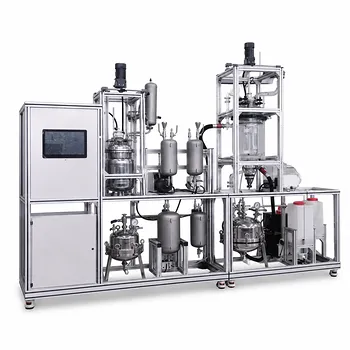
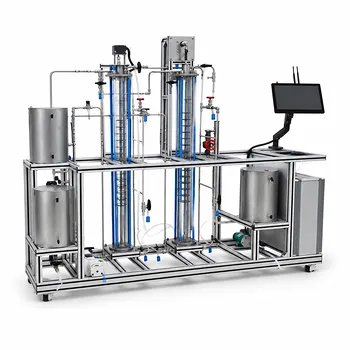
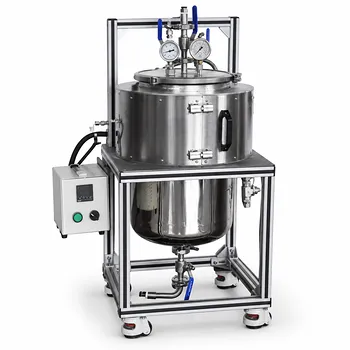
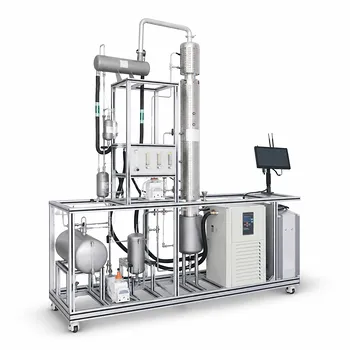
Ready to scale up your processes with precision? LABPARK provides advanced Educational and Vocational Unit Operations Pilot Plants in chemical engineering, bioprocess & biotech, and environmental & water treatment. Designed to meet the rigorous demands of universities, research institutes, and enterprises, our pilot plants ensure reliable LLE data collection and model validation.
Contact LABPARK today to find the perfect pilot plant for your research!
Related Products
- Gallium and Indium Selective Extraction Educational Pilot Plant
- Comprehensive Liquid-Liquid Extraction Pilot Plant for Engineering Education
- Natural Product Extraction Unit Operations Training Pilot Plant
- Multi-Reactor Educational Pilot Plant for Reaction Engineering Unit Operations
- Hot Filtration Educational Unit Operations Pilot Plant Laboratory System
People Also Ask
- How do pilot plants differentiate physical vs chemical extraction? Enhance Chemical Engineering Training
- What is the significance of the isopycnic line in liquid-liquid extraction? Avoid Column Flooding
- Why is predicting multicomponent LLE from binary data more challenging than VLE? Master your pilot plant design.
- How do droplet motion states affect kD in extraction pilot plants? Optimize Mass Transfer
- How to Validate BIPs for LLE Pilot Plants? Steps to Align Simulations with Reality