Knowledge Chemical Engineering Education How do droplet motion states affect kD in extraction pilot plants? Optimize Mass Transfer
Author avatar

Tech Team · LABPARK

Updated 1 month ago

How do droplet motion states affect kD in extraction pilot plants? Optimize Mass Transfer


The motion state of a droplet—whether it behaves as a rigid sphere or develops internal circulation—dictates the dispersed-phase mass transfer coefficient ((k_D)) by switching the transfer mechanism from pure molecular diffusion to convection-enhanced transport. In extraction pilot plants, small, highly viscous droplets at low Reynolds numbers ((Re < 1)) act as rigid spheres, giving the lowest (k_D) determined solely by molecular diffusion. With moderate droplet sizes ((10 < Re \leq 50)), laminar internal circulation boosts (k_D) by roughly 2.7 times. When droplets become large and unstable ((Re \ge 80)), turbulent internal mixing makes (k_D) independent of molecular diffusion and instead controlled by droplet velocity and phase viscosities, yielding the highest mass transfer rates.

The real value in a pilot plant is not just seeing these states, but learning to trigger them deliberately. A droplet’s internal motion can increase its dispersed-phase mass transfer coefficient by a factor of many, making the transition from rigid to circulating flow one of the most powerful levers for optimizing extraction efficiency.

How Droplet Motion Dictates (k_D)

The dispersed-phase mass transfer coefficient is not fixed—it jumps across three distinct hydrodynamic regimes as the droplet Reynolds number changes. In a pilot-scale extraction column or mixer, operators can move droplets from one state to another simply by altering flow velocities or agitation intensity.

The Rigid Droplet: Molecular Diffusion Only ((Re < 1))

When droplets are very small or the dispersed phase is highly viscous, internal motion is completely suppressed. They behave like solid spheres, and solute transfer occurs entirely by molecular diffusion across the stagnant interior.

The mass transfer coefficient in this state is derived from Fick’s second law and takes the form
(k_D = \frac{2\pi^2 D_D}{3 d_p}),
where (D_D) is the molecular diffusivity and (d_p) is the droplet diameter. This yields the lowest possible (k_D) for a given droplet size.

Laminar Internal Circulation: The Krong-Brink Boost ((10 < Re \leq 50))

At intermediate droplet sizes and moderate shear, the external flow induces a toroidal circulation pattern inside the droplet. This laminar circulation continuously brings fresh solute to the interface, sharply accelerating mass transfer.

According to the Krong-Brink model, this internal motion increases (k_D) by approximately 2.7 times relative to a rigid droplet of the same size. In a pilot plant, a 2.7-fold enhancement can turn a borderline extraction into an economically viable process.

Turbulent Internal Circulation: The Handlos-Baron Regime ((Re \ge 80))

Large, fast-moving droplets begin to oscillate and develop chaotic internal eddies. In this fully turbulent state, the molecular diffusivity (D_D) no longer governs the transport—solute is swept through the interior much faster by convective currents.

The Handlos-Baron model shows that (k_D) becomes independent of (D_D) and is instead a function of droplet velocity, droplet diameter, and the viscosities of both phases. This regime can deliver an order-of-magnitude increase in (k_D) compared to the rigid case, making it a tempting target for pilot plant optimization.

Why These Transitions Matter in a Pilot Plant

Direct Control Through Agitation and Flow

A pilot plant is the ideal environment to explore these transitions. By adjusting rotor speed, phase flow ratios, or column internals, you can shift the average droplet Reynolds number across the rigid–laminar–turbulent boundary and observe the resulting step-changes in overall extraction efficiency.

Scaling With Knowledge, Not Guesswork

Knowing exactly which droplet regime you are operating in prevents costly scaling errors. A (k_D) measured under turbulent conditions at pilot scale will not scale linearly if the production column naturally operates in the laminar regime. Recognizing the state gives you a predictive handle on mass transfer performance.

Understanding the Trade-offs

While higher (k_D) is desirable, each droplet state carries practical consequences that can undermine total extraction performance.

  • Rigid droplets give poor (k_D) but are sometimes unavoidable with heavy or viscous feeds. Compensating with longer residence time or increased interfacial area often becomes necessary.
  • Laminar circulation offers a robust, reproducible enhancement ((\sim)2.7×) without the extreme instability of turbulence. It is frequently the most predictable regime for pilot studies and scale-up.
  • Turbulent droplets dramatically raise (k_D), but they simultaneously increase the risk of droplet breakage, coalescence, and interfacial area loss. A higher coefficient multiplied by a smaller area can yield a net loss in mass transfer if not carefully managed.

Making the Right Choice for Your Pilot Plant Goal

Your target droplet state depends on whether you prioritize raw speed, scientific clarity, or system robustness.

  • If your primary focus is maximum extraction rate: Push droplets into the turbulent regime, but invest in real-time monitoring of droplet size distribution and phase separation to avoid losing the gains to coalescence.
  • If your primary focus is studying fundamental mass transfer or building a reliable model: Operate in the laminar circulation regime. The well-characterized 2.7× enhancement factor gives you a solid, reproducible basis for correlation development.
  • If your primary focus is handling high-viscosity dispersed phases: Accept that droplets may remain rigid. Compensate by increasing residence time, elevating temperature to raise diffusivity, or designing internals that promote early drop breakage to create finer dispersions.

By deliberately navigating these droplet motion states, pilot plant operators turn internal circulation from a hidden variable into a precisely controllable knob for extraction performance.

Summary Table:

Droplet Motion State Reynolds Number (Re) Primary Transfer Mechanism kD Performance Impact
Rigid $Re < 1$ Pure molecular diffusion Lowest (baseline, limited by diffusivity)
Laminar $10 < Re \le 50$ Internal circulation (convection) ~2.7x boost compared to rigid
Turbulent $Re \ge 80$ Chaotic internal mixing / eddies Highest (independent of molecular diffusivity)

Optimize Your Extraction Processes with LABPARK

Are you looking to master droplet dynamics and scale up your extraction processes with precision? LABPARK provides state-of-the-art Educational and Vocational Unit Operations Pilot Plants in chemical engineering, bioprocess & biotech, and environmental & water treatment.

Tailored for universities, research institutes, and enterprises, our pilot plants allow you to control hydrodynamic variables and optimize mass transfer coefficients in real-world scenarios.

Contact LABPARK today to find the perfect pilot plant solution for your lab or training facility!

Related Products

People Also Ask

Related Products

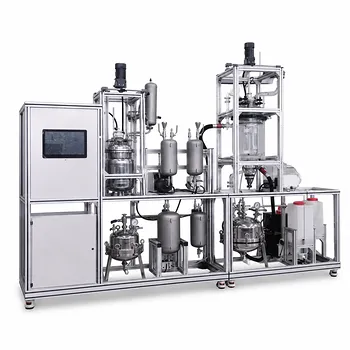
Natural Product Extraction Unit Operations Training Pilot Plant

Natural Product Extraction Unit Operations Training Pilot Plant

Integrated natural product extraction pilot plant for chemical engineering training bridges theory and industrial practice with modular extraction and evaporation/concentration units, hybrid touchscreen and manual control, realistic process simulation, and self-contained softened water and vacuum utilities.

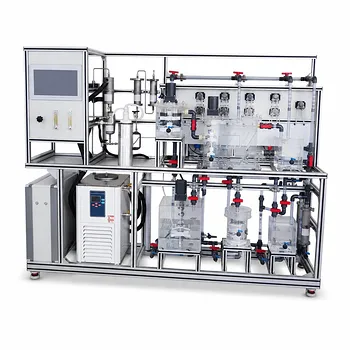
Gallium and Indium Selective Extraction Educational Pilot Plant

Gallium and Indium Selective Extraction Educational Pilot Plant

Integrated pilot-scale laboratory system for engineering education bridging theoretical concepts with industrial practice enabling hands-on study of liquid liquid extraction reaction kinetics and mass transfer for selective gallium and indium separation featuring real-time IoT connectivity with integrated safety

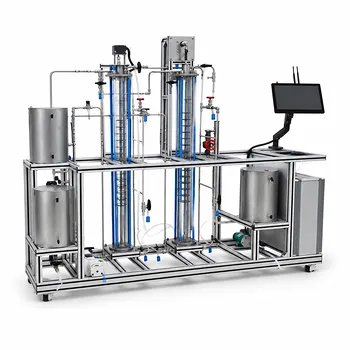
Comprehensive Liquid-Liquid Extraction Pilot Plant for Engineering Education

Comprehensive Liquid-Liquid Extraction Pilot Plant for Engineering Education

Comprehensive liquid-liquid extraction pilot plant for engineering education, integrating rotary and vibratory columns for hands-on observation of phase behavior, flooding limits, and mass transfer efficiency, enabling precise HTU and mass transfer coefficient calculations.

Continuous Batch Extractive Distillation Educational Pilot Plant

Continuous Batch Extractive Distillation Educational Pilot Plant

Versatile pilot plant for continuous, batch, and extractive distillation training. High-borosilicate glass column for visualizing hydraulics, 15.6-inch touchscreen with data logging, precise reflux ratio control 1-99, and durable corrosion-resistant frame. Ideal for chemical engineering education and process research.

Green Anhydrous Ethanol Purification Extractive Distillation Unit Operations Training Pilot Plant

Green Anhydrous Ethanol Purification Extractive Distillation Unit Operations Training Pilot Plant

Modular pilot plant produces high-purity anhydrous ethanol from crude ethanol via extractive distillation in a zero-emission closed-loop process providing hands-on training in unit operations with PLC-based control SCADA software and digitalized process management focusing on green engineering principles

Green Anhydrous Ethanol Refining Practical Training Pilot Plant

Green Anhydrous Ethanol Refining Practical Training Pilot Plant

Advanced integrated pilot plant for university labs demonstrating extractive distillation to produce high-purity absolute ethanol from crude feedstock, featuring multi-column continuous operation, closed-loop solvent recycling, and customizable controls for hands-on engineering education, ideal for chemical engineering training and research.

Multi-Functional Special Distillation Educational Pilot Plant

Multi-Functional Special Distillation Educational Pilot Plant

Versatile multi-functional special distillation pilot plant for chemical engineering education. Supports continuous, vacuum, azeotropic, reactive, extractive distillation. Transparent glass columns enable real-time visual observation of hydrodynamics and separation processes.

Electrolyte Distillation Purification and Formulation Educational Pilot Plant

Electrolyte Distillation Purification and Formulation Educational Pilot Plant

Integrated bench-to-pilot scale educational pilot plant for electrolyte distillation, purification, and formulation with borosilicate glass construction, PLC automation, touchscreen HMI, and advanced industrial safety features for hands-on chemical process training, ideal for chemical engineering and materials science curricula.

Bio-fermentation Ethanol Production Practical Training Unit Operations Pilot Plant

Bio-fermentation Ethanol Production Practical Training Unit Operations Pilot Plant

Bio-fermentation ethanol production pilot plant for hands-on training in unit operations: fermentation, solid-liquid filtration, membrane separation, and distillation. Bridges theory with industrial practice using industrial-grade components, customizable for university labs. Hybrid automated and manual control for comprehensive learning.

Ethyl Acetate Synthesis Unit Operations Pilot Plant for Practical Training

Ethyl Acetate Synthesis Unit Operations Pilot Plant for Practical Training

Modular and customizable pilot plant for ethyl acetate synthesis practical training. Integrates esterification reaction, liquid-liquid extraction, neutralization, and sieve-plate distillation unit operations. Bridging theory and real-world industrial processes. Designed for university chemical engineering labs

100L Continuous Loop Hydrogenation Educational Unit Operations Pilot Plant

100L Continuous Loop Hydrogenation Educational Unit Operations Pilot Plant

This 100L continuous loop hydrogenation pilot plant is designed for chemical engineering education, featuring 316 stainless steel construction, advanced gas-liquid mass transfer components, explosion-proof safety systems, and a 15.6-inch touchscreen with 5G connectivity, cloud data logging, bridging theory and industry.

Fixed-Bed Chemical Reaction and Gas Dust Tar Removal Unit Operations Pilot Plant

Fixed-Bed Chemical Reaction and Gas Dust Tar Removal Unit Operations Pilot Plant

Integrated educational pilot plant for studying catalytic gas-solid reactions and downstream gas purification. Features dual fixed-bed reactor, three-stage heating, and touchscreen control for hands-on engineering training. Ideal for chemical and environmental engineering curricula.

Electrolytic Hydrogen Production Educational Unit Operations Pilot Plant

Electrolytic Hydrogen Production Educational Unit Operations Pilot Plant

Bench-scale electrolytic hydrogen production pilot plant designed for university engineering labs. Provides hands-on training in water electrolysis, gas-liquid separation, and process safety. Fully customizable system with digital PID control, corrosion-resistant components, and hydrogen gas detector. Ideal for chemical engineering curricula.

Methanol Synthesis and Catalyst Performance Evaluation Educational Unit Operations Pilot Plant

Methanol Synthesis and Catalyst Performance Evaluation Educational Unit Operations Pilot Plant

Bench-scale methanol synthesis and catalyst evaluation educational pilot plant for chemical engineering labs to study catalytic kinetics, high-pressure operations, process control, and unit operations under realistic conditions with industrial safety features, precision gas delivery, data acquisition, and intelligent monitoring.

Thermal Desorption Exhaust Gas and Tail Water Treatment Educational Pilot Plant

Thermal Desorption Exhaust Gas and Tail Water Treatment Educational Pilot Plant

Bench-scale educational pilot plant for treating thermal desorption exhaust gas and tail water integrates condensation, Fenton oxidation, precipitation, filtration, and carbon adsorption. Ideal for chemical engineering and environmental labs, teaching unit operations, process control, and real-time data analysis.

Rising and Falling Film Evaporation Educational Unit Operations Pilot Plant

Rising and Falling Film Evaporation Educational Unit Operations Pilot Plant

Hands-on educational pilot plant for studying rising and falling film evaporation, flow regimes, and heat transfer. Customizable for university labs with industrial instrumentation and data acquisition. Enables comparative evaluation of evaporation modes and energy efficiency.

Supercritical High-Gravity Flash Evaporation Educational Unit Operations Pilot Plant

Supercritical High-Gravity Flash Evaporation Educational Unit Operations Pilot Plant

Bench-scale integrated teaching system for advanced separation and mass transfer, combining supercritical high-gravity flash evaporation with heating, chemical reaction, and material collection, featuring modular design, Stainless Steel 316L construction, transparent visualization, touchscreen control, and safety systems for chemical engineering education.

Multi Functional Membrane Crystallization Educational Unit Operations Pilot Plant

Multi Functional Membrane Crystallization Educational Unit Operations Pilot Plant

Integrated bench-scale membrane crystallization pilot plant for engineering education. Provides hands-on training in advanced separation technologies, combining membrane distillation crystallization and process intensification. Features variable scaling vessels, industrial-grade flow control, and interactive digital data acquisition. Customizable for university labs.

Educational Unit Operations Pilot Plant for Intraparticle Diffusion Effective Factor Measurement

Educational Unit Operations Pilot Plant for Intraparticle Diffusion Effective Factor Measurement

Designed for chemical engineering university labs, this pilot plant allows hands-on determination of catalyst particle intraparticle diffusion effective factors and gas-solid reaction kinetics using a fixed-bed tubular reactor with industrial touchscreen control, bridging theory and practical reactor design.

Multi-Reactor Educational Pilot Plant for Reaction Engineering Unit Operations

Multi-Reactor Educational Pilot Plant for Reaction Engineering Unit Operations

Integrated bench-scale educational pilot plant for chemical engineering teaching featuring fixed bed fluidized bed and stirred tank reactors with web-based digital twin controls and safety interlocks for hands-on unit operations and reaction engineering comparative studies in one compact system.


Leave Your Message