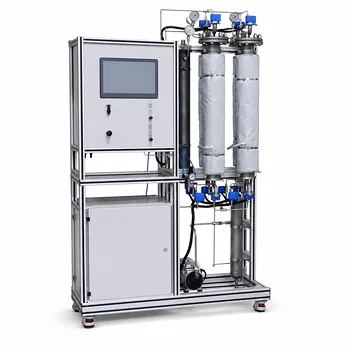
How to confidently select the right thermodynamic model: The standard Redlich-Kwong equation of state fails for your carbon dioxide-water absorption pilot plant because it fundamentally cannot describe the behavior of polar molecules like water, leading to gross inaccuracies in solubility predictions. For reliable design and evaluation of your experiments, the recommended model is the Modified Van der Waals (M-VDW) equation, as it is specifically designed to handle polar components with the accuracy required for mass and energy balance calculations.
Before diving into the specific equations, the core issue is that not all equations of state are created equal—their underlying assumptions dictate their realm of validity. The central challenge in your CO2-water system is the highly polar nature of water, which breaks the core assumptions of simple models like the standard Redlich-Kwong equation. The recommended M-VDW model solves this by making its parameters a function of temperature, allowing it to accurately capture the behavior of polar substances and provide the reliable phase equilibrium data essential for your pilot plant.
Why the Standard Redlich-Kwong Equation Isn't Enough
The standard Redlich-Kwong (RK) equation is a foundational tool, but it has a critical blind spot that makes it unsuitable for your specific system. Understanding this limitation is key to grasping why a more advanced model is not just an academic preference, but a practical necessity.
The Fundamental Limitation: Handling Polarity
The RK equation has a built-in volume-dependence that works exceptionally well for non-polar molecules, where interactions are primarily governed by simple dispersion forces.
However, it fails catastrophically when applied to polar molecules like water. The model's simple structure cannot account for the strong, orientation-dependent forces like hydrogen bonding that dictate water's behavior. This isn't a minor error—it's a fundamental mismatch between the model's physics and the actual molecular physics of your system.
A Quantifiable Error in Your System
This theoretical limitation translates directly into a practical, quantifiable error in a CO2-water absorption pilot plant. For instance, when predicting the crucial design parameter of water solubility in dense-phase CO2, the standard RK equation can produce an error of up to a factor of eight at liquid-liquid saturation conditions.
An 8x error in solubility prediction makes the model completely useless for evaluating column efficiency, calculating mass transfer rates, or closing a mass balance. Any experimental data analyzed with this model would yield incorrect and misleading conclusions.
The Recommended Solution: The M-VDW Equation
To overcome this critical limitation and obtain reliable data from your pilot plant, the Modified Van der Waals (M-VDW) equation is the recommended choice. It represents a targeted upgrade designed specifically to address the weaknesses of simpler models.
How M-VDW Solves the Polarity Problem
The innovation of the M-VDW equation lies in its temperature-dependent parameters. While standard equations use constant parameters, M-VDW allows its attraction parameter and co-volume parameter to change with temperature.
This simple but powerful modification gives the equation the flexibility needed to mimic the effective interactions of polar molecules under different conditions. The result is an accuracy in predicting the properties of polar components that becomes comparable to what standard equations achieve for non-polar compounds. For your pilot plant, this means generating reliable vapor-liquid and liquid-liquid equilibrium data, which is the absolute bedrock of any separation process analysis.
Practical Implications for Pilot Plant Operation
For your pilot plant runs, using the M-VDW model translates directly into experimental integrity. It provides the correct equilibrium compositions, allowing you to accurately determine your column's efficiency through methods like the McCabe-Thiele analysis.
Furthermore, reliable equilibrium data makes it possible to close your component and overall mass balances with confidence. Without this, you cannot distinguish between experimental error and a fundamental misunderstanding of the process.
Understanding the Trade-offs
While the M-VDW model resolves the primary issue of polarity, an expert approach requires being aware of its place within the broader landscape of thermodynamic models and other potential pitfalls.
When Simplicity Isn't the Answer
For an educational pilot plant, it's tempting to use a simple model to teach fundamental principles. While deceptively simple models like standard RK are computationally easy, their use with a polar system like CO2-water would be deeply misleading.
The massive errors would obscure the real thermodynamic principles you're trying to demonstrate, making the experimental data worthless. A more complex model, like M-VDW, is actually the simpler choice in this context because it reflects reality, enabling meaningful learning about separation processes.
The Complexity-Speed vs. Accuracy Spectrum
You could theoretically consider even more complex models, such as the Bender equation with its 20 constants. These offer highly accurate representations of physical properties over wide ranges. However, they are generally restricted to small, non-polar molecules without hydrogen bonding and require extensive experimental data to tune.
The M-VDW model sits in a practical sweet spot. It provides the necessary accuracy for a key polar system without the extreme complexity and narrow applicability of models like Bender, offering a balanced tool for reliable pilot plant work.
The Critical Caveat: Parameter Tuning is Everything
For any advanced model dealing with polar mixtures, a crucial lesson is that the quality of the output depends entirely on the quality of the input parameters. Standard cubic equations of state can model water-containing systems, but their success hinges on using properly optimized binary interaction parameters regressed from experimental data.
If you were to use a model like Peng-Robinson with a "default" interaction parameter for CO2-water, the simulation could just as easily fail to predict complex phase behaviors like three-phase equilibria. This highlights that the physical pilot plant experiment is the ultimate arbiter; its data is often used to tune and validate the thermodynamic software models themselves.
Making the Right Choice for Your Pilot Plant Goal
To translate this analysis into a specific action plan, base your modeling choice on the primary goal of your pilot plant exercise.
- If your primary focus is designing and evaluating a CO2-water absorption column: Implement the Modified Van der Waals (M-VDW) equation. It directly addresses the polarity issue, providing the phase equilibrium accuracy you need for reliable efficiency calculations and mass balance closure.
- If your primary focus is teaching the impact of thermodynamic model selection: Run a comparative study. Simulate your process with standard Redlich-Kwong, a complex model like Peng-Robinson with default parameters, and the recommended M-VDW equation to vividly illustrate how model choice creates massive discrepancies in predicted separation performance for polar systems.
- If your primary focus is modeling a liquid-liquid extraction or a three-phase system: Look beyond standard cubic equations entirely. In such cases, an activity coefficient model like the Non-Random Two-Liquid (NRTL) equation is likely required, as it is specifically formulated to predict liquid-phase immiscibility, a feature many equations of state lack.
The choice of a thermodynamic model is not merely a software setting; it is the foundational assumption upon which your entire experimental interpretation is built.
Summary Table:
| Thermodynamic Model | Polar Molecule Handling | CO2-Water Solubility Accuracy | Best Use Case |
|---|---|---|---|
| Standard Redlich-Kwong (RK) | Poor (cannot account for hydrogen bonding) | Low (up to 8x error at saturation) | Simple, non-polar gas mixtures |
| Modified Van der Waals (M-VDW) | Good (uses temperature-dependent parameters) | High (accurate VLE/LLE data) | Polar systems like CO2-water absorption |
| Activity Coefficient Models (NRTL) | Excellent (for liquid phases) | High (captures phase immiscibility) | Liquid-liquid extraction & 3-phase systems |
Bring Precision to Your Chemical Engineering Labs with LABPARK
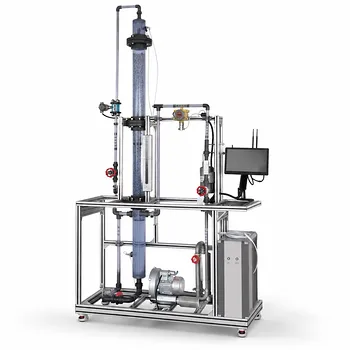
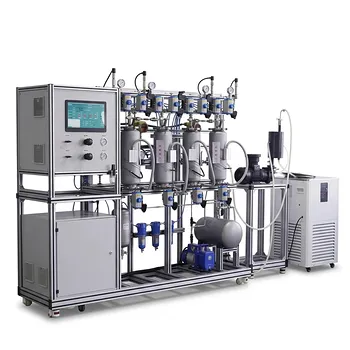
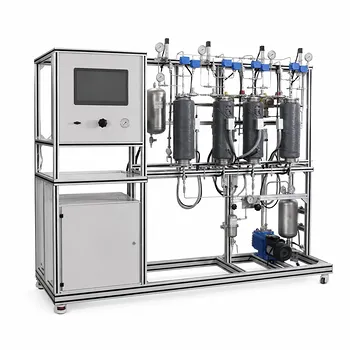
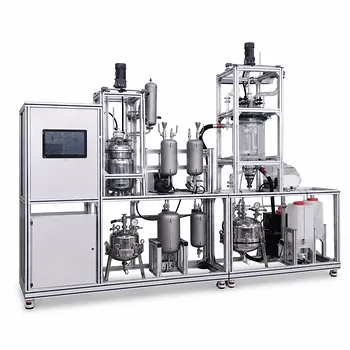
Accurate thermodynamic modeling is only half the battle—reliable experimental validation requires robust physical systems. LABPARK provides state-of-the-art Educational and Vocational Unit Operations Pilot Plants in chemical engineering, bioprocess & biotech, and environmental & water treatment.
Specially designed for universities, research institutes, and enterprises, our pilot plants enable students and researchers to safely study gas-liquid absorption, phase equilibria, and mass transfer with industrial-grade accuracy.
Ready to elevate your engineering curriculum or research capabilities? Contact LABPARK today to discuss your custom pilot plant requirements!
Related Products
- Packed Bed Absorption Educational Unit Operations Pilot Plant
- Dual-Mode Gas Absorption and Desorption Unit Operations Training Pilot Plant
- Absorption and Desorption Educational Unit Operations Pilot Plant
- Carbon Dioxide Absorption and Desorption Educational Pilot Plant for Carbon Capture Studies
- Multi-Component Gas Pressure Swing Adsorption Pilot Plant for Unit Operations Education
People Also Ask
- How Do Flow Regimes Transition in Packed Bed Pilot Plants? Key Scale-up Insights
- How does reactant concentration determine absorption column control? Gas-film vs. dual-film.
- How is the packing height of an absorption column calculated? Master HTU & NTU Concepts
- How does the wall effect impact packed-bed conversion? Essential pilot plant scale-up tips.
- How does static vs. operating holdup affect pilot plant calibration? Avoid Critical Scale-Up Errors