Knowledge Chemical Engineering Education How does insulation thermal conductivity impact steam pipe thickness and heat loss? Optimize pilot plant design.
Author avatar

Tech Team · LABPARK

Updated 1 month ago

How does insulation thermal conductivity impact steam pipe thickness and heat loss? Optimize pilot plant design.


Thermal conductivity is the single most influential material property when determining how thick your insulation must be to prevent heat loss from a steam pipe. In a chemical engineering pilot plant, using an insulation material with a lower thermal conductivity directly allows you to achieve the same target heat loss with a significantly thinner layer. Conversely, for a fixed insulation thickness, a lower conductivity material will dramatically reduce the energy wasted to the surroundings—a critical factor for maintaining accurate energy balances and compact system layouts.

In steam piping insulation, a lower thermal conductivity translates to a thinner insulation layer for the same heat loss limit—or far lower heat loss for the same thickness. This direct relationship is the foundational lever for optimizing both thermal efficiency and spatial footprint in pilot-scale unit operations.

How Thermal Conductivity Dictates Insulation Thickness

The Governing Equation for Cylindrical Insulation

For a pipe, the steady‑state heat loss through the insulation follows a cylindrical form of Fourier’s law. The thermal resistance (R) of the insulation layer is (R = \frac{\ln(r_o/r_i)}{2\pi L\lambda}), where (\lambda) is the thermal conductivity, (r_o) the outer radius, (r_i) the inner radius, and (L) the pipe length.

To determine the required thickness, engineers first compute the combined convection and radiation heat transfer coefficient from the outer surface to the ambient air. The heat loss per unit length is set equal to the conductive heat transfer through the insulation. Solving for (r_o) (and thus the thickness (r_o - r_i)) directly reveals the impact of (\lambda). A lower (\lambda) produces a smaller required (r_o).

A Dramatic Real‑World Example

Consider a steam line where the design goal is to hold heat loss below a fixed threshold. If you choose an insulation with (\lambda = 0.12,\text{W/(m·°C)}), the calculated thickness might be 50 mm. However, selecting a material with a higher (\lambda = 0.3,\text{W/(m·°C)}) would force the thickness to balloon to 220 mm to meet the same limit. The relationship is non‑linear: doubling the thermal conductivity can more than quadruple the required thickness because of the logarithmic term.

Heat Loss Prevention: The Inverse Relationship

If you keep the insulation thickness constant, the heat loss (Q) is directly proportional to (\lambda). A material with half the thermal conductivity will cut the conductive heat loss in half. In pilot plant steam systems, this means superior heat retention and a smaller corrective term in the overall energy balance, ensuring process heat is directed where intended.

Practical Implications for Pilot Plant Steam Systems

Minimising Footprint and Equipment Clearances

Pilot plants often operate in tight quarters. Using low‑(\lambda) insulation—such as silica aerogels or fine fiberglass ( (\lambda < 0.2,\text{W/(m·°C)}) )—lets you shrink insulation thickness to a fraction of what traditional mineral wool would require. That saved radial space means closer pipe routing, easier maintenance access, and a smaller overall unit footprint without sacrificing thermal performance.

Ensuring Accurate Energy Balances

In research and teaching environments, the pilot plant is an instrument. Unaccounted heat loss distorts energy balance calculations and can mislead students or invalidate experimental conclusions. By selecting insulation with the lowest practical thermal conductivity, external heat losses become negligible. This ensures that the measured energy flows reflect the true internal process dynamics, as intended by the design.

Controlling Surface Temperature for Safety

Steam piping can create hot surfaces that pose burn risks. A low‑(\lambda) insulation layer allows the outer surface temperature to drop well below safe touch thresholds—often below 60°C—even with a relatively thin profile. The outer protective layer remains safe to touch, while the internal steam temperature stays high, which is a non‑negotiable requirement in any teaching or research laboratory.

Understanding the Trade-offs and Real‑World Considerations

Cost Must Be Balanced with Performance

Lower thermal conductivity materials, such as aerogel blankets or vacuum‑insulated panels, come at a higher purchase cost. For a sprawling pilot plant with ample space, a thicker layer of inexpensive fiberglass may be the most economical choice. For a compact, heavily instrumented skid, the premium for a space‑saving low‑(\lambda) material is often justified by easier layout and lower operational heat loss.

Temperature‑Dependent Thermal Conductivity Matters

The (\lambda) of many insulation materials changes with temperature. As solids heat up, their thermal conductivity can increase. For example, fibrous materials may exhibit a notable rise in (\lambda) between ambient conditions and steam‑system temperatures. Pilot plants that operate across a wide range of conditions must use the thermal conductivity value at the maximum service temperature when calculating thickness. Failing to do so can lead to undersized insulation and unexpected heat loss.

Multi‑Layer Systems Add Complexity

Steam piping often uses two or three layers: an inner high‑temperature‑resistant material, a low‑conductivity insulating core, and an outer weatherproof jacket. The overall thermal resistance is the sum of the individual layer resistances. The layer with the lowest (\lambda) will take the largest temperature drop, so placing the most effective insulator just beneath the jacket maximizes the overall performance. The order and compatibility of materials must be verified to avoid overheating or degradation of the outer layers.

Making the Right Choice for Your Steam Piping System

Your specific constraints will guide the final material selection. Use the following goal‑based lens:

  • If your primary focus is minimizing equipment footprint: Choose the lowest feasible thermal conductivity insulation, even at a higher unit cost, to keep the insulation profile thin and free up valuable pilot plant space.
  • If your primary focus is lifecycle cost optimization: Balance initial material expense against energy savings. In uncongested areas, use cost‑effective medium‑(\lambda) materials with thicker layers; reserve low‑(\lambda) products only for space‑critical or high‑temperature sections.
  • If your primary focus is educational accuracy and experimental reproducibility: Specify insulation with a well‑characterized, stable thermal conductivity at your operating temperatures. This ensures the heat loss term in your energy balance is predictable and consistently low.

By treating thermal conductivity as the central design variable, you can tailor your steam piping insulation to simultaneously satisfy the competing demands of a pilot plant—energy efficiency, safety, and spatial constraints.

Summary Table:

Insulation Material Thermal Conductivity (\lambda) Required Thickness Key Advantages & Applications
Silica Aerogel / Vacuum Panels Very Low ($<0.02$ W/m·°C) Ultra-thin Ideal for tight clearances, compact skids, and maximum heat retention.
Fine Fiberglass Low (~0.03 - 0.05 W/m·°C) Thin to Moderate Excellent balance of cost and performance for standard pilot piping.
Mineral Wool / Calcium Silicate Medium (~0.06 - 0.10 W/m·°C) Thick Cost-effective for spacious layouts; excellent high-temperature durability.

Optimize Your Unit Operations with LABPARK

Designing efficient, safe, and accurate pilot-scale systems requires precise thermal management. LABPARK provides state-of-the-art Educational and Vocational Unit Operations Pilot Plants in chemical engineering, bioprocess & biotech, and environmental & water treatment. Specifically tailored for universities, research institutes, and enterprises, our pilot plants ensure accurate energy balances, minimal heat loss, and maximum hands-on learning value.

Ready to elevate your research or teaching lab? Contact LABPARK today to discover our custom pilot plant solutions!

Related Products

People Also Ask

Related Products

Rising and Falling Film Evaporation Educational Unit Operations Pilot Plant

Rising and Falling Film Evaporation Educational Unit Operations Pilot Plant

Hands-on educational pilot plant for studying rising and falling film evaporation, flow regimes, and heat transfer. Customizable for university labs with industrial instrumentation and data acquisition. Enables comparative evaluation of evaporation modes and energy efficiency.

Bernoulli Equation Demonstration Unit Operations Pilot Plant

Bernoulli Equation Demonstration Unit Operations Pilot Plant

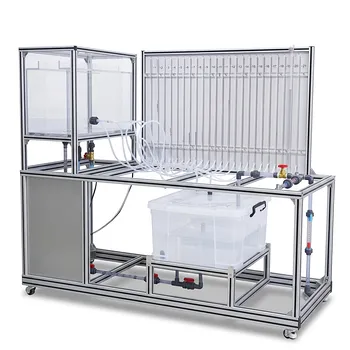
Laboratory pilot plant for Bernoulli's equation demonstration with transparent PVC pipes, 23 piezometer tubes for pressure measurement, and hands-on experiments. Designed for engineering education to study energy conservation, hydraulic grade line, and localized losses in fluid steady-flow systems.

Educational Compression Refrigeration Performance Determination Unit Operations Pilot Plant

Educational Compression Refrigeration Performance Determination Unit Operations Pilot Plant

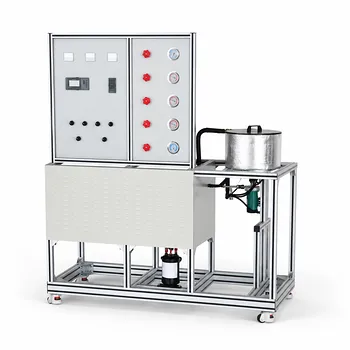
This educational pilot plant for compression refrigeration performance determination offers dual COP evaluation, regenerative cycle comparison, and calorimeter calibration. Customizable for curriculum integration, it features environmentally conscious design. Supports thermodynamic mapping on pressure-enthalpy diagrams and synchronous monitoring with centralized instrumentation.

Three-Tube Heat Transfer Educational Pilot Plant for Unit Operations Training

Three-Tube Heat Transfer Educational Pilot Plant for Unit Operations Training

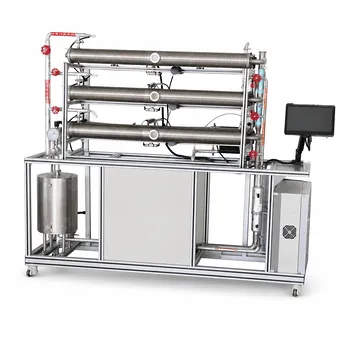
Three-tube heat transfer pilot plant for studying convective heat transfer enhancement and condensation. Allows comparison of smooth, corrugated, turbulent tubes, verifying empirical correlations. Ideal for chemical engineering education with safety and closed-loop steam recovery.

Chemical Pipeline Assembly and Fluid Transport Practical Training Unit Operations Pilot Plant

Chemical Pipeline Assembly and Fluid Transport Practical Training Unit Operations Pilot Plant

Integrated skid-mounted engineering training pilot plant for university labs offers hands-on experience in chemical pipeline assembly, fluid transport, centrifugal pump operation, and pressure testing. Customizable system bridges academic theory and industrial practice with digital pre-lab resources and comprehensive tools.

Solid Spherical Heat Transfer Coefficient Determination Educational Chemical Engineering Pilot Plant

Solid Spherical Heat Transfer Coefficient Determination Educational Chemical Engineering Pilot Plant

This educational chemical engineering pilot plant enables students to determine convective heat transfer coefficients and observe transient thermal behavior of solid spheres under natural convection, forced convection, fixed beds, and fluidized bed regimes.

Multi Pump Fluid Transport Process Piping Unit Operations Training Pilot Plant

Multi Pump Fluid Transport Process Piping Unit Operations Training Pilot Plant

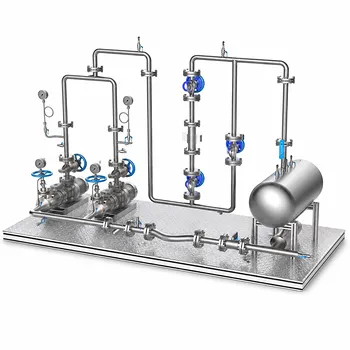
Industrial-scale multi-pump pilot plant for unit operations training in fluid transport and process piping, featuring real-material and semi-physical simulation modes, comprehensive pump and flowmeter calibration, and safety-enhanced two-tier platform, bridging academic theory and industrial practice for chemical engineering education.

Comprehensive Heat Transfer Coefficient Determination Educational Unit Operations Pilot Plant

Comprehensive Heat Transfer Coefficient Determination Educational Unit Operations Pilot Plant

Advanced industrial-grade educational pilot plant for comprehensive heat transfer coefficient determination. Enables quantitative convective heat transfer analysis, evaluates double-pipe and shell-and-tube exchanger configurations, and includes digital data acquisition. Customizable for engineering curriculum. Ideal for engineering unit operations labs.

Throttling Effect Determination Educational Unit Operations Pilot Plant

Throttling Effect Determination Educational Unit Operations Pilot Plant

Investigate the Joule-Thomson throttling effect with this educational unit operations pilot plant. Designed for engineering students, it enables hands-on comparative analysis of adiabatic gas expansion using precise process control, interactive digital interface, and eco-friendly operation, ensuring safe repeatable thermodynamic experiments.

Shell and Tube Heat Exchanger Heat Transfer Coefficient Determination Educational Pilot Plant

Shell and Tube Heat Exchanger Heat Transfer Coefficient Determination Educational Pilot Plant

LABPARK's shell and tube heat exchanger pilot plant enables students to investigate heat transfer coefficients, LMTD, co-current vs counter-current flow, bridging theory and industrial practice. Customizable for chemical, mechanical, environmental engineering curricula. Ideal for unit operations and process engineering labs.

Packed Bed Absorption Educational Unit Operations Pilot Plant

Packed Bed Absorption Educational Unit Operations Pilot Plant

Study gas-liquid absorption, pressure drop, flooding, and mass transfer coefficients with this pilot plant. Transparent packed column, industrial touchscreen, real-time sensor data, automated analysis. Investigate two-phase flow, loading points, column efficiency. Comprehensive data logging and assessment software included.

Hot Filtration Educational Unit Operations Pilot Plant Laboratory System

Hot Filtration Educational Unit Operations Pilot Plant Laboratory System

This integrated laboratory bench-scale hot filtration pilot plant enables students to study solid-liquid separation under thermal conditions, featuring a stainless steel vessel, removable heating jacket, and multi-layer filter plates for unit operations education, ideal for chemical engineering laboratory curriculum.

Fluid Transport and Piping Dynamics Practical Training Unit Operations Pilot Plant

Fluid Transport and Piping Dynamics Practical Training Unit Operations Pilot Plant

This industrial-scale fluid transport and piping dynamics training pilot plant provides essential hands-on experience with pump operations, cavitation, piping resistance, flow metering, and process control. Customizable to fit specific academic engineering curricula.

Centrifugal Pump Performance Determination Educational Unit Operations Pilot Plant

Centrifugal Pump Performance Determination Educational Unit Operations Pilot Plant

This lab system determines centrifugal pump performance curves for unit operations. Students configure dual pumps in series or parallel for hands-on learning. Includes industrial controls, clear piping, and data logging. Customizable for chemical, mechanical, and environmental engineering programs.

Orifice and Venturi Flowmeter Calibration Educational Pilot Plant for Fluid Mechanics Laboratory

Orifice and Venturi Flowmeter Calibration Educational Pilot Plant for Fluid Mechanics Laboratory

Enhance fluid dynamics education with the Orifice and Venturi Flowmeter Calibration Educational Unit Operations Pilot Plant, featuring transparent orifice and Venturi meters, industrial sensors, touchscreen interface for real-time data analysis and automatic coefficient calculations in engineering student laboratories.

Centrifugal Pump Performance and Orifice Flowmeter Calibration Educational Pilot Plant

Centrifugal Pump Performance and Orifice Flowmeter Calibration Educational Pilot Plant

This versatile educational pilot plant enables engineering students to conduct centrifugal pump performance tests, orifice flowmeter calibration, and fluid mechanics experiments using a transparent flow loop, industrial HMI, and 3D virtual simulation for a comprehensive hands-on learning experience.

Fluid Friction Resistance Determination Educational Unit Operations Pilot Plant

Fluid Friction Resistance Determination Educational Unit Operations Pilot Plant

Engineered bench-scale system for university engineering labs. Provides hands-on fluid mechanics experience: quantitative energy loss analysis, flow regime observation, friction coefficient determination. Features four-point pressure measurement, transparent sections, industrial touchscreen PLC, 3D virtual simulation. Ideal for chemical, mechanical, civil engineering.

Carbon Dioxide PVT Curve Determination Educational Unit Operations Pilot Plant

Carbon Dioxide PVT Curve Determination Educational Unit Operations Pilot Plant

Enable hands-on learning of thermodynamic principles with this carbon dioxide PVT curve determination pilot plant. Students visualize critical opalescence, phase transitions, and generate P-V isotherms across liquid, gas, and supercritical regions. Robust safety features, adaptable for university engineering labs.

Educational Unit Operations Pilot Plant for Intraparticle Diffusion Effective Factor Measurement

Educational Unit Operations Pilot Plant for Intraparticle Diffusion Effective Factor Measurement

Designed for chemical engineering university labs, this pilot plant allows hands-on determination of catalyst particle intraparticle diffusion effective factors and gas-solid reaction kinetics using a fixed-bed tubular reactor with industrial touchscreen control, bridging theory and practical reactor design.

Constant Pressure Filtration Educational Unit Operations Pilot Plant

Constant Pressure Filtration Educational Unit Operations Pilot Plant

Hands-on educational pilot plant for constant pressure filtration. Classic plate and frame filter press allows students to study kinetics, determine specific cake resistance, perform cake washing and evaluate washing rates. Ideal for chemical engineering curriculum. Mobile, customizable, safety-compliant design.


Leave Your Message