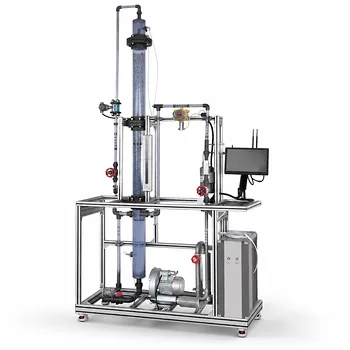
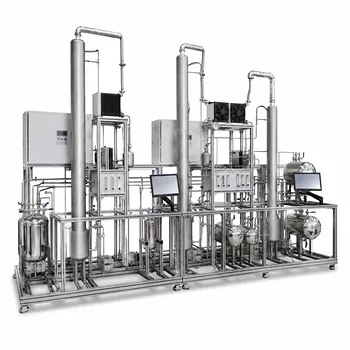
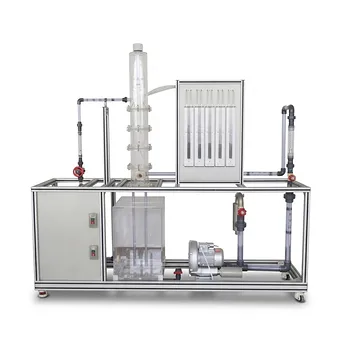
Using equations of state that require only pure-component and binary parameters lets you predict multicomponent phase behavior without costly, time‑consuming experimental data for the full mixture. This predictive power is the cornerstone of efficient pilot‑plant distillation design and operation—it dramatically simplifies thermodynamic modeling, accelerates project timelines, and reduces the risk of costly re‑runs when scaling up.
In pilot‑plant distillation, the ability to forecast ternary, quaternary, and higher‑order vapor‑liquid equilibria from just pure‑component properties and binary interaction data cuts the experimental burden by orders of magnitude. For “normal” fluids—hydrocarbons, light gases, and many organic solvents—the one‑fluid theory embedded in modern cubic equations of state delivers accuracy that is more than sufficient for safe, optimized column design.
Why Predictive Power Matters in a Pilot Plant
The Experimental Cost of Multicomponent Data
Every new ternary or quaternary mixture studied in a pilot plant traditionally demands dedicated experimental runs to map its phase diagram. Those runs consume raw materials, operator time, and valuable equipment hours. By leaning on an EOS that extrapolates from pure‑component and binary parameters, you avoid the majority of that experimental overhead. The model itself becomes a virtual laboratory, letting you screen hundreds of operating conditions before you ever touch the pilot‑plant controls.
Speed and Flexibility in a Teaching or Research Environment
Pilot plants in academic and R&D settings often handle a rotating portfolio of feedstocks and separation tasks. A modeling framework that can be reconfigured in minutes—simply by swapping pure‑component parameters and binary interaction coefficients—gives students and researchers the agility to explore “what‑if” scenarios without rebuilding the experimental infrastructure. This rapid feedback loop is essential for learning and for identifying optimal reflux ratios, feed stage locations, and column diameters in a single afternoon.
How Pure‑Component and Binary Parameters Drive Simplicity
The One‑Fluid Theory and Cubic Equations of State
Workhorses like Peng‑Robinson (PR) and Soave‑Redlich‑Kwong (SRK) are built on the one‑fluid theory: they treat a multicomponent mixture as a single hypothetical fluid whose properties are a mole‑fraction‑weighted combination of pure‑component and pairwise (binary) contributions. This means you only need critical properties, acentric factors, and binary interaction parameters—data that are widely tabulated or can be regressed from a handful of binary VLE experiments. Once those are known, the EOS reliably predicts vapor‑liquid equilibria, enthalpy, entropy, fugacity, and density for the full multicomponent system over a wide range of temperatures and pressures.
Consistent Modeling Across Both Phases
Unlike activity‑coefficient methods that require separate standard‑state fugacities and become cumbersome near the critical region, cubic EOS models apply seamlessly to both vapor and liquid phases. This single‑equation consistency is a major advantage in distillation, where liquid and vapor compositions shift stage by stage. It ensures that heat and mass balance calculations remain numerically stable and physically realistic, preventing simulated process failures that would otherwise send you back to the pilot plant for troubleshooting.
From Pilot Plant Data to Process Insight
Visualizing Phase Envelopes and Safe Operating Windows
With just pure‑component and binary parameters, students and engineers can generate full phase envelopes for multicomponent feeds. They can instantly see whether the column will operate in a two‑phase region, detect potential azeotropic pinch points, or anticipate condensation of heavy components. This visualization bridges the gap between abstract thermodynamic theory and the real physical behavior they observe on the pilot‑scale column, reinforcing the educational value of the experiment.
Bridging the Gap Between Theory and Physical Observation
The model also serves as a diagnostic tool. When actual pilot‑plant data deviate from EOS predictions, the discrepancy highlights phenomena the simple model misses—for example, polar interactions or association—giving researchers a clear signal that a more sophisticated model is needed. The approach thus becomes a structured learning pathway, not a black‑box solution.
Understanding the Trade‑offs and Limitations
When the Pure‑Component/Binary Approach Works Best
The strategy excels for non‑polar, non‑associating mixtures—light hydrocarbons, natural gas liquids, and simple organic solvents. In these systems, binary interaction parameters are often small or zero, and the one‑fluid approximation is remarkably accurate. For such feeds, the reduction in experimental effort is dramatic and the predictive accuracy is entirely fit‑for‑purpose.
When It Falls Short and What You Must Watch For
Heavily polar compounds (water, alcohols, acids), electrolytes, and large bio‑molecules violate the assumptions of a simple cubic EOS. In those cases, predictions can be wildly inaccurate—as shown by the stark difference between M‑VDW and Mark‑V predictions for water‑CO₂ solubility, where errors reached 840 %. Relying solely on pure‑component and binary parameters here would mislead design decisions. You would need an activity‑coefficient model or a complex EOS with advanced mixing rules that require additional parameters beyond binary. The key is to know your mixture: if it includes polar or associating components, the pure‑component/binary approach is a starting point at best, and experimental multicomponent data become essential.
Sensitivity to Mixing Rules
Even for non‑polar systems, the chosen mixing rule affects the result. The van der Waals one‑fluid mixing rules work well for simple systems, but when molecules differ significantly in size or shape, more elaborate mixing rules—often demanding additional parameters—may be necessary. This is a subtle point that pilot‑plant operators must understand to avoid over‑confidence in a single EOS prediction.
Making the Right Choice for Your Pilot Plant Distillation Goals
The decision to embrace an EOS that hinges only on pure‑component and binary data is a strategic one, balancing speed against guaranteed accuracy. Use the following guide to align the approach with your primary objective.
- If your primary focus is fast feasibility screening and design iteration: Adopt a cubic EOS with pure‑component and binary parameters as your default. It lets you evaluate hundreds of feed compositions and operating conditions in hours, quickly narrowing down to the most promising distillation strategies.
- If your primary focus is educating students or training operators on the fundamentals of VLE: This approach is ideal. It distills complex thermodynamics to a manageable set of inputs, letting the learner see cause‑and‑effect relationships—like how changing the binary interaction parameter shifts the entire phase envelope—without drowning in experimental noise.
- If your primary focus is scaling up a process involving polar or associating components: Start with the pure‑component/binary EOS to get a rough process baseline, but immediately plan targeted ternary or quaternary experiments to validate the predictions. Treat the simple model as a hypothesis generator, not a design-certified tool.
When you let thermodynamics work for you—extrapolating from the minimum necessary data—you turn the pilot plant into a high‑speed learning platform rather than a bottleneck. That is why equations of state built on pure‑component and binary parameters remain the backbone of efficient, insightful distillation research and education.
Summary Table:
| Aspect | Key Details & Benefits | Suitable Systems |
|---|---|---|
| Primary Benefit | Eliminates the need for costly multicomponent experimental data | Non-polar & non-associating mixtures |
| Key EOS Models | Peng-Robinson (PR), Soave-Redlich-Kwong (SRK) | Hydrocarbons, light gases, organic solvents |
| Main Limitations | Inaccurate for polar, associating, or electrolyte systems | Avoid for water, alcohols, and organic acids |
| Pilot Plant Value | Speeds up feasibility screening, design iteration, and hands-on training | Ideal for academic, R&D, and process scale-up |
Bring Industrial-Scale Insights to Your Lab with LABPARK
Are you looking to optimize your chemical engineering curriculum or accelerate your process scale-up? LABPARK provides premium Educational and Vocational Unit Operations Pilot Plants in chemical engineering, bioprocess & biotech, and environmental & water treatment.
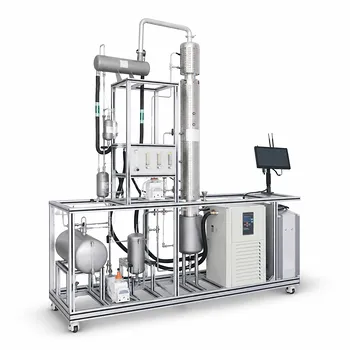
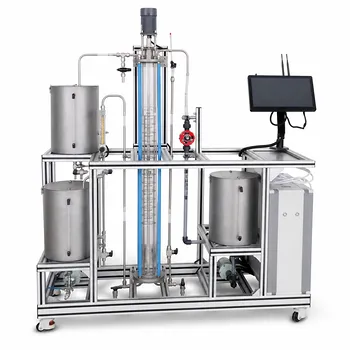
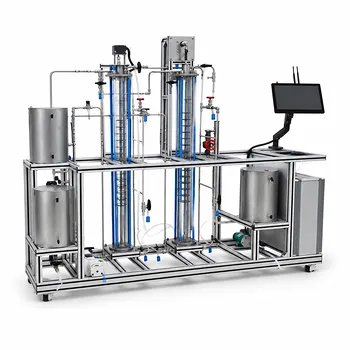
Designed specifically for universities, research institutes, and enterprises, our advanced pilot plants—including state-of-the-art distillation columns—allow students and researchers to bridge the gap between thermodynamic equations of state (EOS) and actual physical operations.
Why Partner with LABPARK?
- Academic & Vocational Excellence: Equip your labs with industry-grade pilot systems designed for intuitive learning and research.
- Robust Scale-Up Validation: Safely test and validate your thermodynamic models under real-world conditions.
- Custom Engineering Solutions: Get tailored setups that match your specific experimental and space requirements.
Ready to elevate your training and research capabilities? Contact LABPARK today to discuss your pilot plant needs!
Related Products
- Continuous Sieve-Plate Distillation Pilot Plant for Unit Operations Laboratory Education
- Multi-Functional Special Distillation Educational Pilot Plant
- Multi-Modal Distillation Unit Operations Training Pilot Plant
- Continuous Batch Extractive Distillation Educational Pilot Plant
- Dual-Mode Rectification Pilot Plant for Practical Training Unit Operations
People Also Ask
- How to select the right activity coefficient model (Wilson, NRTL, UNIQUAC) for distillation pilot plants?
- Why is vacuum operation capability an essential feature for a distillation unit operations pilot plant? Unlock Efficiency
- What are the primary reflux ratio control strategies? Master Distillation Unit Operations
- How does catalyst water concentration affect distillation pilot plant design? Key separation train choices.
- How can real-time carbon number prediction improve distillation pilot plants? Optimize control.