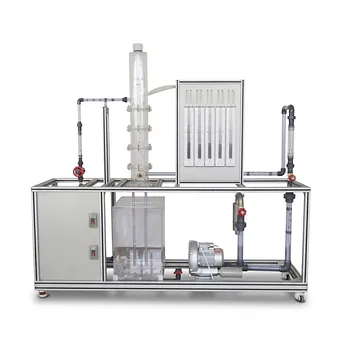
The key to scaling up plug flow reactors without losing performance is to replicate the successful lab-scale geometry, not enlarge it. The "numbering up" strategy achieves this by using a larger number of parallel tubes or channels, each with the exact same internal diameter as the laboratory-scale reactor. By keeping the tube diameter and residence time identical, the flow velocity and the intrinsic heat and mass transfer characteristics remain fundamentally unchanged, ensuring predictable, consistent reaction conditions from the bench to the pilot plant.
Numbering up is a scale-out, not scale-up, approach. It preserves the high surface-to-volume ratios and rapid transport rates of small channels by simply duplicating them. This sidesteps the performance penalties of traditional dimensional enlargement, where a larger diameter naturally degrades heat and mass transfer efficiency.
Why Traditional Diameter Scale-Up Creates Problems
When a single reactor tube is made larger, physics works against you. The process deviations that numbering up avoids are rooted in fundamental geometric shifts.
The Losing Battle of Surface-to-Volume Ratio
A reactor’s volume—and therefore its heat generation potential—grows with the cube of the diameter ($d_R^3$). The heat exchange surface area, however, only grows with the square ($d_R^2$). This means a larger reactor has disproportionately less wall surface available per unit of reacting volume to remove heat. For exothermic reactions, this can lead to dangerous hot spots and runaway.
The Degradation of Transport Rates
In a single, scaled-up tube, the flow velocity changes if you simply try to match residence time through a larger cross-sectional area. More critically, mass transfer distances increase. The time it takes for molecules to diffuse from the bulk fluid to the catalytic wall or for heat to conduct out of the center of the flow grows, creating temperature and concentration gradients. Simple channel enlargement causes a significant loss of transport performance.
The Numbering Up Solution: Preservation by Parallelization
Numbering up directly addresses these problems by refusing to change the critical dimension. You increase total throughput not by making one path bigger, but by adding more identical paths.
Keeping Velocity and Residence Time Identical
The core rule is simple: maintain the exact same internal tube diameter and the same residence time as the lab-scale benchmark. When you do this, the linear flow velocity inside each channel remains identical across scales. Since heat and mass transfer coefficients in a given geometry are strongly dependent on flow velocity, they too remain consistent and predictable.
Leveraging the Power of Small Dimensions
By keeping the channel diameter at the micro- or milli-scale, you permanently lock in the benefits of that scale. High surface-to-volume ratios are maintained across the entire system, providing immense heat transfer capability. Short diffusion paths ensure that molecules and heat rapidly reach the channel walls, keeping the process inherently efficient and safe, even for highly exothermic reactions.
How the Strategy Secures Consistent Heat Transfer
Thermal management is the first critical promise of numbering up.
Maintaining a Near-Constant Heat Transfer Coefficient
The heat transfer coefficient ($h_w$) is only weakly dependent on diameter, decreasing slightly with a factor of $d_R^{-1/9}$. Numbering up eliminates the root cause of thermal problems by prohibiting the diameter increase in the first place. The coefficient in every parallel channel remains virtually identical to the one validated in the lab.
Scaling Heat Removal Capacity Linearly
When you number up, you multiply the effective heat transfer surface area in direct proportion to the number of tubes. One tube has area A; ten tubes have 10A. The total heat generation also scales linearly with the number of tubes. This direct proportionality avoids the dangerous geometric mismatch of a single large tube, where heat generation ($\propto d_R^3$) massively outstrips the growth in surface area ($\propto d_R^2$). Robust jacketed temperature control systems in pilot plants manage the overall bath, but the local thermal stability is engineered into the parallel-channel design.
Ensuring Predictable Mass Transfer Performance
Mass transfer consistency is the second pillar of a successful scale-up.
Preserving Interfacial Area and Flow Dynamics
For multiphase reactions, the specific interfacial area per unit volume must be kept constant. In tubular sparged reactors, this requires keeping the parameter $P_t g u_g$ constant. Numbering up naturally supports this by simply cloning the proven fluid dynamics of a single channel. The identical geometry and flow velocity in each parallel path replicate the mixing pattern, bubble size distribution, and phase contact, ensuring identical mass transfer rates.
The Two Implementation Flavors
Numbering up is executed in two ways:
- External numbering-up: Uses external flow-splitting manifolds to distribute feed into multiple individual, physically separate reactor modules. This is the classical shell-and-tube heat exchanger approach.
- Internal numbering-up (or equaling-up): Distributes the fluid internally at the channel level within a single device, like a micro-channel heat exchanger featuring thousands of parallel channels. This method integrates the splitting and reaction into one compact unit, minimizing connection points.
Understanding the Trade-offs and Pitfalls
Numbering up is not without its own engineering challenges.
The Manifold Design Challenge
The single greatest risk is flow maldistribution. Ensuring that every single parallel channel receives an exactly equal share of the total feed is a complex fluid mechanics problem. A poorly designed manifold will cause some channels to over-flow and others to starve, destroying the uniformity that numbering up promises. This requires careful computational modeling and precision fabrication.
Manufacturing and Operational Complexity
Fabricating a device with thousands of identical micro-channels is more complex and costly than building one large pipe. A leak or blockage in a single channel can be difficult to detect and may compromise the entire unit. External numbering-up solves this by using modular, independent parts, but it introduces many more connections and potential leak points, increasing the system’s physical footprint.
Not All Systems Are Equal
For mechanically agitated contactors, the scale-up rules differ (keeping $P_t/V_l$ and $u_g$ constant). Numbering up in a PFR context is most powerful when you are starting with a channel geometry optimized at the lab scale. If your lab-scale work was done in a stirred tank, simply placing it in parallel tubes will not magically replicate the mixing environment.
Making the Right Choice for Your Pilot Plant
Your specific objective will dictate which numbering-up approach is best.
- If your primary focus is scaling a highly exothermic reaction: Prioritize internal numbering-up with integrated multi-channel mixer-reactor systems. The direct, short-distance heat removal is critical for safety and selectivity.
- If your primary focus is rapid lab-to-pilot transition with minimal re-engineering: Use external numbering-up with identical, replicated tube-in-shell modules. This approach offers modularity, easier maintenance, and a direct visual and operational match to your lab data.
- If your primary focus is flexible, on-demand chemical synthesis: Leverage external numbering-up’s modular nature. It allows you to simply add or remove modules to change total capacity, enabling localized production without redesigning the core reactor geometry.
- If your primary focus is vocational or student education: Demonstrate both strategies. Let students observe flow maldistribution in a poorly designed external manifold, then contrast it with the thermal uniformity of an internal micro-channel device to cement their understanding of fundamental transport principles.
Numbering up is less a single technique and more a philosophy—one that respects the physics of the small scale. By choosing replication over enlargement, you build pilot-plant data that translates directly to production, de-risking the entire scale-up journey.
Summary Table:
| Parameter / Feature | Traditional Scale-Up (Enlarging Diameter) | Numbering Up (Scale-Out/Parallel Channels) |
|---|---|---|
| Tube Diameter | Increases | Remains identical to lab scale |
| Surface-to-Volume Ratio | Decreases ($d_R^2/d_R^3$) | Remains high and constant |
| Heat & Mass Transfer | Degrades (longer diffusion/conduction path) | Preserved (identical path length) |
| Linear Fluid Velocity | Varies (often decreases) | Kept identical |
| Primary Engineering Risk | Thermal runaway, hot spots, bypassing | Flow maldistribution in manifolds |
| Modularity & Flexibility | Low (requires redesign for capacity changes) | High (add/remove parallel modules) |
Bring Advanced Chemical Engineering Principles to Life with LABPARK
Teaching or researching reactor scale-up requires reliable, real-world equipment. LABPARK designs and manufactures premium Educational and Vocational Unit Operations Pilot Plants in chemical engineering, bioprocess & biotech, and environmental & water treatment.
Specifically engineered for universities, research institutes, and enterprises, our pilot plants help you:
- Visualize Complex Concepts: Allow students and researchers to observe flow dynamics, heat integration, and numbering-up strategies firsthand.
- De-Risk Scale-Up Projects: Obtain precise, reproducible data on transfer coefficients and residence times.
- Access Modular Designs: Customize pilot configurations to match your exact curriculum or industrial research needs.
Empower your students and accelerate your research. Contact LABPARK today to discuss your pilot plant requirements!
Related Products
- Tubular Reactor Flow Characteristics Determination Educational Unit Operations Pilot Plant
- Gas Phase Mixing and Residence Time Distribution Determination Educational Unit Operations Pilot Plant
- Residence Time Distribution and Reactor Flow Characteristics Determination Educational Pilot Plant
- 100L Continuous Loop Hydrogenation Educational Unit Operations Pilot Plant
- Fluidized Bed Gas Solid Catalytic Reaction Educational Pilot Plant
People Also Ask
- How to apply Simpson's rule to tracer test data? Reactor Characterization Guide
- When configuring a reactor unit operations pilot plant for highly exothermic reactions, how to prevent thermal runaway?
- How do educational unit operations pilot plants address safety and waste management when scaling up?
- How do educational unit operations pilot plants bridge theory and industrial process development? Hands-On Learning
- How do educational unit operations pilot plants bridge theory and design? Bridge the Engineering Gap