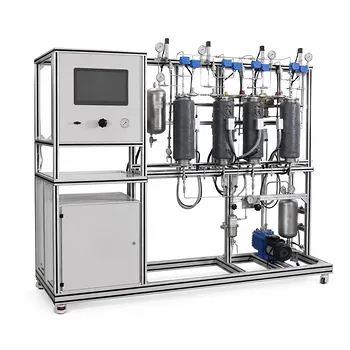
The answer lies not in heating, but in harnessing differential driving forces. When configuring a unit operations pilot plant for bioprocess or environmental engineering, the selection of a separation method for heat-sensitive or high-purity materials must center on non-thermal, rate-controlled techniques. Specifically, you should prioritize membrane separation (e.g., reverse osmosis, ultrafiltration, pervaporation), low-temperature crystallization, and field-controlled methods like electrodialysis. These approaches avoid the thermal degradation, polymerization, and oxidation that make traditional distillation unsuitable for delicate biological products.
The core principle is simple: protect product integrity by avoiding phase-change heat. The optimal choice depends on whether your deepest need is gentle handling of biomolecules, extraction of a high-purity crystal from a close-boiling mixture, or desalination of an environmental water sample. Each of the three recommended methods leverages a different physical property—permeability, solubility, or ionic mobility—operating at ambient or precisely controlled low temperatures.
Why Traditional Thermal Methods Fail Heat-Sensitive Materials
Distillation relies on boiling point differences, but high temperatures irreversibly damage many biological compounds and environmental analytes. Even when boiling points are close, pushing the temperature higher accelerates degradation. Pilot plants must therefore avoid thermal stress unless vacuum or steam techniques are specifically employed to lower the boiling point—and even then, the product still experiences elevated temperatures for some period.
The Degradation Risk Is Systemic
Proteins denature, vitamins oxidize, and volatile aromatics polymerize under heat. For environmental samples, heat can alter the composition of dissolved organic matter or cause unwanted chemical reactions. The primary reference is unequivocal: traditional thermal separation is often unsuitable. The path forward is a shift to methods that operate at ambient temperature or exploit fields instead of heat.
The Purity Paradox
High-purity targets—like pharmaceuticals or fine chemicals from complex broths—suffer when thermal stress creates impurities. A separation method that avoids generating degradation byproducts is critical. Crystallization and membrane processes achieve purification without adding thermal load, making them the instruments of choice.
Membrane Separation: Ambient-Temperature Selectivity
Membrane-based unit operations excel because they function at room temperature without phase changes. A semi-permeable barrier selectively passes components based on size, charge, or affinity, driven by pressure or concentration gradients.
Pressure-Driven Processes Protect Biomolecules
Reverse osmosis, ultrafiltration, and nanofiltration use hydraulic pressure to force solvent or small solutes through a membrane while retaining larger, heat-sensitive species. In bioprocess pilot plants, this means enzymes, antibodies, or whole cells can be concentrated and purified under conditions that fully preserve their native structure. No chemical reagents are added, so the target product remains uncontaminated.
Pervaporation and Dialysis for Specialized Needs
Pervaporation couples membrane permeation with vacuum to remove volatile organics from a liquid mixture at near-ambient temperatures. Dialysis uses diffusion across a membrane to separate small molecules from macromolecules without any pressure or heat. Both are gentle and highly selective, ideal for pilot-scale testing of new biomolecule purification routes.
Scaling and Automation Benefits
Membrane systems are inherently modular and easy to automate. Supplementary references confirm that their simple structure, low energy consumption, and lack of phase changes make them straightforward to scale from bench to pilot. This reduces risk when transitioning to commercial production.
Crystallization: High Purity Without High Heat
When your goal is a solid, high-purity product from a mixture with very close boiling points, crystallization is often superior to distillation. It exploits differences in solubility as temperature is lowered, not raised, keeping thermal stress minimal.
Leveraging Solubility Differences
By precisely cooling a solution, the desired component supersaturates and crystallizes out while impurities remain dissolved. This can achieve extreme purities in one step. In pilot plants, controlled cooling rates and seeding strategies allow researchers to optimize crystal size and purity.
Ideal for Close-Boiling Mixtures
Mixtures like isomers or heat-sensitive natural compounds are trivial for crystallization but impossible or destructive to distill. The method operates well below the boiling points of the components, effectively eliminating thermal degradation. It is a staple in pharmaceutical pilot plants for isolating active ingredients.
Pilot Plant Considerations
Crystallization pilot units require precise temperature control and often a filtration or centrifugation stage to harvest the crystals. The process is inherently scalable but demands careful material compatibility (e.g., avoiding nucleation-promoting surfaces that foul). Yet, the payoff in product quality far outweighs the complexity for high-value materials.
Field-Controlled Separations: Electrokinetic Precision
When thermal and mechanical stress must be absolutely zero, and the mixture contains charged species, field-controlled techniques provide an elegant solution. Electrodialysis uses an electric field to drive ions through selective membranes, separating dissolved salts from organic molecules or concentrating valuable acids.
Electrodialysis for Environmental Water Treatment
Supplementary references highlight its suitability for desalination and nutrient recovery from wastewater. The process runs at ambient temperature, consumes no chemical regenerants, and avoids phase changes entirely. In pilot plants, it enables experimentation with current density, membrane stack design, and flow rates to optimize for brackish water or industrial effluents.
Limitations in Bioprocessing
Electrodialysis works only for ionic species. It cannot separate non-ionic heat-sensitive organics from one another—membrane separation or crystallization must be used instead. Membrane fouling by proteins or colloids is also a concern, requiring pretreatment. Nevertheless, for its niche, it is unmatched in energy efficiency and gentleness.
Understanding the Trade-offs When Thermal Methods Are Unavoidable
Even the best non-thermal methods have limitations. Membrane fouling, low flux, and limited selectivity in complex broths can push engineers to reconsider thermal routes. In such cases, you must understand the compromises.
Vacuum Distillation: Lower Temperature, Higher Cost
Applying a vacuum reduces the boiling point, making distillation possible for some heat-sensitive materials. However, the supplementary references warn that vacuum distillation requires expensive equipment, thicker column walls, and additional safety measures for flammable solvents. It still subjects the liquid to elevated wall temperatures, so it is a last resort for truly fragile molecules.
Steam Distillation for Immiscible Products
For high-boiling, water-immiscible compounds (e.g., essential oils), steam distillation lowers the effective boiling point by reducing partial pressure. It is a simpler, lower-cost alternative to vacuum and is often used in educational pilot plants to demonstrate thermodynamic principles. But it is only applicable if water contact does not damage the product and the desired component is volatile in steam.
Membrane Fouling and Crystallization Challenges
Membranes foul over time, reducing throughput and requiring chemical cleaning—which can itself damage the membrane. Crystallization requires a relatively high initial purity to achieve high final purities; otherwise, impurities may co-crystallize. Both methods need careful feed pretreatment and pilot-scale validation to ensure economic viability.
Making the Right Choice for Your Pilot Plant Goal
Your decision must map to the specific properties of the feed and the end-use of the separated product. Use the following priorities to guide your configuration.
- If your primary focus is preserving the bioactivity of a therapeutic protein or enzyme: Choose ultrafiltration or dialysis, as they operate without heat, chemicals, or phase change.
- If your primary focus is obtaining an ultrapure solid from a close-boiling, heat-labile mixture: Configure a crystallization pilot plant with precise cooling control and solvent screening capabilities.
- If your primary focus is desalination or ion removal from an environmental water sample: Deploy an electrodialysis stack, which will remove salts at ambient temperature without altering non-ionic organic contaminants.
- If you must demonstrate versatility for educational purposes and cost is a constraint: Consider a steam distillation unit alongside membrane modules to teach thermodynamic principles and compare energy penalties.
By aligning the separation driving force—permeability, solubility, or ionic mobility—with the material’s vulnerability, you ensure that your pilot plant not only mirrors industrial reality but also safeguards the very product you seek to study.
Summary Table:
| Separation Method | Driving Force | Key Benefit | Ideal Application |
|---|---|---|---|
| Membrane Separation | Pressure / Concentration | Ambient temp, no phase change | Concentrating biomolecules (enzymes) |
| Crystallization | Solubility (Cooling) | High purity, no thermal stress | Isolating close-boiling compounds |
| Electrodialysis | Electric Field | Low energy, ionic selectivity | Desalination & nutrient recovery |
Optimize Your Pilot Plant Configurations with LABPARK
Are you looking to design or upgrade a pilot-scale system for delicate bioprocesses or environmental testing? LABPARK provides premium Educational and Vocational Unit Operations Pilot Plants in chemical engineering, bioprocess & biotech, and environmental & water treatment.
We help universities, research institutes, and enterprises achieve precise, scalable results with custom configurations tailored to heat-sensitive and high-purity materials.
Let’s build the perfect setup for your laboratory—contact us today to consult with our engineering experts!
Related Products
- Hot Filtration Educational Unit Operations Pilot Plant Laboratory System
- Potassium Salt Thermal Dissolution and Crystallization Separation Educational Unit Operations Pilot Plant
- Carbon Material Thermal Pretreatment Multiphase Separation Educational Pilot Plant
- Three-Tube Heat Transfer Educational Pilot Plant for Unit Operations Training
- Comprehensive Multi-Modal Heat Transfer Unit Operations Pilot Plant for Engineering Training
People Also Ask
- How to Determine Specific Cake (r) & Filter Medium (Rm) Resistance Using Filtration Pilot Plant Data
- How can researchers identify and resolve filter medium blinding? Optimize Your Pilot Plant Runs
- How to select solid-liquid separation equipment for pilot plants? A Step-by-Step Guide
- Why Demo Constant-Rate to Constant-Pressure Filtration on a Pilot Plant? Key Practical Insights
- How do Buchner funnels & leaf filters differ in filtration scale-up? Key Differences Explained