Knowledge Chemical Engineering Education Proportional Band vs Gain: What is the significance in process control training?
Author avatar

Tech Team · LABPARK

Updated 1 month ago

Proportional Band vs Gain: What is the significance in process control training?


The practical significance is that proportional band is the direct, hands-on tuning parameter on a pilot-plant controller faceplate, while proportional gain is the mathematical concept behind it. In chemical engineering process control training, the two are inversely related: a smaller band (e.g., 10%) applies a larger gain and forces the controller to respond more aggressively, whereas a larger band (e.g., 200%) reduces the gain and produces a gentler, more stable action. This inversion, and the visual feedback it provides, is what makes band an essential link between theory and the real-world hardware students encounter.

Understanding proportional band bridges textbook control theory and industrial practice. You calculate stability margins and loop performance using gain, but you dial in a percentage band to balance speed, stability, and steady-state error on an actual controller.

The Inverse Relationship: From Equations to Faceplate Dials

When you write a controller equation, gain multiplies the error. On a training system, you usually see a “proportional band” percentage instead. The connection is a simple reciprocal—if you want to think in terms of gain, you must convert.

The Mathematical Inversion

Proportional band (PB) and proportional gain (Kc) are directly linked through the measurement span. For a controller with a standard 0–100% output and a process variable scaled over its full range, the relationship is PB = 100 / Kc (when Kc is dimensionless). Conversely, Kc = 100 / PB. A PB of 20% equals a gain of 5; a PB of 200% equals a gain of 0.5.

Why Faceplates Use Proportional Band

Industrial and educational controllers display band because it answers a practical question: “How much error does it take to move the output from 0 to 100%?” A 25% band means a 25% change in the process variable drives the output fully open or closed. This percentage-based logic is more intuitive for operators and directly ties tuning to the instrument’s span, reducing mental calculation during startup and troubleshooting.

Tuning Trade-offs in Pilot-Plant Systems

Training systems expose the consequences of band selection in real time. The same physical process—a flow loop, a heated tank, a level column—will react very differently when you twist the band dial.

The Aggression–Stability Spectrum

A small proportional band (high gain) makes the controller act forcefully on tiny deviations. The process variable corrects quickly, but you risk overshoot and sustained oscillations. A large proportional band (low gain) delivers a sluggish response. The system recovers slowly from disturbances and avoids oscillation, but at the cost of a more pronounced offset.

The Offset Problem

In a proportional-only controller, the band determines the magnitude of the remaining steady-state error. A wider band tolerates a larger error before the output changes enough to balance the load. Students can directly observe this: as they slowly increase the PB to calm oscillations, the process variable stabilizes further from the setpoint. This hands-on lesson is often more powerful than a dozen simulation graphs.

Common Pitfalls When Translating Gain to Band

Training system consoles can lull you into a false sense of security, but misinterpreting the band control leads to confusing loop behavior. Watch for these traps.

  • Assuming a larger number means stronger action. Because a larger gain means a stronger response, it is easy to assume that a larger PB percentage also means a stronger response. The inverse relationship makes that intuition dangerously wrong. Always double-check whether you are interpreting a low PB as high aggressiveness.
  • Neglecting process dynamics when choosing a starting band. A “safe” wide band on a fast flow loop can be so sluggish that offset dominates. Conversely, the same band on a slow temperature loop might already be too aggressive. Always match the starting band estimate to the process time constant, not a rote number.
  • Tuning purely by “feel” without understanding the unit scaling. Controllers may define PB relative to the transmitter span or the engineering range. If you switch instruments or re-scale a transmitter, the effective gain changes even if the faceplate band remains identical. Calibrate your conversions carefully.

How to Apply This in Your Training Sessions

The goal isn’t to memorize a formula, but to internalize the trade-off so that when you see a trending oscillation or a sluggish response, your hand moves to the right dial with confidence. Adjust your approach based on the learning objective at hand.

  • If your primary focus is demonstrating stability limits: Start with a moderate band, then slowly decrease it until the loop oscillates. Show students how the PB dial directly translates into gain margin limitation.
  • If your primary focus is teaching offset and reset action: Tune with a wide band to create a visible offset, then introduce integral action while explaining why the band alone cannot eliminate steady-state error.
  • If your primary focus is mimicking industrial startup procedures: Force students to interpret a traditional faceplate where only PB is shown. Have them calculate the equivalent Kc in their heads before opening a simulation. This builds the mental habit that bridges the classroom and the control room.

Proportional band isn’t just an older way of stating gain—it’s the tactile, percentage-based language of industrial loop tuning, and mastering its inverse relationship gives you complete control over the balance between fast correction and smooth operation.

Summary Table:

Parameter Definition Formula High Value Effect
Proportional Band (PB) % error required for 100% output change PB = 100 / Kc Sluggish response, larger offset, higher stability
Proportional Gain (Kc) Mathematical multiplier of the error Kc = 100 / PB Aggressive response, fast correction, risk of oscillation

Elevate Your Process Control Training with LABPARK

Bridge textbook control theory and hands-on industrial practice. LABPARK provides premium Educational and Vocational Unit Operations Pilot Plants in chemical engineering, bioprocess & biotech, and environmental & water treatment designed for universities, research institutes, and enterprises.

Ready to enhance your lab's training capabilities? Contact LABPARK today to find the perfect pilot plant solution for your institution!

Related Products

People Also Ask

Related Products

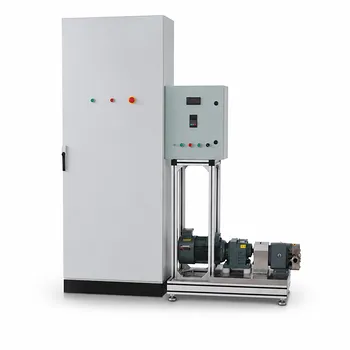
Quantitative Dosing and Liquid Flow Control Educational Unit Operations Pilot Plant

Quantitative Dosing and Liquid Flow Control Educational Unit Operations Pilot Plant

Explore industrial fluid transport and automated process control with this quantitative dosing and liquid flow control educational pilot plant, featuring local and remote control cabinets, variable speed metering pump, high-precision flow sensors, and PLC-based SCADA integration for engineering students.

Dual Mode Heat Transfer Pilot Plant for Unit Operations Training

Dual Mode Heat Transfer Pilot Plant for Unit Operations Training

Engineering-scale dual-mode heat transfer pilot plant for hands-on unit operations training in chemical engineering. Features real and simulated modes, multiple heat exchanger types, comprehensive coefficient determination, and advanced process control with data acquisition for engineering students and researchers.

Natural Product Extraction Unit Operations Training Pilot Plant

Natural Product Extraction Unit Operations Training Pilot Plant

Integrated natural product extraction pilot plant for chemical engineering training bridges theory and industrial practice with modular extraction and evaporation/concentration units, hybrid touchscreen and manual control, realistic process simulation, and self-contained softened water and vacuum utilities.

Multi-Modal Distillation Unit Operations Training Pilot Plant

Multi-Modal Distillation Unit Operations Training Pilot Plant

Multi-modal distillation pilot plant for practical unit operations training in chemical engineering education. Features real, analog, and semi-physical simulation modes, industrial construction, customizable for university labs. Hands-on fractionation columns, SCADA control, safety systems. Includes sight glasses, sampling ports, closed-loop recycling.

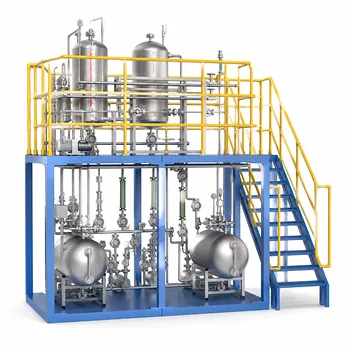
Dual-Mode Rectification Pilot Plant for Practical Training Unit Operations

Dual-Mode Rectification Pilot Plant for Practical Training Unit Operations

Industrial-scale dual-mode rectification pilot plant for chemical engineering practical training. Features real-material and simulated-material operation modes, sieve-plate column with sight glasses for visual observation of hydrodynamics, and customizable SCADA control for safe, hands-on learning of unit operations and mass transfer.

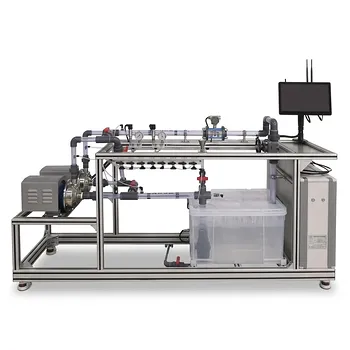
Multi Pump Fluid Transport Process Piping Unit Operations Training Pilot Plant

Multi Pump Fluid Transport Process Piping Unit Operations Training Pilot Plant

Industrial-scale multi-pump pilot plant for unit operations training in fluid transport and process piping, featuring real-material and semi-physical simulation modes, comprehensive pump and flowmeter calibration, and safety-enhanced two-tier platform, bridging academic theory and industrial practice for chemical engineering education.

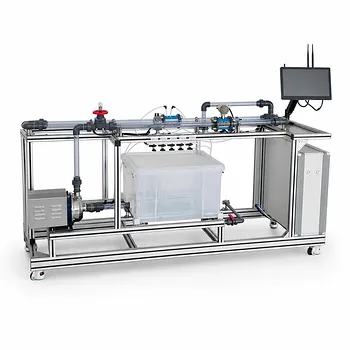
Orifice and Venturi Flowmeter Calibration Educational Pilot Plant for Fluid Mechanics Laboratory

Orifice and Venturi Flowmeter Calibration Educational Pilot Plant for Fluid Mechanics Laboratory

Enhance fluid dynamics education with the Orifice and Venturi Flowmeter Calibration Educational Unit Operations Pilot Plant, featuring transparent orifice and Venturi meters, industrial sensors, touchscreen interface for real-time data analysis and automatic coefficient calculations in engineering student laboratories.

100L Continuous Loop Hydrogenation Educational Unit Operations Pilot Plant

100L Continuous Loop Hydrogenation Educational Unit Operations Pilot Plant

This 100L continuous loop hydrogenation pilot plant is designed for chemical engineering education, featuring 316 stainless steel construction, advanced gas-liquid mass transfer components, explosion-proof safety systems, and a 15.6-inch touchscreen with 5G connectivity, cloud data logging, bridging theory and industry.

Comprehensive Multi-Modal Heat Transfer Unit Operations Pilot Plant for Engineering Training

Comprehensive Multi-Modal Heat Transfer Unit Operations Pilot Plant for Engineering Training

Comprehensive multi-modal heat transfer unit operations pilot plant for engineering training. Features four heat exchanger types, multi-media switching, and three operating modes. Hands-on experience in safety, optimization, and process control. Industrial-grade design with real-time data acquisition for chemical engineering labs.

Centrifugal Pump Performance Determination Educational Unit Operations Pilot Plant

Centrifugal Pump Performance Determination Educational Unit Operations Pilot Plant

This lab system determines centrifugal pump performance curves for unit operations. Students configure dual pumps in series or parallel for hands-on learning. Includes industrial controls, clear piping, and data logging. Customizable for chemical, mechanical, and environmental engineering programs.

Fluid Transport and Piping Dynamics Practical Training Unit Operations Pilot Plant

Fluid Transport and Piping Dynamics Practical Training Unit Operations Pilot Plant

This industrial-scale fluid transport and piping dynamics training pilot plant provides essential hands-on experience with pump operations, cavitation, piping resistance, flow metering, and process control. Customizable to fit specific academic engineering curricula.

Chemical Pipeline Assembly and Fluid Transport Practical Training Unit Operations Pilot Plant

Chemical Pipeline Assembly and Fluid Transport Practical Training Unit Operations Pilot Plant

Integrated skid-mounted engineering training pilot plant for university labs offers hands-on experience in chemical pipeline assembly, fluid transport, centrifugal pump operation, and pressure testing. Customizable system bridges academic theory and industrial practice with digital pre-lab resources and comprehensive tools.

Multi-Functional Special Distillation Educational Pilot Plant

Multi-Functional Special Distillation Educational Pilot Plant

Versatile multi-functional special distillation pilot plant for chemical engineering education. Supports continuous, vacuum, azeotropic, reactive, extractive distillation. Transparent glass columns enable real-time visual observation of hydrodynamics and separation processes.

Bench Scale Dual Column Gas Separation and Capture Educational Pilot Plant

Bench Scale Dual Column Gas Separation and Capture Educational Pilot Plant

This dual-column educational pilot plant provides hands-on teaching of gas adsorption, separation, and capture processes. It features stainless steel columns, regeneration up to 400°C, and a 15.6-inch touchscreen PLC for TSA and PSA studies in chemical engineering curricula, process simulation.

Ethyl Acetate Synthesis Unit Operations Pilot Plant for Practical Training

Ethyl Acetate Synthesis Unit Operations Pilot Plant for Practical Training

Modular and customizable pilot plant for ethyl acetate synthesis practical training. Integrates esterification reaction, liquid-liquid extraction, neutralization, and sieve-plate distillation unit operations. Bridging theory and real-world industrial processes. Designed for university chemical engineering labs

Carbon Material Thermal Pretreatment Multiphase Separation Educational Pilot Plant

Carbon Material Thermal Pretreatment Multiphase Separation Educational Pilot Plant

Educational pilot plant for carbon material thermal pretreatment and multiphase separation. Features jacketed agitated reactor, separation column, and modern controls for hands-on unit operations training in heat transfer, fluid flow, and process safety with industrial-grade materials and wireless data acquisition.

Three-Tube Heat Transfer Educational Pilot Plant for Unit Operations Training

Three-Tube Heat Transfer Educational Pilot Plant for Unit Operations Training

Three-tube heat transfer pilot plant for studying convective heat transfer enhancement and condensation. Allows comparison of smooth, corrugated, turbulent tubes, verifying empirical correlations. Ideal for chemical engineering education with safety and closed-loop steam recovery.

Multi-Reactor Educational Pilot Plant for Reaction Engineering Unit Operations

Multi-Reactor Educational Pilot Plant for Reaction Engineering Unit Operations

Integrated bench-scale educational pilot plant for chemical engineering teaching featuring fixed bed fluidized bed and stirred tank reactors with web-based digital twin controls and safety interlocks for hands-on unit operations and reaction engineering comparative studies in one compact system.

Comprehensive Heat Transfer Coefficient Determination Educational Unit Operations Pilot Plant

Comprehensive Heat Transfer Coefficient Determination Educational Unit Operations Pilot Plant

Advanced industrial-grade educational pilot plant for comprehensive heat transfer coefficient determination. Enables quantitative convective heat transfer analysis, evaluates double-pipe and shell-and-tube exchanger configurations, and includes digital data acquisition. Customizable for engineering curriculum. Ideal for engineering unit operations labs.

Continuous Batch Extractive Distillation Educational Pilot Plant

Continuous Batch Extractive Distillation Educational Pilot Plant

Versatile pilot plant for continuous, batch, and extractive distillation training. High-borosilicate glass column for visualizing hydraulics, 15.6-inch touchscreen with data logging, precise reflux ratio control 1-99, and durable corrosion-resistant frame. Ideal for chemical engineering education and process research.


Leave Your Message