The choice of crystallization method starts with a single question: How does the solute’s solubility change as temperature drops?
For substances whose solubility plunges when cooled, cooling crystallization is the standard, most energy-efficient path. When solubility barely moves across the operable temperature range—or even increases as the solution cools—evaporative crystallization must remove solvent to force supersaturation. For heat‑sensitive materials and intermediate solubility slopes, vacuum adiabatic cooling crystallizers offer a gentle, balanced alternative. In an educational pilot plant, mapping these thermodynamic behaviors to the right unit operation equips students with the foundational logic of industrial process selection.
Crystallization method selection is a direct consequence of the solute’s solubility vs. temperature curve. Use cooling crystallizers where the curve is steep and positive; switch to evaporative or vacuum crystallizers where the curve is flat, inverse, or the product cannot tolerate prolonged heating. A modular pilot plant that lets students experimentally compare these responses turns physical chemistry into an intuitive design skill.
Understanding the Solubility–Temperature Relationship
Before selecting any hardware, operators must read the solute’s solubility curve. This single graph determines whether temperature manipulation or solvent removal will be the primary driver of supersaturation—the engine of every crystallization.
The Solubility Curve as a Decision Map
A solubility curve plots concentration against temperature. Its slope tells you how much more solute can dissolve as you add heat. Four practical curve shapes dictate the method:
- Steep positive slope: Solubility rises sharply with temperature (e.g., potassium nitrate, potassium phosphate). These solutes are ideal candidates for cooling crystallization.
- Flat slope: Solubility changes little with temperature (e.g., sodium chloride). Cooling alone will barely yield crystals—you need evaporative crystallization.
- Inverse slope: Some solutes become less soluble at higher temperatures (e.g., calcium sulfate above ~40 °C). Here, cooling is counterproductive; evaporation or vacuum methods are mandatory.
- Intermediate slopes with thermal sensitivity: When the curve is neither dramatically steep nor completely flat, or the product degrades with heat, vacuum adiabatic cooling becomes the preferred route.
Strong Positive Dependence: Cooling Crystallization
When solubility drops by more than 50 % across a feasible temperature window, cooling becomes the most elegant supersaturation tool. The operator simply reduces the solution temperature through a jacketed crystallizer with precise temperature control. As heat is removed, the solubility limit is crossed, and nucleation begins.
Educational pilot plants typically demonstrate this with well‑characterized systems like potassium nitrate or copper sulfate. Students observe how a controlled cooling ramp impacts crystal size distribution and yield, and they learn why industrial cooling crystallizers are so widely used—they avoid the high energy costs of boiling off solvent.
Flat and Inverse Curves: Evaporative Crystallization
If the solubility curve hardly moves, lowering the temperature will never generate enough supersaturation. The only practical route is to remove solvent, concentrating the solute until it exceeds the limit. This is evaporative crystallization: the solution is heated to boil off water or solvent, driving the remaining liquid into the metastable zone.
The classic laboratory example is sodium chloride. Boiling a brine solution provides exactly the driving force a cooling jacket cannot. For inverse‑solubility compounds like calcium sulfate, evaporation circumvents the fact that cooling would actually increase solubility and waste energy. In pilot plant training, operating an evaporator crystallizer teaches the link between mass transfer, energy input, and crystal yield.
Sensitive and Intermediate Cases: Vacuum Adiabatic Cooling
Many valuable fine chemicals, pharmaceutical intermediates, or heat‑labile biological molecules degrade if held at elevated temperatures. Meanwhile, their solubility curve may not be steep enough to justify pure cooling alone. Vacuum adiabatic cooling resolves this dilemma.
The method lowers the boiling point of the solvent by pulling a vacuum. Adiabatic evaporation cools the solution, simultaneously concentrating it and lowering its temperature without applying external heat. This dual action generates supersaturation gently. In an educational setting, a vacuum crystallizer shows how fundamental thermodynamics—not just hardware—can solve conflicting constraints like heat sensitivity and modest curve slopes.
Matching the Method to Pilot Plant Hardware
Choosing the right method also guides how you configure the pilot plant. Each crystallization class demands specific equipment, and educational setups benefit from modular designs that let students run multiple experiments back‑to‑back.
Essential Equipment Configurations
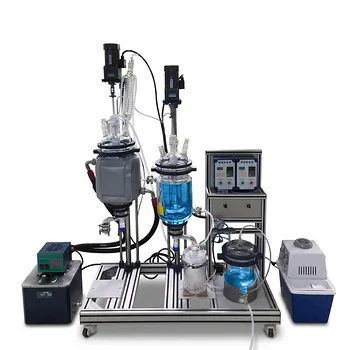
- Cooling crystallizers require jacketed vessels, circulating chillers, and accurate thermocouples. These are often batch‑operated tank crystallizers, ideal for initial demonstrations of classical nucleation and growth kinetics.
- Evaporative setups need jacketed boilers with condensers, vacuum pumps (if reduced‑pressure evaporation is used), and temperature‑resistant vessels. In pilot labs, a simple forced‑circulation evaporator can illustrate how supersaturation develops by solvent stripping.
- Vacuum adiabatic crystallizers combine a flash chamber, vacuum pump, and condensate recovery. A typical lab‑scale unit includes a draft tube and baffle to maintain crystal suspension, recreating the environment of an industrial draft‑tube baffle (DTB) crystallizer while prioritizing low‑temperature operation.
Adding Crystallizer Types for Scale‑up Learning
Beyond method selection, advanced pilot plants may integrate multiple crystallizer architectures. While the method is dictated by the solubility curve, the type of crystallizer influences crystal size and distribution. For example, an Oslo fluidized‑bed crystallizer can be used with evaporative systems to produce large, uniform ammonium sulfate crystals, directly connecting the classroom solubility concept to real‑world product quality. This layered design—method first, then equipment type—builds systematic problem‑solving skills.
Understanding the Trade-offs
Selecting a method based solely on the solubility curve is a strong start, but every choice comes with constraints that a well‑taught operator must weigh.
Energy and Operational Costs
Cooling crystallization is often the most energy‑efficient because it removes only sensible and latent heat from the solution, not the massive enthalpy required to vaporize solvent. By contrast, evaporative crystallization demands substantial heat input to boil off liquid, and vacuum adiabatic systems add the energy cost of maintaining a vacuum. In an educational plant, this trade‑off sets the stage for discussions about green chemistry and process economics.
Crystal Purity and Product Quality
Evaporative methods can co‑concentrate impurities, potentially compromising crystal purity. Cooling crystallization, when controlled slowly, can exclude impurities from the growing crystal lattice and yield higher purity. Vacuum adiabatic cooling often provides an intermediate pathway, especially for heat‑sensitive products where thermal degradation would otherwise ruin purity. Students who learn to correlate method choice with final product attributes gain a holistic view of process engineering.
Risk of Scaling and Fouling
Flat‑curve salts like sodium chloride tend to scale on heat‑exchange surfaces during evaporation. In pilot plants, operators sometimes alternate between methods or use scraped‑surface crystallizers to avoid fouling when dealing with viscous or scaling streams. Understanding that a method influenced solely by solubility may still be impractical in a real plant is an essential lesson in design maturity.
Making the Right Choice for Your Educational Goal
Not every pilot plant is built to maximize yield. Define your primary pedagogical or research objective, then tailor method selection and equipment accordingly.
- If your primary focus is demonstrating thermodynamic fundamentals: Choose a solute pair with contrasting solubility curves—such as potassium nitrate (cooling) and sodium chloride (evaporative)—and run them side‑by‑side in a modular plant. This makes the abstract solubility curve tangible.
- If your primary focus is scale‑up process design: Select a single solute and operate it across cooling, evaporative, and vacuum modes, then compare yield, crystal size distribution, and energy consumption. Add a classifying crystallizer (DTB or Oslo) to link method choice with industrial crystallizer performance.
- If your primary focus is troubleshooting real‑world fouling and heat sensitivity: Incorporate a scraped‑surface evaporator and a vacuum adiabatic system, and challenge students to adapt their method when the solubility curve’s theoretical advantage meets practical constraints.
- If your primary focus is broadening exposure to uncommon behaviors: Include a solute with an inverse solubility curve (e.g., calcium sulfate above 40 °C) and let students discover that cooling would actually lower supersaturation, cementing why the curve alone never lies.
A pilot plant designed around solubility‑curve thinking transforms rote equipment selection into an investigative science, equipping the next generation of engineers to read the material before they ever touch a valve.
Summary Table:
| Solubility Curve Type | Recommended Crystallization Method | Required Hardware Configuration | Typical Example Solutes |
|---|---|---|---|
| Steep Positive Slope | Cooling Crystallization | Jacketed vessel, chiller, precise thermocouples | Potassium nitrate, Copper sulfate |
| Flat or Inverse Slope | Evaporative Crystallization | Jacketed boiler, condenser, vacuum pump | Sodium chloride, Calcium sulfate |
| Intermediate / Heat-Sensitive | Vacuum Adiabatic Cooling | Flash chamber, vacuum pump, condensate recovery | Fine chemicals, pharmaceuticals |
Bring Industrial-Scale Crystallization to Your Lab
Equip your students and researchers with the practical skills needed to master complex chemical processes. LABPARK provides premium Educational and Vocational Unit Operations Pilot Plants in chemical engineering, bioprocess & biotech, and environmental & water treatment tailored for universities, research institutes, and enterprises.
Ready to upgrade your laboratory training capabilities? Contact us today to design a modular pilot plant that fits your curriculum and research goals!
Related Products
- Multi Functional Membrane Crystallization Educational Unit Operations Pilot Plant
- Potassium Salt Thermal Dissolution and Crystallization Separation Educational Unit Operations Pilot Plant
- Multi-Modal Distillation Unit Operations Training Pilot Plant
- Multi-Reactor Educational Pilot Plant for Reaction Engineering Unit Operations
- Dual-Mode Rectification Pilot Plant for Practical Training Unit Operations
People Also Ask
- Control Crystallization Pilot Plant Secondary Nucleation: 4 Key Adjustments
- Why is precise temperature control critical in crystallization pilot plants? Key to Scale-Up Success
- What key factors should be considered when configuring a crystallization unit operations pilot plant?
- What are the benefits of integrating online PAT tools like ATR-FTIR into crystallization unit operations pilot plants?
- How to use crystallization pilot plant agitation speed to identify diffusion vs reaction growth?