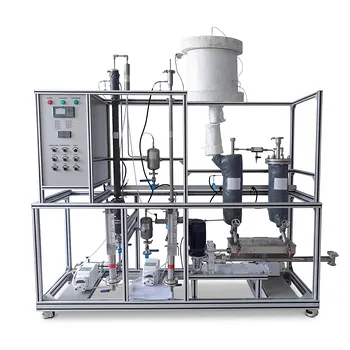
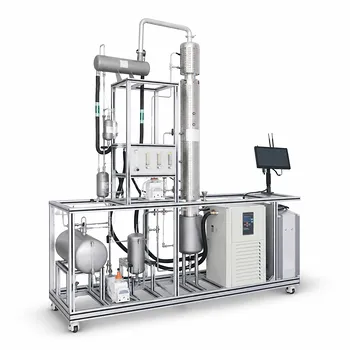
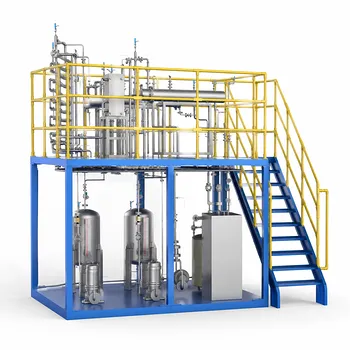
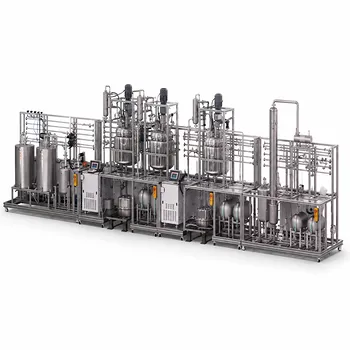
Hands-on learning with a combined Gas-Heated Reformer (GHR) and Autothermal Reformer (ATR) is the most effective way to teach process intensification and heat integration in a pilot plant.
This integrated system allows students to physically couple the endothermic steam reforming reaction with the exothermic partial oxidation of methane. By controlling feed ratios and reactor configurations, they directly observe how waste heat from the ATR drives the GHR, virtually eliminating the need for external fuel.
A pilot plant featuring a series-connected GHR and ATR creates a self-sustaining thermal loop. Students learn that process intensification is not just about shrinking equipment—it is about merging heat supply and reaction into one compact, efficient unit that dramatically cuts energy demand and plant footprint.
The Core Teaching Tool: A Coupled GHR-ATR Pilot Plant
How the System Works
The GHR uses hot, reformed gas from the ATR as its convective heating medium.
Students adjust the feed of methane, steam, and oxygen to the ATR, where partial oxidation generates intense heat.
This hot effluent then flows through the shell side of the GHR, providing the endothermic heat for the steam reforming reaction taking place in the tubes.
Process Intensification in Action
The GHR is a textbook example of a heat-integrated reactor—it combines heat exchange and reaction in a single piece of equipment.
Instead of using a large fired furnace, the pilot plant teaches that the reaction heat comes directly from the chemistry itself.
Students measure the dramatic reduction in external energy demand and compare the physical footprint to a conventional stand-alone reformer, cementing the principle of footprint minimization.
Designing Experiments That Drive Deep Understanding
Mastering Heat Integration Fundamentals
Students begin by establishing a baseline where the GHR is heated electrically, then switch to ATR coupling.
By varying the oxygen-to-methane ratio, they control the ATR outlet temperature and see the direct, measurable impact on GHR conversion.
This hands-on manipulation makes the concept of thermal coupling tangible—heat is no longer a black box, but a controlled process stream.
Comparing Series and Parallel Arrangements
The pilot plant can be reconfigured to run the reactors in series or in a split-flow parallel mode.
In series, the full ATR outlet passes through the GHR; in parallel, part of the feed bypasses the ATR directly to the GHR.
Students log temperature profiles and syngas yields to discover how the optimal configuration balances thermal load, methane slip, and H₂/CO ratio.
Calculating Energy Efficiency and Pinch Points
Using the collected temperature data, students calculate the heat recovery efficiency—how much sensible heat is converted into chemical energy.
They can experimentally identify the minimum temperature approach (a pinch-like concept) between the hot ATR gas and the cold GHR feed, reinforcing the thermodynamic limits of heat exchange.
These exercises translate abstract pinch theory into a physically observed driving force.
Understanding the Trade-offs and Practical Challenges
Safety and Material Constraints
Running a self-sustaining ATR-GHR system at elevated temperatures carries a real risk of runaway if oxygen control fails.
The pilot plant must have robust over-temperature interlocks and pressure relief systems, which itself becomes a lesson in industrial safety culture.
Additionally, the materials of construction must withstand high-temperature hydrogen attack—a discussion point on alloy selection and process intensification’s demand for advanced materials.
Complexity vs. Pedagogical Clarity
A fully integrated system can overwhelm beginners. Instructors often start with decoupled mode (each reactor heated independently) before activating the ATR-to-GHR heat link.
The intensive instrumentation—multiple thermocouples, flow controllers, gas analyzers—requires careful calibration, but this teaches data validation as a core skill.
Without proper preparation, students may not appreciate the energy savings until they compare the electrical heating power needed in decoupled mode, so a structured comparison step is essential.
Process Limitations and Coking Risks
The tight heat coupling means the GHR outlet temperature is limited by the ATR exit temperature—there is little room for independent control.
Students must calculate the steam-to-carbon ratio carefully; too low a ratio risks carbon formation (coking) that deactivates the catalyst and fouls the heat exchanger.
These real-world constraints turn a simple experiment into a genuine optimization problem, mirroring industrial challenges.
Making the Right Choice for Your Curriculum
The teaching approach must align with your educational objectives. Here is how to tailor the pilot-plant module:
- If your primary focus is fundamental heat integration: Keep the system simple. Have students map energy flows and calculate the autothermal point where external heat input is zero. Use series configuration to clearly show how exothermic and endothermic reactions balance.
- If your primary focus is process intensification and footprint reduction: Emphasize the GHR design as a reactor-heat exchanger hybrid. Compare its volume and external energy demand against a conventional fired-reformer model through back-of-the-envelope calculations.
- If your primary focus is advanced control and optimization: Challenge students to maintain syngas quality while minimizing oxygen use. Introduce disturbances (steam pressure drops), and let them design a control strategy that keeps the ATR-GHR loop stable.
A well-instrumented GHR-ATR pilot plant transforms abstract process intensification ideals into a vivid, hands-on lesson—one where students leave not just understanding the theory, but knowing exactly how to build a more sustainable chemical process.
Summary Table:
| Teaching Configuration | Core Focus | Key Learning Outcome |
|---|---|---|
| Decoupled Mode | Baseline operation & independent reactor control | Instrument calibration, data validation, and safety limits |
| Coupled Mode (Series) | Full thermal coupling and self-sustaining loops | Heat recovery efficiency calculations and pinch point analysis |
| Parallel Mode | Split-flow and bypass feed optimization | Balancing thermal load, methane slip, and desired H2/CO ratio |
Bring Advanced Process Intensification to Your Lab with LABPARK
Ready to elevate your chemical engineering curriculum? LABPARK designs and manufactures high-quality Educational and Vocational Unit Operations Pilot Plants in chemical engineering, bioprocess & biotech, and environmental & water treatment. We help universities, research institutes, and enterprises bridge the gap between theory and industrial reality with safe, highly instrumented, and configurable pilot systems.
Contact LABPARK today to customize your pilot plant solution!
Related Products
- Steam Methane Reforming Hydrogen Production and Purification Educational Pilot Plant
- Multi Pump Fluid Transport Process Piping Unit Operations Training Pilot Plant
- Multi-Modal Distillation Unit Operations Training Pilot Plant
- Multi-Reactor Educational Pilot Plant for Reaction Engineering Unit Operations
- Tubular Reactor Flow Characteristics Determination Educational Unit Operations Pilot Plant
People Also Ask
- How is carbon deposition controlled in steam reforming? The Critical Role of S/C Ratio
- How does temperature affect syngas equilibrium? Practical limits in steam reforming
- How to Minimize Hazardous Inventory in Pilot Plants? Master Inherently Safer Design
- What causes boiler water foaming in pilot plants, and how to monitor & control it?
- What are the differences between steam reforming and ATR in pilot plants? Key Design Guide