A solid product layer renders one of your most intuitive process levers—agitation—almost completely ineffective, forcing a strategic pivot toward chemical and physical preparation parameters.
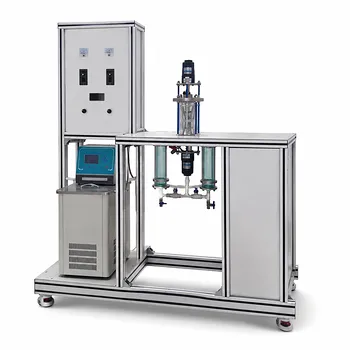
When you run a solid-liquid leaching pilot plant and encounter a reaction that forms an insoluble solid coating (like calcium sulfate on phosphate rock during sulfuric acid leaching), the rate-limiting step shifts decisively. Instead of the easy-to-fix liquid film diffusion, diffusion through that solid product layer becomes the bottleneck. The immediate consequence for your control strategy is stark: cranking up the impeller speed will not accelerate the extraction rate. You must instead command variables that shrink the internal diffusion resistance—initial particle size, temperature, lixiviant concentration, and vessel residence time.
The critical control insight: When a solid product layer governs the reaction kinetics, your pilot plant's agitator becomes a secondary tool. The real process levers are particle size reduction, higher solvent concentration, and elevated temperature—all aimed at accelerating diffusion through the stubborn ash layer, not the liquid boundary film.
Why a Solid Product Layer Changes Everything
The Three-Step Gatekeeper Model
Leaching rates are always dictated by a sequence of three resistances: diffusion through the liquid film surrounding the particle, diffusion through any solid product layer, and the chemical reaction at the unreacted core surface.
In a clean, non-product-forming system like copper oxide acid leaching, the particle simply shrinks. The film or the reaction itself usually controls the pace, and increasing agitation can slash film resistance immediately.
The Insertion of a New, Dominant Resistance
A solid reaction product—like gypsum—inserts a rigid, porous coating between the solvent and the shrinking core. The reactant must now navigate through this coating.
For diffusion-controlled product layers, the classic Valensi-Carter and Crank-Ginstling-Brounshtein models apply. They show that the conversion rate declines steeply as the layer thickens, because the diffusion path grows ever more torturous and longer.
Diagnosing the Rate-Limiting Step in Your Pilot Plant
You can pinpoint the true bottleneck with a simple experiment. Vary the agitation speed significantly at constant temperature and particle size.
If the extraction rate skyrockets, your process is film-diffusion controlled—increase the mixer’s RPM, and you win. If the rate barely budges, the solid product layer is the gatekeeper, and you have just been handed your new control playbook.
Retuning Your Control Strategy for a Solid Product Layer
Once you confirm that internal diffusion through the product layer is the rate-determining step, you abandon hydrodynamic tweaks and focus on four precision levers.
Particle Size: The Most Powerful Lever
The diffusion path through the solid product layer is directly proportional to the final particle size. Grinding your solids to a smaller initial diameter has an outsized, non-linear effect: the time for complete conversion decreases with the square of the radius for product-layer diffusion.
In your pilot plant, implementing size classification and pre-milling to a strict upper limit is often the single most effective control action you can take.
Temperature and Solvent Concentration: Driving Force Engineering
An often-overlooked mistake is adding more solvent without raising the concentration. Raising the lixiviant concentration increases the chemical potential gradient across the product layer, directly boosting the diffusive flux.
Similarly, elevating the reactor temperature serves a dual purpose. It increases the diffusion coefficient according to an Arrhenius-type relationship and often improves the porosity of the product layer itself, making the path less resistive.
Residence Time: Patience as a Process Parameter
When a solid product layer governs the clock, you cannot cheat time with mechanical energy. The shrinking core model mathematically ties the fractional conversion to a specific time constant.
Your pilot plant control philosophy must therefore treat residence time not as a variable to minimize, but as a design specification. You will size the reactor and control the feed rate to guarantee the solid spends the full required time under the optimized chemical conditions, not a second less.
The Trade-offs of Over-Correcting
Aggressively applying these new levers carries real penalties that your control strategy must balance.
- Excessive reagent concentration can trigger unwanted side reactions, increase downstream purification costs, or attack the vessel materials, all without proportional yield gains once a maximum flux is reached.
- Over-grinding the feed beyond a certain point yields diminishing returns. It skyrockets milling energy costs and can create fines that blind downstream solid-liquid separation, turning a kinetic success into an operational headache in the leachate clarification step.
- Applying mechanical shear to disrupt the product layer (through extremely high agitation or ultrasound) can succeed but is dangerous to scale. It introduces unpredictable particle breakage and often produces an inconsistent, difficult-to-filter slurry.
Making the Right Control Decision for Your Pilot-Scale Goal
Your optimal process control strategy depends entirely on the primary objective of your pilot campaign.
- If your primary focus is proving maximum theoretical yield: Commit immediately to the smallest practical particle size distribution and push lixiviant concentration to its safe upper limit while establishing the corresponding minimum residence time.
- If your primary focus is generating scale-up data for a commercial plant: Factor in the real cost of grinding and the capital intensity of a large, long-residence-time reactor. Use the pilot plant to find the economic sweet spot where particle size and residence time meet an achievable internal rate of return.
- If your primary focus is consistent product quality and operability: Run targeted experiments on the impact of temperature and concentration on the product layer's mechanical structure. A slightly more porous layer formed at a different temperature can improve filtration far more drastically than a marginal yield increase.
By mapping every control input directly to the fundamental diffusion resistance that governs your system, you stop wasting effort on ineffective variables and start building a kinetics-driven, scalable process.
Summary Table:
| Control Variable | Kinetic Impact under Product Layer Control | Key Trade-offs / Considerations |
|---|---|---|
| Particle Size | Decreases diffusion path; conversion time drops with square of radius | High milling energy; creates fines that blind downstream filtration |
| Temperature | Increases diffusion coefficient and improves product layer porosity | Higher energy costs; potential material corrosion |
| Lixiviant Conc. | Increases chemical potential gradient and diffusive flux | Risk of side reactions; increased chemical consumption |
| Residence Time | Ensures sufficient time for diffusion-limited conversion | Requires larger reactor sizing; limits throughput |
| Agitation Speed | Minimal impact (only reduces boundary film resistance) | Wasted energy; excessive shear can cause unpredictable particle breakage |
Optimize Your Unit Operations with LABPARK
Are you looking to master complex chemical kinetics and process control in your labs? LABPARK provides premium Educational and Vocational Unit Operations Pilot Plants in chemical engineering, bioprocess & biotech, and environmental & water treatment. Tailored for universities, research institutes, and enterprises, our systems enable precise control configuration for solid-liquid leaching and beyond.
Contact LABPARK today to find the ideal pilot plant solution for your educational or research needs!
Related Products
- Comprehensive Liquid-Liquid Extraction Pilot Plant for Engineering Education
- Hot Filtration Educational Unit Operations Pilot Plant Laboratory System
- Ternary Liquid-Liquid Equilibrium Educational Pilot Plant
- Gallium and Indium Selective Extraction Educational Pilot Plant
- Fluidized Bed Gas Solid Catalytic Reaction Educational Pilot Plant
People Also Ask
- How do pilot plants differentiate physical vs chemical extraction? Enhance Chemical Engineering Training
- How are ternary phase diagrams and LLE data applied in extraction experiments? Optimize Pilot Plant Scale-up
- In a liquid-liquid extraction pilot plant, how is a ternary-phase diagram utilized to determine solvent feed requirements?
- How to Validate BIPs for LLE Pilot Plants? Steps to Align Simulations with Reality
- How Do Selectivity & Distribution Coefficients Influence LLE Pilot Plant Solvent Choice?