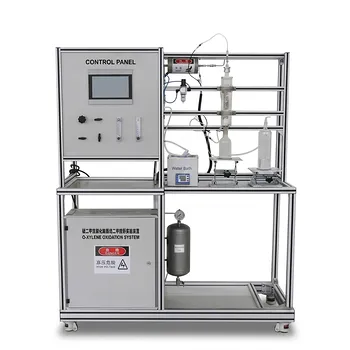
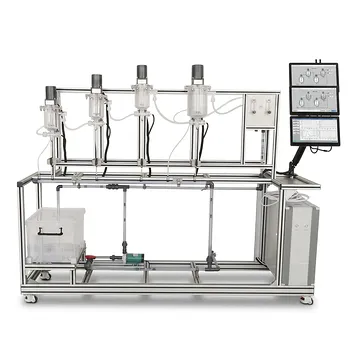
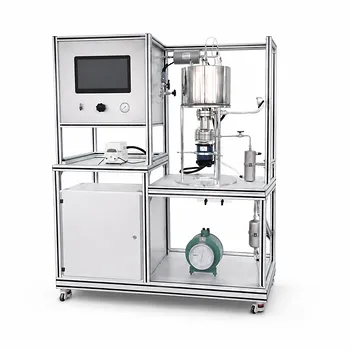
The core distinction lies in how the heat of reaction is managed moment by moment. An adiabatic quench reactor controls temperature by injecting cold fresh feed between successive catalyst beds, producing a distinctive saw-tooth temperature profile with sharp drops and re-heat cycles. In contrast, a cooled tubular reactor continuously removes heat through tube walls using a surrounding cooling medium—typically boiling water—resulting in a far more uniform, near-isothermal temperature landscape. The quench design is mechanically simpler but surrenders thermal precision, while the tubular design offers the tight temperature control essential for studying catalyst limits, optimizing conversion, and demonstrating heat recovery on a pilot scale.
The fundamental choice is between staged, discrete cooling that trades uniformity for simplicity, and continuous wall cooling that delivers thermal precision at the cost of added complexity. This decision dictates whether your pilot plant excels at teaching basic reactor staging or at validating advanced heat-transfer and kinetic models.
How the Two Reactors Manage Temperature
Adiabatic Quench: Staged Cooling and Saw-Tooth Profiles
In this configuration, the fixed-bed reactor is divided into multiple stages, each preceded by a quench gas injection port. Cold reactant gas is mixed with the hot effluent from the previous bed, instantly lowering the reaction temperature.
The exothermic methanol synthesis then reheats the gas as it flows downward through the next catalyst layer, creating a series of temperature spikes and sharp drops. The resulting saw-tooth thermal profile means the catalyst spends significant time above and below the optimal window, which can suppress peak reaction rates and favor side reactions.
Cooled Tubular: Continuous Heat Removal and Isothermal Operation
A cooled tubular reactor places the catalyst inside multiple parallel tubes that are surrounded by a cooling medium on the shell side. Boiling water is often used because its constant temperature provides an exceptionally stable heat sink.
Heat generated by the reaction is continuously conducted through the tube wall into the boiling water, holding the catalyst bed within a narrow, near-optimal band—typically 250–255 °C. This near-isothermal profile maximizes the single-pass conversion to methanol, minimizes byproduct formation, and protects the catalyst from sintering-inducing hot spots.
Comparing Pilot-Scale Behavior for Methanol Synthesis
Temperature Uniformity and Catalyst Protection
Hot spots in an adiabatic quench reactor can exceed 300 °C locally, accelerating catalyst deactivation and promoting the formation of unwanted compounds like higher alcohols or dimethyl ether.
A cooled tubular reactor suppresses these excursions. By constantly removing reaction heat, the catalyst experiences a gentle, uniform thermal environment that extends its useful life and yields cleaner methanol—a critical advantage when your pilot plant is designed to generate reliable kinetic data or produce representative product samples.
Single-Pass Conversion and Byproduct Selectivity
The quench approach forces each catalyst bed to operate across a broad temperature range, including suboptimal cool regions. Consequently, single-pass CO conversion is typically lower, and methanol selectivity can suffer.
The near-isothermal tubular design allows the entire catalyst mass to work at a peak kinetic sweet spot. This consistently delivers higher conversion per pass and a purer methanol stream, making it the preferred configuration when demonstrating industrial-grade performance metrics in a research or teaching environment.
Energy Recovery and Heat Integration
A quench reactor recovers only limited energy because the heat of reaction is merely diluted, not captured. Cooled tubular reactors, however, can generate byproduct steam in the shell side of the same vessel, turning the reactor into a direct steam-raising device.
For educational pilot plants, this enables the simultaneous study of reaction kinetics and thermal energy recovery. Some advanced tube-cooled designs even preheat the incoming feed gas inside a double-pipe structure, eliminating the need for a separate feed preheater and showcasing true process intensification.
Understanding the Trade-offs
Mechanical simplicity favors the quench. A quench reactor requires no shell-and-tube construction, no boiler feed water system, and no steam drum. This makes it less expensive to build, faster to commission, and easier to clean or reconfigure for different catalyst layers.
Thermal precision and data quality favor the tubular design. However, that precision arrives with higher capital cost, more complex ancillary equipment, and greater water consumption. For a modular pilot plant intended to let students or researchers compare heat removal strategies, this complexity is a feature—it reveals the real-world engineering challenge of balancing reaction control against plant utility demands.
Operational risk is different for each. The tubular reactor’s uniform temperature eliminates hot spots, but a cooling system failure can rapidly lead to a dangerous runaway reaction if not properly instrumented. Quench reactors, while less thermally demanding, can still experience temperature excursions if quench gas distribution is poor or bed staging is incorrectly set.
Choosing the Right Configuration for Your Pilot Plant
- If your primary focus is demonstrating staged temperature control and basic reactor operation: Choose the adiabatic quench reactor. It allows users to viscerally grasp the saw-tooth profile and the principles of inter-bed quenching without the distraction of a utility-intensive cooling loop.
- If your primary focus is studying catalyst kinetics, optimizing selectivity, or demonstrating modern heat integration: The cooled tubular reactor is the clear choice. Its isothermal behavior provides clean kinetic data, high methanol purity, and the added benefit of live steam generation for energy-balance experiments.
By matching the reactor’s heat-management philosophy to the specific learning or research objectives of your unit operations pilot plant, you transform a simple hardware choice into a powerful educational and investigational tool.
Summary Table:
| Feature / Parameter | Adiabatic Quench Reactor | Cooled Tubular Reactor |
|---|---|---|
| Temperature Profile | Saw-tooth (staged cooling with temperature spikes) | Near-isothermal (continuous cooling, stable temp) |
| Temperature Control | Staged cold feed gas injection (discrete) | Shell-side boiling water cooling (continuous) |
| Methanol Selectivity | Lower (due to off-optimum temperature windows) | Higher (catalyst operates at kinetic sweet spot) |
| Catalyst Protection | Higher risk of hot spots and sintering | Minimal hot spots; extended catalyst lifespan |
| Energy Recovery | Low (heat is diluted within the process) | High (produces useful byproduct steam) |
| Mechanical Complexity | Low (simple design, cheaper to build & configure) | High (requires shell-and-tube design & utilities) |
| Ideal Application | Teaching basic staging and reactor dynamics | Kinetic research, heat integration, & optimization |
Enhance Your Process Engineering Labs with LABPARK
Are you looking to upgrade your chemical engineering curriculum or accelerate your process research? LABPARK designs and delivers state-of-the-art Educational and Vocational Unit Operations Pilot Plants across chemical engineering, bioprocess & biotech, and environmental & water treatment.
Whether you represent a university, research institute, or enterprise, our custom-engineered pilot plants—featuring both adiabatic and cooled tubular reactor options—provide the precise temperature control, robust data logging, and safety systems required for cutting-edge training and validation.
Contact our engineering experts today to discuss your pilot plant specifications and request a detailed quote!
Related Products
- Methanol Synthesis and Catalyst Performance Evaluation Educational Unit Operations Pilot Plant
- Carbon Dioxide Hydrogenation Methanol Synthesis Educational Unit Operations Pilot Plant
- Carbon Dioxide Hydrogen Methanol Synthesis Educational Unit Operations Pilot Plant
- Methane Cracking Educational Unit Operations Pilot Plant
- Ethyl Acetate Synthesis Unit Operations Pilot Plant for Practical Training
People Also Ask
- Why is a purge system necessary when operating a gas recirculation loop in a methanol synthesis pilot plant? (Guide)
- How do temp & pressure affect methanol synthesis pilot plants? Optimize equilibrium and catalyst performance.
- Why do modern methanol pilot plants operate at lower pressures? Catalyst & Feed Requirements Explained
- What are the operational requirements for catalyst activation? Safe Methanol Pilot Plant Operation
- Why Compare Predicted and Experimental Excess Enthalpy? Key to Accurate Pilot Plant Scale-up