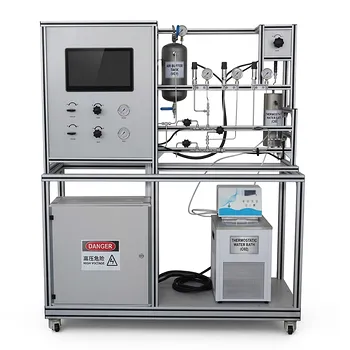
Dry-coal feeding operates at atmospheric pressure with high-velocity oxygen carrier gas, achieving fast kinetics at 1500–1600°C but requiring complex solid-feeding hardware. In contrast, coal-water slurry feeding uses pumps to inject the fuel into a pressurized (4–9.8 MPa), ultra-hot (up to 2000°C) reactor, where the water vaporizes and participates in the chemistry, yielding a hydrogen-rich syngas but incurring an energy penalty that lowers cold gas efficiency by roughly 10 percentage points.
The core trade-off in entrained-flow pilot plants is between the high thermal efficiency and mechanical complexity of dry feeding, and the operational simplicity but lower efficiency of slurry feeding. The selection of feed system directly sets the plant’s pressure regime, temperature profile, gas composition, and the kind of unit operations equipment students will encounter.
The Two Feeding Paradigms
Dry-Coal Feeding: Atmospheric Speed and Complexity
Dry-pulverized coal is conveyed into the gasifier by a high-velocity oxygen stream. This method eliminates liquid carrier delay, producing extremely low diffusion resistance and correspondingly high reaction rates.
Key process parameters include operating at atmospheric pressure and temperatures in the 1500–1600°C range. Because no water is introduced, all supplied energy drives coal conversion, resulting in a cold gas efficiency typically between 80% and 83%.
The operational penalty is handling. Dry feed requires specialized lock-hopper or rotary valve systems to meter solids reliably, especially if the pilot plant ever scales to pressurized configurations. Maintenance and safety protocols are more demanding for fine-pulverized coal dust.
Coal-Water Slurry Feeding: Pressurized Simplicity at a Cost
Slurry feeding mixes coal with water (typically 60–70% solids) and pumps it like a liquid. This enables simple, reliable, high-pressure feeding—a significant operational advantage for pilot plants demonstrating industrial-scale concepts.
The reactor operates at pressures from 4 to 9.8 MPa and achieves internal temperatures up to 2000°C (outlet ∼1400°C). The water flash-vaporizes upon injection, consuming about 10–15% of the gasifier’s thermal input and lowering cold gas efficiency (69–77%).
However, the resulting syngas is rich in H₂ (35–36%) and CO (44–51%), making it attractive for chemical synthesis. Operationally, the pilot plant will feature high-pressure slurry pumps and atomization nozzles whose spray characteristics critically influence carbon conversion and are a key educational focus.
Key Process Parameter Showdown
Pressure and Mechanical Design
Dry-coal systems, as demonstrated in the Koppers-Totzek (K-T) type, are inherently atmospheric to avoid the extreme challenge of locking solids into a pressurized vessel. Slurry systems are inherently pressurized, pushing the reactor shell and downstream handling toward ASME-coded pressure vessels and high-pressure let-down valves.
Temperature and Kinetics
Dry-fed gasifiers run at lower absolute temperatures (1500–1600°C) but achieve very high reaction rates because the coal particles are immediately surrounded by oxygen. Slurry gasifiers must operate 200–400°C hotter to compensate for the water quench effect, stressing refractory linings and burner tips. Yet the higher final temperature ensures slag tapping and high carbon conversion.
Gas Composition and Efficiency
Slurry injection introduces steam as a coreactant, shifting the equilibrium toward H₂ and CO₂. Dry feeding typically produces a lower H₂/CO ratio because the primary reaction is partial oxidation. Efficiency-wise, the energy penalty for vaporizing water makes dry feeding the unequivocal winner—80–83% cold gas efficiency vs. 69–77%—a difference that becomes economically critical when students scale their pilot data to commercial viability.
Understanding the Trade‑offs
Thermal Efficiency vs. Mechanical Reliability
The central operational conflict is between process efficiency and equipment simplicity. Slurry feeding trades thermal losses for pump-based, reliable pressurization that eliminates the notorious down-time risks of lock-hopper systems. Dry feeding prioritizes fuel economy and oxygen consumption at the expense of complex solids-handling hardware that can dominate maintenance budgets.
Educational and Pilot Plant Focus
For a vocational or university pilot plant, the choice defines the curriculum. A slurry-fed unit lets students characterize high-pressure slurry pumps, atomization nozzle physics, and steam-to-carbon tuning. A dry-fed unit focuses lessons on pneumatic conveying, dust explosion safety, and lock-hopper valve dynamics. The thermodynamic “carrier cost” becomes a tangible metric students can measure directly through cold gas efficiency calculations.
Common Pitfalls
- Assuming dry feed always means low pressure – While K‑T is atmospheric, some dry-fed designs use staged pressurization; this increases complexity but is feasible at pilot scale, blurring the comparison.
- Ignoring slurry atomization – Poor nozzle maintenance can drop carbon conversion by 5–10 percentage points, negating any pressure-based reactivity benefit.
- Overlooking oxygen consumption – Slurry systems require more oxygen to overcome the water load, which, at scale, ripples through the air separation unit’s economics.
Making the Right Choice for Your Goal
The feeding decision should flow from your pilot plant’s primary objective.
- If your primary focus is maximizing cold gas efficiency and studying rapid reaction kinetics: Favor a dry-coal, atmospheric system. You will trade mechanical complexity for effluent data that directly scales to high‑efficiency power or fuel production.
- If your primary focus is demonstrating high‑pressure process reliability and pump‑based feeding for chemical synthesis: Choose a slurry-fed system. The lower efficiency is offset by the hands‑on experience with industrial‑style pumping, atomization, and the generation of a synthesis‑ready, H₂‑rich syngas.
- If your primary focus is creating a balanced teaching platform for unit operations: Opt for a modular pilot plant that can showcase both. If not possible, the slurry unit’s combination of high‑pressure operation, clear thermodynamic penalty, and rich nozzle physics often provides a more diverse set of student learning objectives.
In any case, the feed system you select becomes the definitive instructor for your team—rigorously teaching either the art of balancing energy in a hot reactor or the art of reliably feeding a solid into a high‑pressure world.
Summary Table:
| Parameter / Feature | Dry-Coal Feeding System | Coal-Water Slurry Feeding System |
|---|---|---|
| Operating Pressure | Atmospheric (typically) | High pressure (4–9.8 MPa) |
| Gasifier Temperature | 1500–1600°C | Up to 2000°C (internal) |
| Cold Gas Efficiency | 80% – 83% (High) | 69% – 77% (Lower energy penalty) |
| Syngas Composition | Lower $H_2/CO$ ratio | Hydrogen-rich ($35\text{-}36% H_2$, $44\text{-}51% CO$) |
| Mechanical Complexity | High (lock-hoppers, solids metering) | Low (liquid slurry pumps, atomizers) |
| Primary Educational Focus | Pneumatic conveying & solids handling | Pump characterization & nozzle physics |
Equip Your Lab with Industry-Grade Unit Operations
Choosing the right gasification feeding system is crucial for aligning your curriculum or research with industrial realities. LABPARK provides state-of-the-art Educational and Vocational Unit Operations Pilot Plants in chemical engineering, bioprocess & biotech, and environmental & water treatment.
Designed specifically for universities, research institutes, and enterprises, our pilot plants help students master complex concepts like thermodynamics, mass balances, and process control in a safe, controlled environment.
Ready to elevate your training and research capabilities? Contact LABPARK today to discuss your custom pilot plant requirements!
Related Products
- Two Phase Flow Pattern Velocity Resistance Measurement Educational Pilot Plant
- Gas Phase Mixing and Residence Time Distribution Determination Educational Unit Operations Pilot Plant
- Fixed-Bed Chemical Reaction and Gas Dust Tar Removal Unit Operations Pilot Plant
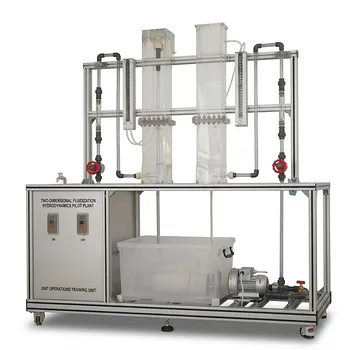
- Two-Dimensional Fluidization Hydrodynamics Educational Pilot Plant for Unit Operations Training
- Dual-Mode Gas Absorption and Desorption Unit Operations Training Pilot Plant
People Also Ask
- How to update chemometric calibration models in pilot plants? Best practices for process engineers.
- Why Correct Sig Figs & Rounding Matter in Educational Pilot Plants: Ensure Data Accuracy
- How can educational pilot plants be used to teach process safety and risk assessment in chemical engineering curricula?
- How does nuclear yield inefficiency translate to chemical engineering education? Optimize kinetics with pilot plants.
- What safety requirements must educational pilot plants meet? Ensure Lab Safety