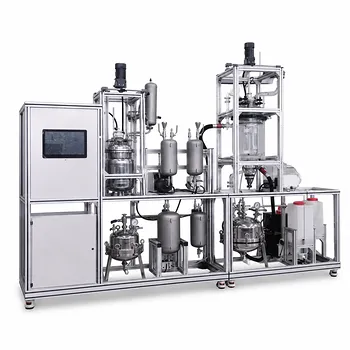
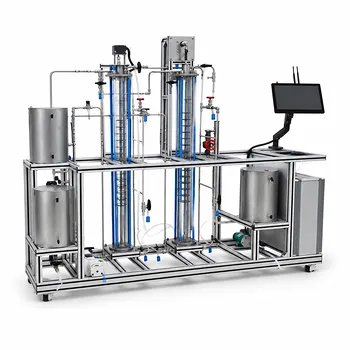
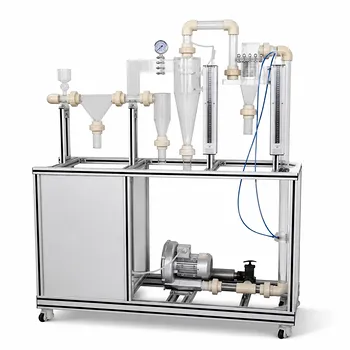
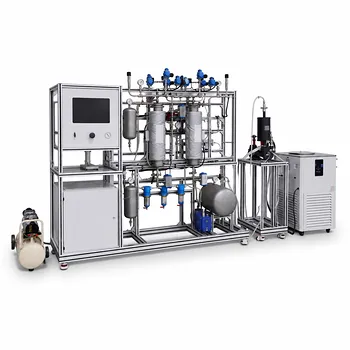
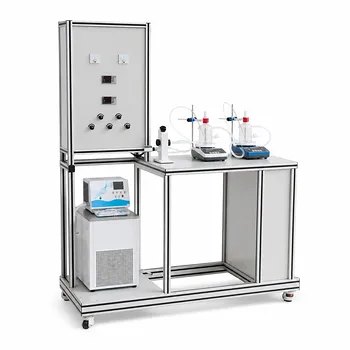
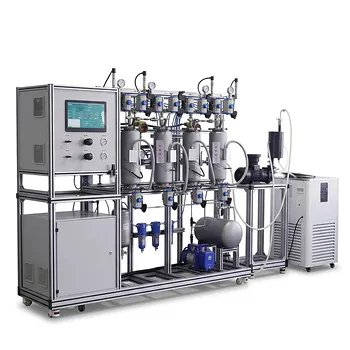
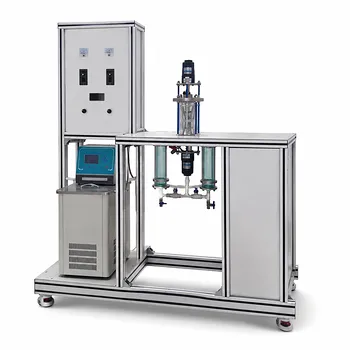
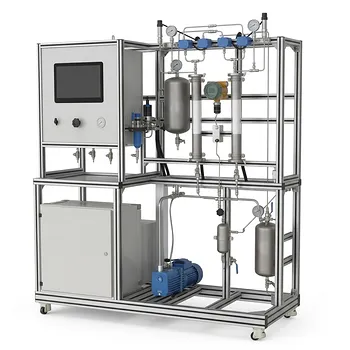
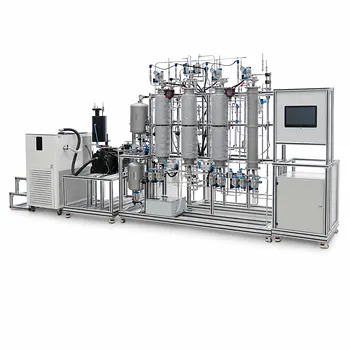
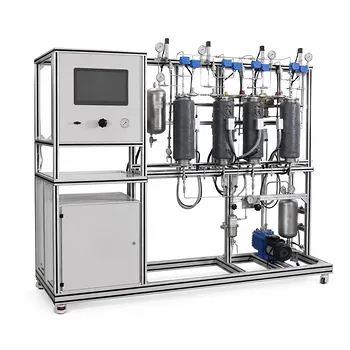
Flash expansion, gravity settling, and gas scrubbing form the core unit operations for separating complex liquid-liquid-gas mixtures such as gas liquor. In a laboratory pilot plant, these steps are studied by using a train of transparent vessels equipped with sensors—allowing researchers to visually track phase disengagement, measure residence time distributions, and quantify separation efficiency under controlled conditions.
The deep need isn’t just listing the equipment—it’s understanding how to design, sequence, and validate a multi-phase separation train in a safe, observable setting. Pilot plants bridge the gap between idealized thermodynamics and the messy realities of emulsion breaking, density-driven settling, and dissolved gas release, giving engineers the data needed to size industrial decanters, flash drums, and scrubbers.
The Core Unit Operations in Multi-Phase Separation
When a stream carries gas, two immiscible liquids, and often fine solids, no single device can split everything cleanly. The separation must be staged to leverage different driving forces at each step.
Step 1: Gas-Liquid Flashing in Expansion Vessels
Any pressurized liquid containing dissolved gases will release them when the pressure drops. The first operation passes the feed through an expansion (flash) vessel, where a sudden pressure reduction allows light ends and permanent gases to evolve as a separate vapor stream.
In a gas liquor system, this initial disengagement prevents gas bubbles from destabilizing downstream liquid-liquid separation. Pilot plants replicate this with small flash drums equipped with back-pressure regulators, letting students measure the volume of liberated gas versus equilibrium predictions.
Step 2: Gravity Settling and Decantation for Bulk Phase Split
Immiscible liquid phases separate under gravity when left undisturbed for a sufficient residence time. The second unit operation channels the degassed liquid into a horizontal or vertical separator, where a heavy phase (tar), a lighter aqueous phase (water), and a light organic phase (oil) stratify by density.
In a pilot plant, this is often a modular decanter with adjustable weirs or overflow legs. By changing the weir height or flow rate, researchers can see exactly how the interface position shifts, quantify emulsion pad thickness, and measure the droplet coalescence time—critical inputs for designing full-scale oil-water-tar separators.
Step 3: Gas Scrubbing for Polishing and Mass Transfer
Trace contaminants or valuable components remaining in the gas phase must be recovered or neutralized. The third unit operation scrubs the evolved gas with a suitable liquid (e.g., water, alkaline solution, or lean oil) in a small absorption column.
This step transforms the lab setup from a simple phase splitter to a complete mass transfer train. Students can measure pressure drop across packing, analyze inlet and outlet gas composition, and calculate the height of a transfer unit (HTU) for the specific contaminant—directly mirroring industrial acid gas or stripping columns.
How Laboratory Pilot Plants Bring These Operations to Life
Studying a complex liquid-liquid-gas separation purely through simulation is risky. Pilot plants introduce real fluids and real time constants, revealing behaviors that process simulators smooth over.
Visual Transparency Unlocks Intuition
Educational pilot plants favor borosilicate glass columns and vessels precisely because you can see what’s happening. Researchers literally watch the gas breakout pattern in the flash drum, the clarity of the liquid-liquid interface in the decanter, and the flooding point in the scrubber. This builds an instinct for troubleshooting—spotting emulsion crud layers or entrainment that a pressure gauge alone would miss.
Real-Time Data Collection for Mass and Energy Balances
Modern pilot plants integrate temperature, pressure, level, and flow sensors along the entire train. The supplementary references highlight that these instruments enable the same kind of automated, real-time monitoring seen in industry. Students close mass balances around each unit, verify that the measured vapor flow matches the depressurization enthalpy balance, and quantify where losses occur—often from imperfect decantation or unexpected solubility.
Bridging Theory to Design with Residence Time Studies
The biggest design question for gravity separators is “How long must the mixture stay?” In a pilot plant, you can perform step-change tracer tests to measure the actual residence time distribution. You quickly discover that dead zones and short-circuiting reduce effective volume below the geometric volume. This drag-and-drop understanding of fluid dynamics inside a real vessel is impossible to replicate with textbook equations alone.
Emulsion Breaking and Interface Dynamics
Liquid-liquid mixtures often form stable emulsions that defy simple density calculations. The pilot plant becomes a testbed for emulsion-breaking strategies—adjusting pH, adding heat, or introducing coalescing media. By observing how the rag layer thickness changes with flow rate or chemistry, researchers gather the kinetics needed to size industrial electrostatic coalescers or mesh pad demisters.
Understanding the Trade-offs and Limitations
No matter how well-designed, a laboratory pilot plant has constraints you must respect to avoid drawing wrong conclusions.
Scale-down compromises mixing and wall effects. The ratio of wall surface area to fluid volume is much larger in a pilot decanter than in a 10-meter industrial vessel, which can exaggerate heat losses and distort coalescence behavior. Data on settling velocities must be carefully scaled using dimensionless groups like the Reynolds and Bond numbers, not just linear throughput.
Model fluids may hide real-world complexity. While the primary reference describes a gas liquor containing tar and oil, pilot plants for education often substitute safe model fluids. This makes the concept visible but can mask issues like fouling, variable viscosity, or waxy solids that disrupt real industrial separators. The separation principles transfer, but the mechanical reliability challenges do not.
Process integration demands careful control. A pilot plant linking flash, decantation, and scrubbing units introduces interactions—downstream pressure fluctuations can upset upstream liquid levels. Learning to tune these integrated controls is itself a major educational outcome, but it also means the data reflect your control scheme, not just the unit operation physics.
Making the Right Choice for Your Goal
Your specific objective determines which aspects of a multi-phase pilot plant to emphasize and how to interpret the results.
- If your primary focus is education on separation fundamentals: Use a glass, modular pilot plant with safe model fluids. Concentrate on closing mass balances, measuring residence time distributions, and visually correlating interface behavior with flow disturbances.
- If your primary focus is scale-up for an industrial gas liquor process: Run the pilot plant with the actual production fluids at target temperatures. Prioritize emulsion stability tests, decanter weir geometry optimization, and long-duration fouling trials over academic mass balance accuracy.
- If your primary focus is developing a new scrubber design: Decouple the scrubbing section and feed it a synthetic gas mixture. Systematically vary liquid-to-gas ratios and packing types while measuring pressure drop and removal efficiency to build a scalable performance model.
Ultimately, a laboratory pilot plant for liquid-liquid-gas separation is a decision-making tool. It reveals what your process simulator’s ideal stages can’t predict—the real-world mixing, emulsion persistence, and interface control challenges that dictate whether a separation works in the plant, not just on paper.
Summary Table:
| Unit Operation | Driving Force / Mechanism | Key Pilot Plant Study Focus |
|---|---|---|
| Flash Expansion | Pressure reduction / flashing | Dissolved gas release & equilibrium validation |
| Gravity Settling | Density difference / decantation | Phase interface shifts, residence time & emulsion breaking |
| Gas Scrubbing | Mass transfer / absorption | HTU calculation, pressure drop, trace contaminant recovery |
Accelerate Your Research and Teaching with LABPARK Pilot Plants
Translating complex thermodynamic separation theories into practical industrial designs requires hands-on validation. LABPARK designs and manufactures premium Educational and Vocational Unit Operations Pilot Plants in chemical engineering, bioprocess & biotech, and environmental & water treatment for universities, research institutes, and enterprises.
With our highly visual, sensor-integrated glass systems, you can safely study real-world emulsion breaking, residence time distributions, and mass transfer kinetics.
Ready to upgrade your laboratory capabilities? Contact LABPARK today to customize your pilot plant setup!
Related Products
- Gallium and Indium Selective Extraction Educational Pilot Plant
- Comprehensive Liquid-Liquid Extraction Pilot Plant for Engineering Education
- Gas-Solid Heterogeneous Separation Demonstration Educational Unit Operations Pilot Plant
- Bench Scale Dual Column Gas Separation and Capture Educational Pilot Plant
- Ternary Liquid-Liquid Equilibrium Educational Pilot Plant
People Also Ask
- How do pilot plants differentiate physical vs chemical extraction? Enhance Chemical Engineering Training
- What is the significance of the isopycnic line in liquid-liquid extraction? Avoid Column Flooding
- Why is predicting multicomponent LLE from binary data more challenging than VLE? Master your pilot plant design.
- How do droplet motion states affect kD in extraction pilot plants? Optimize Mass Transfer
- How to Validate BIPs for LLE Pilot Plants? Steps to Align Simulations with Reality