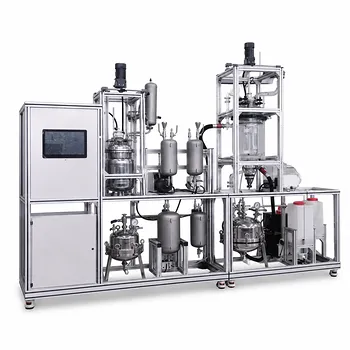
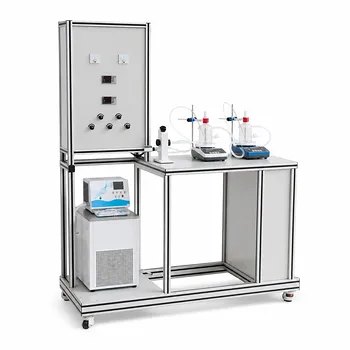
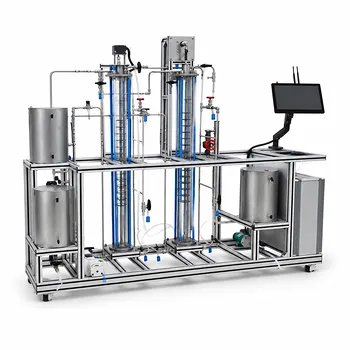
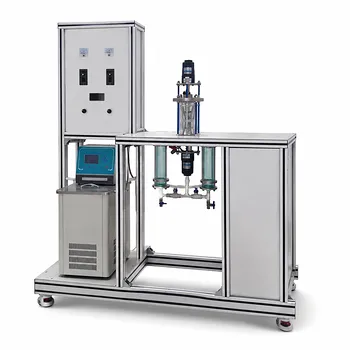
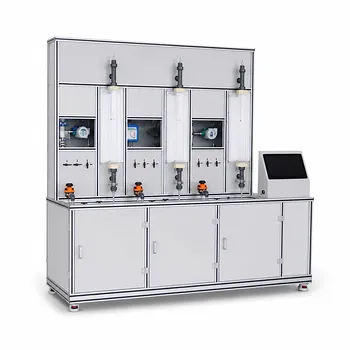
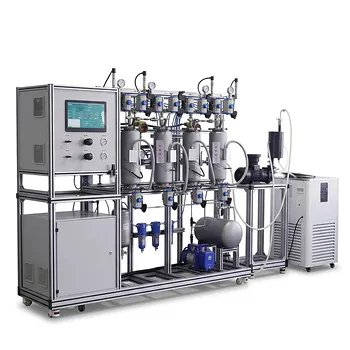
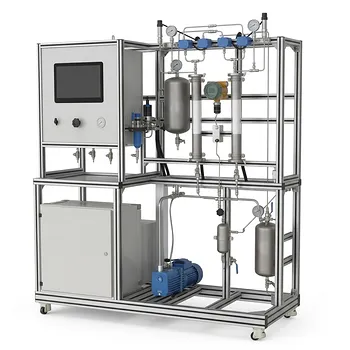
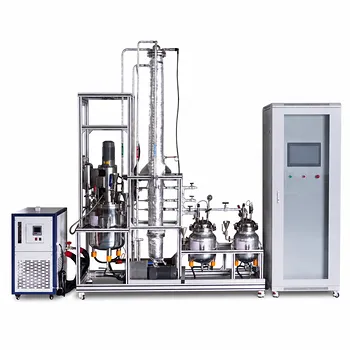
For demonstrating liquid-liquid phase separation and slag‑like impurity removal in a chemical engineering curriculum, the most suitable unit‑operation pilot plants are liquid–liquid extraction trains and gravity settling separators.
These systems operate with safe, immiscible model fluids at ambient or moderate temperatures, yet they perfectly replicate the density‑driven separation, interface dynamics and coalescence behaviour that govern high‑temperature slag‑metal separation. By working with such pilot plants, students can directly observe and measure the same fundamental transport phenomena—settling velocity, interfacial tension effects, residence time distribution and interface detection—without the extreme hazards of molten metals and slags.
The central insight: A liquid–liquid extraction or gravity settling pilot plant is the safest, most educationally rich analogue for slag‑like impurity removal, because it isolates the identical physical principles—density difference, phase disengagement and coalescence—that control industrial metallurgical separation, while letting students visualise and instrument the entire process.
Why liquid‑liquid and settling pilot plants are the right analogue
Mimicking slag separation at safe temperatures
Industrial slag removal exploits a large density contrast between molten metal and a reactive slag layer (e.g. CaO‑SiO₂ melts at 1000‑1200°C).
Bringing such conditions into a teaching lab is simply not feasible due to extreme hazards and infrastructure demands.
An educational liquid‑liquid or gravity settling pilot plant replaces the metal/slag pair with two immiscible liquids of known density difference—for instance, water and a heavier organic solvent doped with a colour tracer.
The physics of phase disengagement is identical: the heavier “slag‑like” phase settles, the lighter “metal‑like” phase overflows, and the sharp interface between them can be observed through transparent vessel walls.
Visualising density‑driven phase separation
In a transparent settler or mixer‑settler, students watch the formation of a clear phase boundary.
They can measure settling times, estimate droplet rise/fall rates, and immediately connect those observations to Stokes’ law and the actual density difference of their model fluids.
This direct visual link between theory and measurement is what makes the pilot plant genuinely educational.
It transforms abstract transport phenomena into a tangible, measurable experiment.
Bridging fundamental principles and industrial metallurgy
When students run a liquid‑liquid extraction unit configured as a simple gravity settler (without mass transfer), they replicate the core hydrodynamic step that occurs inside a slag‑metal separator.
They learn how fluid viscosity, density difference, interfacial tension and flow geometry govern the rate of impurity removal—concepts that map directly onto the design of industrial decanters, settler tanks and even continuous casting tundishes.
Moreover, by later introducing a solute that partitions between the two phases, the same pilot plant can demonstrate liquid‑liquid extraction, expanding the learning scope to mass transfer and purification.
Key features of an educational pilot plant
Choice of unit: mixer‑settlers versus continuous columns
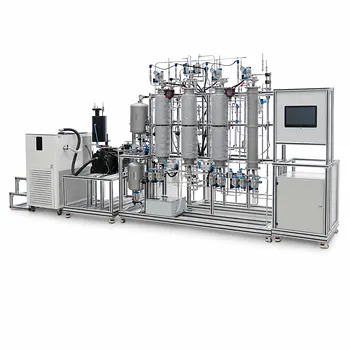
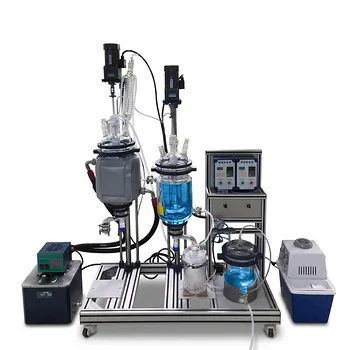
Mixer‑settler cascades are the most intuitive setup for slag‑like impurity demonstration.
Each stage consists of a stirred vessel where the two liquids are dispersed, followed by a quiescent settling chamber where they separate. Students directly observe droplet break‑up, coalescence and phase disengagement, then sample each phase to track “impurity” progress.
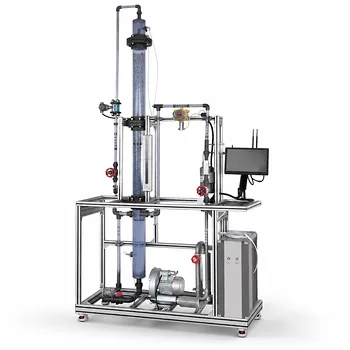
Continuous extraction columns (spray, packed or pulsed columns) are better when the focus is on steady‑state operation and mass transfer alongside phase separation.
In the context of a slag analogue, a pulsed column or a simple spray column can demonstrate how counter‑current flow affects residence time and interface stability, illustrating the importance of axial mixing—a critical scale‑up factor.
Instrumentation that reinforces engineering practice
A well‑equipped pilot plant should include differential‑pressure or conductivity‑based interface level detection, peristaltic or diaphragm pumps with precise flow control, and online pH/conductivity sensors.
This exposes students to the same process analytical technology (PAT) now standard in modern refineries and metallurgical plants.
Recording real‑time data on phase interface position and pump flow rates allows them to calculate residence time distributions and observe the onset of entrainment or emulsification—directly linking equipment design to process robustness.
Model fluid systems that emulate slag behavior
Choosing the right fluid pair is critical for an instructive experiment.
A typical safe system uses a heavy halogenated solvent (e.g., dichloromethane or a heavier halogenated oil) as the “slag” phase and an aqueous solution as the “metal” phase, with a dye selectively dissolved in the heavy phase.
To mimic the small density differences encountered in real slag‑metal systems, you can intentionally tune the composition—for instance, by diluting the heavy solvent with a lighter miscible oil.
This forces students to confront the slow coalescence and emulsification challenges that are otherwise invisible with a large density gap.
Understanding the trade‑offs and limitations
Small density differences slow down separation
When density contrast is deliberately reduced to approximate real systems, settling velocities become very small.
Students see that even a few percent change in composition can turn a sharp interface into a diffuse rag layer, teaching them why industrial vessels must be oversized and why coalescence‑enhancing internals are essential.
Emulsification and axial mixing can dominate
In a mixer‑settler, excessive agitation readily creates stable emulsions, especially if surfactants are present—even trace impurities can drastically change interfacial tension.
This is a powerful lesson, but it can also frustrate students if not carefully controlled. The pilot plant must allow easy adjustment of impeller speed and visible access to judge the dispersion quality.
What a liquid‑liquid pilot plant does not capture
While the fluid dynamics are analogous, the chemical role of slag—its reactivity with impurities (e.g., CaO + SiO₂ → CaSiO₃)—is absent in a purely physical model.
To incorporate that aspect, one could add a reactive component that precipitates or changes colour upon contact, but that introduces complexity that may distract from the core phase‑separation lesson.
Our recommendation is to treat the liquid‑liquid settling experiment as a hydrodynamic analogue, and later supplement it with a separate bench‑scale precipitation experiment (e.g., heavy‑metal sulfide precipitation) to cover the chemical removal mechanism.
How to match the pilot plant to your learning goals
- If your primary focus is demonstrating the physical principle of density‑driven impurity removal: Choose a simple, transparent gravity settling tank with two immiscible liquids and visual interface tracking. This gives the most direct, intuitive analogy to slag‑metal separation.
- If your primary focus is studying coalescence, interfacial tension and scale‑up effects: A mixer‑settler cascade or an extraction column with variable agitation and online interfacial‑level control is ideal, because it exposes students to emulsification, axial mixing and residence‑time distribution challenges.
- If your primary focus is combining separation with mass transfer education: Use the same liquid‑liquid extraction plant to first run a simple settling experiment, then introduce a solute (e.g., an acid or a dye) that partitions between phases, connecting impurity removal with extraction fundamentals.
- If your primary focus is preparing students for modern automated plants: Ensure the pilot plant is fitted with PAT probes, data logging and programmable logic control (PLC) for flow and level loops, so students practice real‑time monitoring and feedback control during phase separation.
The right pilot plant turns a textbook diagram into a live, instrumented process—and nothing builds engineering intuition faster than seeing a “slag” layer slowly clear, knowing exactly which fluid properties and operating choices made it happen.
Summary Table:
| Pilot Plant Type | Slag Separation Analogue | Key Learning Objective |
|---|---|---|
| Gravity Settling Separator | Simulates density-driven phase boundary formation and settling velocity. | Stokes' Law, interface level tracking, and residence time distribution. |
| Mixer-Settler Cascade | Visualizes droplet break-up, coalescence, and multi-stage separation. | Stage efficiency, emulsion challenges, and scale-up dynamics. |
| Continuous Extraction Column | Models steady-state counter-current flow and interface stability. | Column hydrodynamics, axial mixing, and mass transfer principles. |
Enhance Your Engineering Curriculum with LABPARK
Bring industrial-scale concepts safely and visually into your laboratory. LABPARK provides premier Educational and Vocational Unit Operations Pilot Plants in chemical engineering, bioprocess & biotech, and environmental & water treatment, tailored specifically for universities, research institutes, and enterprises.
Ready to elevate your training capabilities? Contact LABPARK today to discover how our customized pilot plants can transform your educational and research programs.
Related Products
- Gallium and Indium Selective Extraction Educational Pilot Plant
- Ternary Liquid-Liquid Equilibrium Educational Pilot Plant
- Comprehensive Liquid-Liquid Extraction Pilot Plant for Engineering Education
- Hot Filtration Educational Unit Operations Pilot Plant Laboratory System
- Liquid-Liquid Mass Transfer Coefficient Determination Educational Pilot Plant
People Also Ask
- How do pilot plants differentiate physical vs chemical extraction? Enhance Chemical Engineering Training
- What is the significance of the isopycnic line in liquid-liquid extraction? Avoid Column Flooding
- How do droplet motion states affect kD in extraction pilot plants? Optimize Mass Transfer
- Why is predicting multicomponent LLE from binary data more challenging than VLE? Master your pilot plant design.
- How are ternary phase diagrams and LLE data applied in extraction experiments? Optimize Pilot Plant Scale-up