The answer lies not in choosing one property, but in prioritizing a robust, multi-property regression. You must prioritize thermodynamic parameters that are developed simultaneously from volumetric (PVT), calorimetric (enthalpy), and phase equilibrium (VLE) data. This holistic approach prevents the model from accurately predicting one property at the expense of others, which is a common pitfall when modeling non-ideal mixtures in educational pilot plants.
Standard equations of state fail predictably when stretched beyond their design. The core challenge in teaching equipment is preventing predictive failure during complex separations. The priority, therefore, is not just collecting data, but regressing temperature- and pressure-independent binary interaction parameters from a multi-property foundation to ensure the model is flexible, consistent, and physically meaningful.
The Foundation: Multi-Property Parameter Regression
When teaching with unit operations equipment, the goal is to connect theoretical models to real-world behavior. For non-ideal mixtures, a model tweaked to fit only vapor pressure will often misrepresent liquid density, leading to flawed equipment sizing calculations. This disconnect between simulation and experiment is the critical teaching moment.
Why Volumetric Data is Non-Negotiable
Liquid molar volume directly impacts column sizing, pipe diameter, and residence time calculations. A model that gets density wrong will undermine all subsequent physical design.
For highly asymmetric mixtures—like those containing water and hydrocarbons—a modified approach is required. Using a three-parameter equation of state, such as the modified Van der Waals (M-VDW) equation with its symmetry (S) and energy (A) parameters, allows for accurate prediction of liquid molar volume within ±2%.
The Calorimetric Anchor: Enthalpy
A model’s ability to predict vapor-liquid equilibrium might look perfect on a paper plot, yet fail completely to calculate the energy required for the separation. This is a catastrophic failure for pilot plant operation.
Heat exchanger duties and reboiler energy demands are derived from enthalpy calculations. For polar compounds, calculated enthalpy deviations from density data are notoriously unreliable and must be validated against direct calorimetric data. Constraining your EOS parameters with experimental enthalpy anchors ensures thermodynamic consistency between mass transfer and energy balance simulations.
The Heart of Separation: Vapor-Liquid Equilibrium (VLE)
VLE data defines the very possibility of separation, especially when azeotropes are present. In teaching, the ability to model an azeotrope's formation and its subsequent breakdown with an entrainer demonstrates the power and subtlety of applied thermodynamics.
The key is how you model the mixture's asymmetry. Standard cubic equations fail for large or highly polar molecules because their inherent mixing rules are too simplistic. For these systems, you must prioritize regressing robust binary interaction parameters from experimental VLE data of the specific mixture.
Generalizing Behavior: The Priority of Binary Interaction Parameters
The single greatest factor determining whether your VLE simulation will match your pilot plant's distillation column tray performance is the quality of your binary interaction parameters. This is where inaccurate simulations most often become teachable moments.
Temperature and Pressure Independence
A parameter that changes with every temperature run is not a parameter; it's a fudge factor. For educational clarity, you must prioritize parameters that are temperature- and pressure-independent.
This independence is crucial for modeling multi-component separations where temperature and pressure vary across the column. To achieve this, the parameters should be generalized as a function of fundamental molecular properties, like size-shape factors or polarity parameters, rather than being a simple empirical fit to one isotherm.
The Alternative for Associating Fluids
Standard cubic equations of state structurally fail for associating fluids like organic acids that form dimers in the vapor phase. No amount of parameter regression can fix a flawed functional form.
In these cases, the teaching priority shifts from binary interaction parameters to correct fugacity modeling. You must use the virial equation of state for the vapor-phase fugacity coefficient, coupled with a liquid-phase activity coefficient model. For fluids with strong association, the model must also incorporate a dimerization constant.
Ensuring Consistency: Data Quality Before Model Fit
The most sophisticated regression algorithm is useless if the experimental data is corrupted. In a pilot plant laboratory, the physical equipment itself introduces errors that must be understood before tuning the software model.
Why Surfaces and Phases Matter
For polar solvents, discrepancies between datasets are often caused by surface effects—physical adsorption or chemical reactions on the experimental apparatus. Students must learn to identify these anomalies.
The recommended procedure is to first "fix the coexistence dome." This means using the most reliable experimental two-phase properties—critical constants, the vapor pressure curve, and saturation densities—as hard boundaries. Then, constrain the PVT surface of the equation of state to align perfectly with these anchored boundaries. This ensures thermodynamic consistency from the ground up.
Understanding the Trade-offs
An EOS that works beautifully for a methane-ethane mixture can fail spectacularly when you introduce water. The critical pressure prediction is a perfect example of this variance. The modified Redlich-Ngo procedure may show an average deviation of 90.0 psia for methane mixtures, while the Chueh-Prausnitz method deviates by 278.0 psia. The choice of method is a decision about acceptable error.
- Flexibility vs. Complexity: A three-constant, three-parameter EOS offers much greater flexibility for modeling complex polarity and size asymmetry, but it requires significantly more high-quality, multi-property data to regress the parameters uniquely.
- Standard Models vs. Modifications: Moving away from standard Peng-Robinson to a heavily modified version solves many accuracy problems but sacrifices the simplicity and "plug-and-play" nature that can be beneficial for introductory teaching.
- Empirical Fit vs. Predictive Power: You can fit a binary interaction parameter to perfectly match one VLE dataset. However, that regressed parameter may have zero predictive value for a multi-component system unless it has been generalized correctly.
How to Apply This to Your Teaching Equipment
The best thermodynamic parameter strategy aligns your curriculum's learning objectives with the analytical methods.
- If your primary focus is material balance and phase behavior fundamentals: Prioritize the collection and regression of VLE data to build accurate Txy diagrams. Use this to teach the direct link between binary interaction parameters and the existence of azeotropes.
- If your primary focus is energy balance and equipment sizing: You must expand your data requirements beyond VLE. Anchor your EOS parameters with experimental enthalpy and volumetric (density) data to ensure your calculated heat duties and column diameters have real physical meaning.
- If your primary focus is demonstrating model limitations: Intentionally select systems for which standard models fail, such as associating fluids or highly asymmetric water-hydrocarbon mixtures. Use the predictive failure to introduce alternative models, like the virial EOS with activity coefficients, and the necessity of physical pilot plant validation.
The pilot plant is the ultimate arbiter of a model's value. By prioritizing a multi-property, physically-constrained approach to parameterization, you transform the inevitable discrepancies between simulation and reality into the most powerful learning experiences the equipment can provide.
Summary Table:
| Parameter Type | Core Data Source | Pilot Plant Impact |
|---|---|---|
| Volumetric (PVT) | Molar volume, liquid density | Accurate column sizing and piping design |
| Calorimetric | Enthalpy data | Precise heat duty and reboiler energy calculation |
| Phase Equilibrium (VLE) | Vapor-liquid equilibrium data | Reliable separation and azeotrope modeling |
| Binary Interaction | Temp/pressure-independent constants | Robust multicomponent simulation scaling |
Bridge the Gap Between Thermodynamic Theory and Real-World Operations
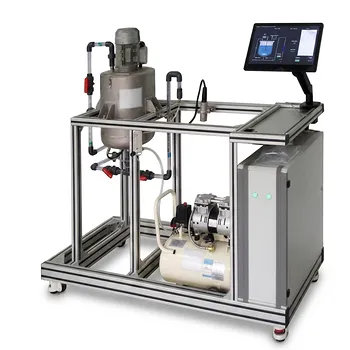
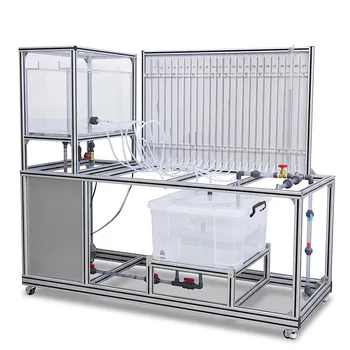
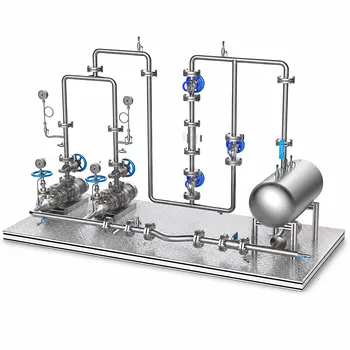
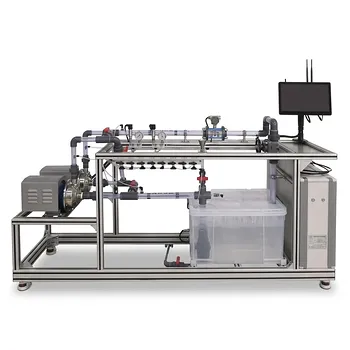
Don't let simulation errors disrupt your curriculum. LABPARK designs and delivers high-performance Educational and Vocational Unit Operations Pilot Plants for chemical engineering, bioprocess & biotech, and environmental & water treatment. Specifically tailored for universities, research institutes, and enterprises, our pilot plants provide students and researchers with hands-on, reliable validation of equations of state and non-ideal mixture behavior.
Ready to elevate your engineering lab? Contact LABPARK today to explore our customizable pilot plant solutions.
Related Products
- Agitation and Mixing Educational Unit Operations Pilot Plant
- Multi-Functional Membrane Separation Educational Pilot Plant for Unit Operations Lab
- Multi-Modal Distillation Unit Operations Training Pilot Plant
- Three-Tube Heat Transfer Educational Pilot Plant for Unit Operations Training
- Two-Dimensional Fluidization Hydrodynamics Educational Pilot Plant for Unit Operations Training
People Also Ask
- Why is the Reynolds number ($Re_M$) critical in mixing? Master N_P for pilot plants.
- What are the four guiding principles of process intensification? Educational Equipment Guide
- How do educational unit operations pilot plants support process analysis? Connect theory with real data
- How does the pseudobinary diffusion approximation simplify mass transport equations in educational pilot plants?
- Why is post-implementation performance evaluation and gap analysis critical when deploying educational unit operations pilot plants?