Alcohol‑hydrocarbon mixtures introduce a thermodynamic wild card: self‑association through hydrogen bonding.
Accurate vapor‑liquid equilibrium (VLE) modeling of such systems is a classic troubleshooting challenge in the chemical engineering lab. Alcohol molecules not only stick to themselves but can also cross‑associate with solvents like aromatics, creating strong deviations from ideality that standard cubic equations of state cannot capture. The answer lies in choosing activity‑coefficient models that explicitly account for association and anchoring them with carefully regressed binary parameters from experimental pilot‑plant data.
The root challenge is the energetic organization of hydrogen bonds, which adds a chemical reaction‑like contribution to physical mixing. Solving it demands a shift from simple equations of state to excess Gibbs energy frameworks—such as those derived from Flory's polymer‑solution theory or modern association‑capable models—always disciplined by real VLE measurements.
The Root of the Problem: Molecular Association and Non‑Ideality
Self‑Association of Alcohols
Alcohols form hydrogen‑bonded oligomers (dimers, trimers, and higher chains) even in the pure liquid state. This self‑association lowers the effective number of free, volatile molecules, dramatically altering the liquid‑phase fugacity.
When mixed with hydrocarbons, the dilution breaks some alcohol–alcohol bonds, releasing more “free” monomers. The resulting activity coefficients can rise well above unity, leading to strong positive deviations from Raoult’s law and often a minimum‑boiling azeotrope.
Cross‑Association with Solvents
In systems containing aromatic hydrocarbons or carbon tetrachloride, alcohol molecules form complexes through OH–π or charge‑transfer interactions. This creates a negative contribution to the excess Gibbs energy.
The competing forces of alcohol self‑association and alcohol–solvent cross‑association can produce unexpected VLE behavior: inflected activity coefficient curves, double azeotropes, or suppressed positive deviations that simple mixing rules completely miss.
Consequences for VLE Behavior
Neglecting association makes it impossible to predict whether a mixture will form an azeotrope, what the separation factor will be, or how sensitive the equilibrium is to temperature. In a laboratory distillation pilot plant, this translates directly to poor simulation fidelity and flawed column design.
Why Standard Equations of State Fall Short
The Limitations of Cubic EOS
Equations of state like Peng‑Robinson or Soave‑Redlich‑Kwong are built on a physical picture of dispersion and repulsion in non‑polar fluids. They lack any built‑in term for the strong, directional, saturable forces of hydrogen bonding.
For an alcohol‑hydrocarbon mixture, a cubic EOS might predict complete miscibility and near‑ideal VLE, while the real system exhibits a low‑boiling azeotrope. The missing physics leads to qualitatively wrong phase diagrams.
Binary Interaction Parameter Sensitivity
Fitting a single binary interaction parameter ( k_{ij} ) can partially patch the result, but it often cannot compensate for the fundamental structural inability of the model to reproduce association. Even with optimized ( k_{ij} ), predictions for three‑phase equilibria or hydrate formation remain unreliable because the energetic origins of the deviation are not captured.
Specialized Modeling Approaches That Capture Association
Flory’s Theory for Associating Mixtures
An early breakthrough was the application of Flory’s polymer‑solution theory to alcohol‑hydrocarbon systems. The model treats the alcohol as a mixture of linear associating chains and defines two equilibrium constants: one for alcohol–alcohol self‑association (A–A) and one for alcohol–solvent cross‑association (A–B).
This approach directly translates molecular association into a physical‑chemical excess Gibbs function. It naturally explains both positive deviations (from broken alcohol chains) and negative deviations (from strong A–B complexing) in a single consistent framework.
Activity‑Coefficient Models: NRTL, UNIQUAC, UNIFAC
Modern local‑composition models like NRTL and UNIQUAC can be fitted to represent highly non‑ideal VLE, including azeotropes. Their strength lies in flexibility: with suitable binary interaction parameters regressed from experimental data, they often reproduce the observed bubble and dew curves accurately.
For screening and design when data is scarce, group‑contribution methods such as UNIFAC offer predictive power. They build the solution from molecular fragments that can capture hydrogen‑bond interactions, though accuracy remains limited without tuning against some real measurements.
Modern Association Models: CPA and SAFT
Equation‑of‑state frameworks like the Cubic‑Plus‑Association (CPA) model and the Statistical Associating Fluid Theory (SAFT) explicitly incorporate a chemical association term. They combine a physical cubic EOS with a term derived from Wertheim’s theory that accounts for bonding sites.
These models can describe complex VLE, liquid–liquid equilibrium, and even derivative properties across wide ranges. However, they require pure‑component and cross‑association parameters that must be estimated from experimental data—often the same pilot‑plant measurements they aim to predict.
The Critical Role of Experimental Parameter Regression
Why Pilot‑Plant VLE Data Is Irreplaceable
No amount of theoretical elegance can substitute for laboratory‑scale phase equilibrium data. In a university or research pilot plant, VLE measurements provide the ground truth to tune the 2‑3 binary parameters that any of the above models need.
The primary reference emphasizes that models for alcohol systems must account for both A–A and A–B interactions, and the supplementary reference reinforces that insufficiently optimized interaction parameters cause simulation models to fail at predicting azeotropes or multi‑phase behavior. Both converge on the same requirement: rigorous experimental regression.
Avoiding the “Garbage In, Garbage Out” Trap
When binary parameters are not regressed against high‑quality, mixture‑specific VLE data, even the most advanced model produces unreliable phase diagrams. Pilot plants close the loop between theory and reality, teaching that a model is only as good as its tuned connection to the actual laboratory bench.
Understanding the Trade‑offs and Common Pitfalls
The Curse of Over‑Parameterization
NRTL and UNIQUAC models can become dangerously flexible when too many parameters are fitted simultaneously. They may reproduce the training data perfectly but lose all predictive power when extrapolated to new temperatures or compositions—exactly what happens when scaling up from lab data to an industrial column.
Temperature and Pressure Sensitivity
Association energetics are highly temperature‑dependent. Binary parameters regressed at one temperature often fail at another, especially for systems where cross‑association weakens significantly with heating. Always validate over the full temperature range of interest, or choose a model with built‑in temperature functionality like SAFT.
Ignoring Azeotropic Data
If you fit a model only to data points away from the azeotrope, you risk getting the azeotropic composition and temperature completely wrong. In alcohol‑hydrocarbon systems, the azeotrope is often the most critical feature for distillation design—missing it makes the model useless for separation tasks.
Computational Cost vs. Practical Need
CPA and SAFT models, while physically grounded, involve iterative solution of association equilibria and can be computationally heavy. For a single‑stage flash or simple binary distillation, a well‑fitted NRTL model often delivers the same engineering answer with far less effort. Choose complexity only when the problem demands it.
Making the Right Choice for Your Simulation Goal
- If your primary focus is reproducing a specific alcohol‑hydrocarbon binary with high fidelity: Regress NRTL or UNIQUAC binary parameters against your own carefully measured pilot‑plant VLE data, and explicitly include azeotropic points in the regression set.
- If you need a predictive tool for screening or solvent selection: Start with a group‑contribution method like UNIFAC, but treat the results as a first estimate and validate at least a few key points experimentally before committing to a process design.
- If the system shows strong alcohol‑aromatic complexes that lead to unusual phase behavior: Adopt a Flory‑based excess Gibbs model or a modern framework like CPA, which separately parameterizes self‑ and cross‑association, and invest the time to regress the required equilibrium constants.
- If your simulations encounter three‑phase regions or hydrate formation: Recognize that standard approaches break down; implement association‑capable equations of state and recalibrate all binary interaction parameters using targeted pilot‑plant measurements.
Mastering alcohol‑hydrocarbon VLE is less about choosing the “best” model and more about matching the model’s physics to the molecular reality, then grounding it in honest experimental data. When you honor that principle, even the most stubborn azeotrope becomes a predictable, manageable feature of your separation process.
Summary Table:
| Thermodynamic Model | Key Feature | Best Use Case |
|---|---|---|
| NRTL / UNIQUAC | Local-composition model, highly flexible | Correlating specific binary VLE with experimental data |
| UNIFAC | Group-contribution predictive method | Initial screening and solvent selection when data is scarce |
| CPA / SAFT | Integrates physical cubic EOS with association terms | Complex multi-phase, high-pressure, or 3-phase systems |
Bridge the Gap Between VLE Theory & Experimental Reality with LABPARK
Accurate thermodynamic modeling relies on high-quality experimental data. LABPARK provides state-of-the-art Educational and Vocational Unit Operations Pilot Plants in chemical engineering, bioprocess & biotech, and environmental & water treatment.
Specially designed for universities, research institutes, and enterprises, our pilot plants allow you to generate precise, real-world VLE measurements to discipline and validate your simulation models.
Ready to upgrade your laboratory capabilities? Contact LABPARK today to find the ideal pilot plant solution for your research and training needs!
Related Products
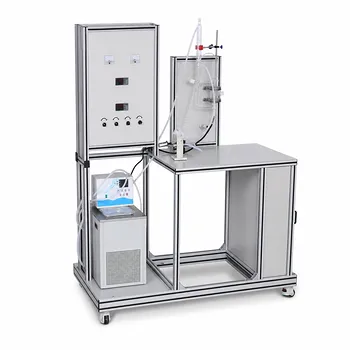
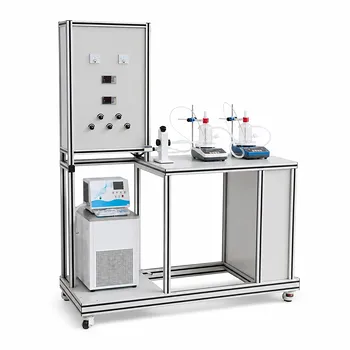
- Binary System Vapor Liquid Equilibrium Data Determination Educational Unit Operations Pilot Plant
- Two Phase Flow Pattern Velocity Resistance Measurement Educational Pilot Plant
- Ternary Liquid-Liquid Equilibrium Educational Pilot Plant
- Liquid-Liquid Mass Transfer Coefficient Determination Educational Pilot Plant
- Comprehensive Liquid-Liquid Extraction Pilot Plant for Engineering Education
People Also Ask
- How can pilot plants assist in validating VLE models? Bridge theory and physical reality.
- Why Collect Isothermal vs. Isobaric VLE Data? Key Pilot Unit Advantages
- How Do Equations of State Predict VLE in Pilot Plants? Optimize Your Separation Design
- How do intermolecular forces and molecular kinetic energy govern gas liquefaction and vaporization? Explore VLE pilot plants
- For VLE Experiments: Fugacity vs. Activity Coefficient Method Selection Criteria