Thermal lag in a kettle reactor can make a simple PID loop feel like steering a ship with a toothpick. The core solution implemented in pilot plants to handle this delay is cascade control. Instead of one controller fighting the entire thermal inertia alone, you establish a master loop for the slow-responding reactor temperature and a slave loop that quickly arrests disturbances in the jacket temperature, utility flow rate, or reactor pressure.
To faithfully mimic industrial reactor behavior and teach robust process control, a kettle reactor pilot plant must move beyond single-loop feedback. The definitive configuration for taming thermal lag is a cascade scheme, where a fast inner loop absorbs utility-side upsets before they ever disturb the delicate reaction temperature, turning a sluggish process into a responsive, teachable system.
Why Single-Loop Control Fails Against Thermal Lag
The Inertia Problem in Jacketed Vessels
A kettle reactor holds a large thermal mass—reactants, internals, and the jacket fluid itself. When the controller calls for heating or cooling, the energy must first overcome the metal wall and the liquid volume. The resulting measurement delay means the controller is always reacting to the past.
The Disturbance Rejection Gap
In a training environment, disturbances are inevitable: utility pressure drops, cooling water temperature swings, or exothermic peaks. A single-loop controller only sees these after the reactor temperature has already shifted. By then, overshoot and oscillation are locked in. Cascade control closes this gap by introducing a secondary measurement point much closer to the source of the disturbance.
Cascade Control: The Proven Solution for Kettle Reactors
How Cascade Control Works
A cascade scheme uses two controllers. The outer (master) controller monitors the reactor temperature and sends a remote setpoint to an inner (slave) controller. The inner controller then manipulates the final control element (a valve or heating power) based on a faster-responding variable. This structure rejects utility-side upsets in seconds, long before they reach the bulk reaction mass.
Configuration 1: Reactor Temperature to Jacket Temperature
This is the most common implementation. The master loop sets the desired jacket temperature, and the slave loop maintains it using a heating/cooling split-range valve or power controller. The jacket temperature sensor captures changes almost instantly, allowing the slave loop to correct for a cooling water supply surge before the reactor wall even feels it. This setup is ideal for teaching inner-loop tuning and understanding how secondary dynamics shelter the primary process.
Configuration 2: Reactor Temperature to Utility Flow Rate
Here, the master loop directly sets the flow rate of the heating or cooling medium. The inner loop becomes a simple flow control loop, which is inherently fast. This configuration shines when the jacket supply header pressure is unsteady, as the flow controller compensates immediately. In a training plant, this demonstrates how cascading to a physical property (flow) can linearize the final control element and simplify overall tuning.
Configuration 3: Reactor Temperature to Reactor Pressure (Boiling Systems)
For exothermic reactions run at the solvent's boiling point, temperature is tied to pressure via the vapor-liquid equilibrium. The master temperature controller sends a setpoint to a pressure controller that adjusts a reflux condenser coolant valve or a back-pressure regulator. Because pressure responds far more rapidly than liquid temperature, this inner loop provides exceptional disturbance rejection, turning the kettle into a near-isothermal system. This configuration directly illustrates the principles of evaporative cooling and vapor-compression dynamics.
Beyond Cascade: Supplementary Strategies for Robust Training
Split-Range Control for Seamless Heating/Cooling Transitions
A kettle reactor often cycles between heating and cooling. A split-range controller divides a single output signal to operate two valves—one for steam/hot oil, one for chilled water. This prevents simultaneous utility opposition and ensures smooth transitions. While not a solution for thermal lag on its own, split-range logic is typically embedded into the slave loop of a cascade system, giving students a complete picture of industrial actuator coordination.
Evaporative Cooling for Near-Isothermal Operation
When the reaction heat is removed through the latent heat of vaporization, the reactor operates at its boiling point. This method bypasses the thermal lag of sensible heat transfer through the jacket entirely. The temperature remains constant as long as the pressure is fixed. In a pilot plant, this strategy is often paired with Configuration 3 above, giving researchers a powerful tool to safely study highly exothermic, temperature-sensitive reactions.
Understanding the Trade-offs
Complexity vs. Pedagogical Value
Cascade control requires two sensors, two controllers, and careful tuning—tune the inner loop first, then the outer. For a training plant, this added complexity is not a flaw; it is the precise industrial challenge that engineers must master. However, it also demands instructors who can demystify the step-by-step commissioning process without overloading new operators.
Sensor and Actuator Limitations
A cascade strategy is only as reliable as its inner-loop measurement. A sluggish jacket temperature sensor or a sticking flow control valve can introduce its own dead time, undermining the cascade’s advantage. Pilot plants must be instrumented with low-inertia thermowells and high-performance positioners to ensure the configuration teaches sound principles, not equipment limitations.
Making the Right Choice for Your Training Goal
Faced with a kettle reactor, the configuration you implement should serve the educational objectives above all else.
- If your primary focus is demonstrating industrial best practices for batch reactors: Implement a reactor-to-jacket temperature cascade with a split-range slave loop. It is the industry standard and covers the most operational scenarios.
- If your primary focus is teaching students to tune PID loops and analyze process dynamics: Start with a reactor-to-flow cascade. The linear inner loop makes the system more predictable, highlighting the master controller’s role in compensating for the remaining vessel lag.
- If your primary focus is running highly exothermic or temperature-sensitive reactions safely: Adopt a reactor-to-pressure cascade with an overhead condenser. This configuration teaches the critical link between thermodynamics and control while providing unbeatable disturbance rejection.
Mastering thermal lag is, at its core, about teaching the next generation of engineers how to see the unseen delays in a process and counter them with structural control design—not just software tuning.
Summary Table:
| Configuration Type | Inner Loop Variable | Key Benefit / Ideal Application |
|---|---|---|
| Reactor Temp. to Jacket Temp. | Jacket Temperature | Rejects utility-side disturbances before they affect the reaction mass. |
| Reactor Temp. to Utility Flow | Utility Flow Rate | Linearizes control valve action and stabilizes header pressure fluctuations. |
| Reactor Temp. to Reactor Pressure | Reactor Pressure | Exceptional disturbance rejection for boiling, near-isothermal reactions. |
| Split-Range Control | Heating/Cooling Medium Valves | Prevents utility opposition during transitions between heating and cooling. |
| Evaporative Cooling | Latent Heat of Vaporization | Bypasses sensible heat transfer lag entirely for exothermic reactions. |
Bring Industrial-Scale Process Control to Your Lab with LABPARK
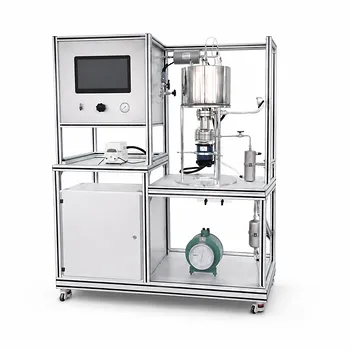
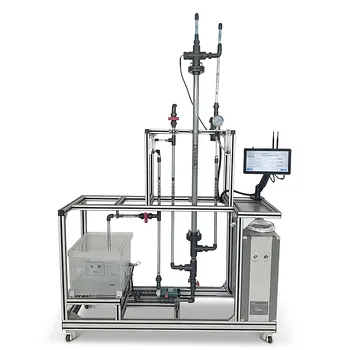
Teaching students to master complex process dynamics like thermal lag requires hands-on experience with realistic systems. LABPARK designs and manufactures high-quality Educational and Vocational Unit Operations Pilot Plants in chemical engineering, bioprocess & biotech, and environmental & water treatment for universities, research institutes, and enterprises.
Our pilot plants are equipped with industry-grade instrumentation and advanced control configurations (including cascade and split-range control) to prepare the next generation of engineers for real-world challenges.
Ready to elevate your training curriculum? Contact LABPARK today to explore our customizable pilot plant solutions!
Related Products
- Fixed-Bed Chemical Reaction and Gas Dust Tar Removal Unit Operations Pilot Plant
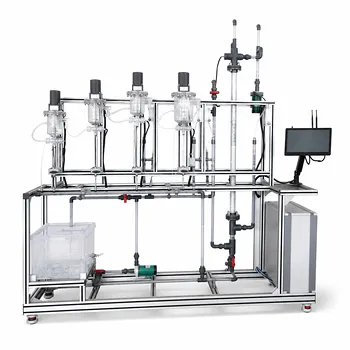
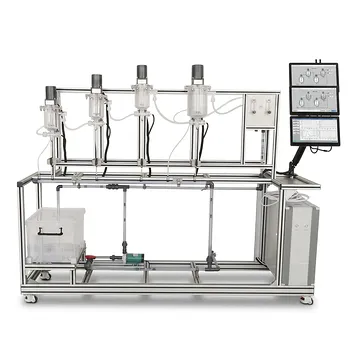
- Multi-Reactor Educational Pilot Plant for Reaction Engineering Unit Operations
- 100L Continuous Loop Hydrogenation Educational Unit Operations Pilot Plant
- Fluidized Bed Gas Solid Catalytic Reaction Educational Pilot Plant
- Internal Circulation Gradient Free Catalytic Reaction Educational Pilot Plant
People Also Ask
- When to transition from PID to adaptive control in pilot plants? Key process indicators.
- How do deviations in estimating latent heat impact pilot plant thermal systems? Avoid hardware mis-sizing.
- Why Compare Predicted and Experimental Excess Enthalpy? Key to Accurate Pilot Plant Scale-up
- How to study gasification in pilot plants? Compare exit gas composition & efficiency
- Why Use PTFE & Hastelloy in Chemical Pilot Plants? Prevent Corrosion & Ensure Safety