The Reynolds number is the master switch for mixing performance in zigzag micro-channels. In chemical engineering unit operations, it directly dictates whether species intermingle through slow molecular diffusion or rapid, convection-enhanced transport. Below a critical value (Re ≈ 80), the channel operates in a diffusion-limited plateau, yielding a moderate, constant efficiency around 81% and requiring long mixing lengths. Above that threshold, repeated bending at the channel’s corners generates secondary flow circulations that boost mixing efficiency to levels as high as 99% at Re = 267.
The Reynolds number acts as a dimensionless gatekeeper for zigzag micro-channels. It controls a sharp transition from a gentle, diffusion-dominated regime to a turbulent-like, secondary-flow regime. Harnessing this transition is the key to tailoring mixing speed, efficiency, and energy cost in micro-reactor design.
The Two Mixing Regimes: Diffusion vs. Convection
Zigzag micro‑channels owe their mixing behavior to an interplay between viscous forces and inertial forces—exactly what the Reynolds number quantifies. The channel’s serpentine geometry amplifies the impact of Re, creating two distinct operational windows.
Low Reynolds Numbers: The Diffusion-Limited Plateau
At Re ≤ 80, fluid movement is gentle and highly ordered. Inertial effects are too weak to generate cross‑stream disturbances.
- Mixing occurs solely through molecular diffusion. Layers of fluid slide past each other, and chemical species migrate across the channel purely by random molecular motion.
- Efficiency plateaus near 81%. Because the mechanism does not change, pushing more fluid through the channel does not improve the mixing fraction—it only reduces the time available for diffusion unless the channel is lengthened.
- The penalty is residence time. Achieving a homogeneous mixture demands a significantly longer channel, which can increase footprint and back‑pressure.
Above the Critical Threshold: Secondary Flows Take Over
Once the Reynolds number crosses roughly 80, fluid inertia begins to dominate. The zigzag turns become powerful mixers.
- Centrifugal instabilities create Dean‑vortex like secondary flows. At each sharp corner, the fluid is forced to change direction. The momentum imbalance drives transverse recirculation patterns that stretch and fold the fluid interfaces.
- Mixing efficiency surges. Optimized zigzag designs can reach 99% mixing at Re = 267. The rapid transverse transport continuously refreshes the contact area between species, dramatically reducing the required channel length.
- The gain is process intensification. Shorter residence times and smaller hardware footprints become possible, which is a major advantage in portable or pilot‑scale unit operations.
Why the Reynolds Number Matters in Unit Operations
The critical role of Re extends far beyond micro-channels. A clear understanding of dimensionless numbers is an engineer’s primary tool for predicting behavior across scales.
A Universal Dimensionless Guide
In larger stirred‑tank pilot plants, the mixing Reynolds number ($Re_M = \frac{n d^2 \rho}{\mu}$) governs power draw and impeller efficiency. At $Re_M < 10$, the Power number $N_P$ is inversely proportional to $Re_M$, and mixing is costly and slow. Above $Re_M \approx 10^4$, $N_P$ becomes a constant that depends only on impeller geometry, and mixing is far more efficient per unit of power.
Zigzag micro-channels follow the same philosophy. The Reynolds number tells you whether you are in a regime where viscous forces hide the real mixing cost (diffusion plateau) or where inertial forces unlock rapid convection. In both macro and micro domains, crossing the critical Re triggers a beneficial change in the flow structure—a universal principle for any chemical engineering unit operation that relies on mass transfer.
Design Levers Beyond the Reynolds Number
While Re is the central knob, geometry can shift the dial. The channel shape, size, and bending angle all modulate the exact Re value at which secondary flows become dominant.
Geometry Modifies the Onset of Convection
The primary reference shows that zigzag channels capitalize on repeated corners to induce secondary flows. The supplementary insight into micro‑tee mixers reinforces this: reducing a channel’s diameter from 254 µm to 100 µm improves mixing at the same Reynolds number.
- Sharper bends and smaller diameters intensify transverse transport. They shorten the diffusion path length and increase the surface area‑to‑volume ratio, making it easier for secondary flows to fold the fluid.
- You can therefore “engineer” the critical Re. A channel with aggressive zigzag angles might flip into the convection‑enhanced regime at a Re of 50 instead of 80, giving you high‑quality mixing with a lower flow rate and less pressure drop.
Understanding the Trade‑offs
Pushing the Reynolds number higher to chase better mixing is not a free lunch. Every design decision involves a compromise.
- Pressure drop rises sharply with flow rate. For a given channel geometry, doubling the Reynolds number typically means a significant increase in the upstream pressure required. This can lead to pump limitations or mechanical stresses in thin‑walled micro‑devices.
- Shear forces can become destructive. In biological or nanoparticle applications, intense recirculation zones may tear cells, denature proteins, or cause undesirable aggregation. A diffusion‑limited, low‑Re operation might be gentler and more product‑safe.
- Pilot‑plant scale‑up demands balance. A regime that works beautifully in a 100 µm channel may translate into excessive energy costs or by‑product formation when scaled up. The Reynolds number must be considered alongside the overall process economics and product quality requirements.
Making the Right Choice for Your Goal
Your target application determines the ideal Reynolds number window. Use these guidelines to navigate the trade‑offs.
- If your primary focus is rapid, high‑throughput mixing: Operate firmly in the convection‑enhanced regime (Re > 80, ideally near the design‑optimized peak). Accept the higher pressure drop and ensure your materials can tolerate the associated shear. This is ideal for fast chemical reactions where residence time is the bottleneck.
- If your primary focus is low‑shear processing of sensitive materials: Stay in the diffusion‑dominated regime (Re ≤ 80). Compensate for the lower efficiency by extending the channel length or implementing static split‑and‑recombine elements further downstream. This protects shear‑sensitive cells, large molecules, or fragile emulsions.
- If your primary focus is process intensification with balanced constraints: Use geometry to your advantage. Choose a narrower channel diameter or sharper zigzag angles to lower the critical Reynolds number. This allows you to access significant secondary‑flow mixing at a moderate Re, finding a sweet spot between mixing performance, pressure drop, and shear exposure.
Ultimately, the Reynolds number is your compass. By understanding exactly when and why it flips the switch in a zigzag micro‑channel, you can design unit operations that are simultaneously fast, efficient, and tailored to the chemistry at hand.
Summary Table:
| Regime | Reynolds Number (Re) | Primary Mixing Mechanism | Max Efficiency | Key Design Trade-off |
|---|---|---|---|---|
| Diffusion-Limited | Re ≤ 80 | Pure molecular diffusion | ~81% | Requires longer channels & increased residence time |
| Convection-Enhanced | Re > 80 | Secondary flows (Dean-like vortices) | Up to 99% | Higher pressure drop & increased shear forces |
Scale Up Your Research with LABPARK Pilot Plants
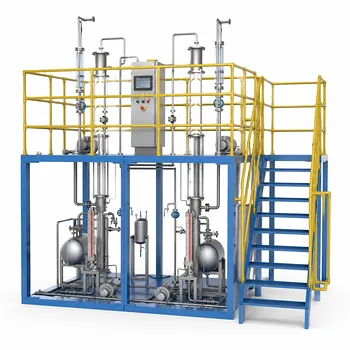
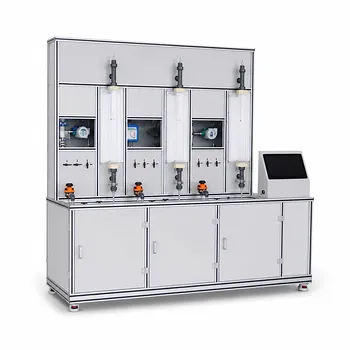
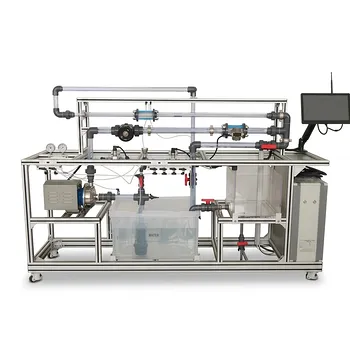
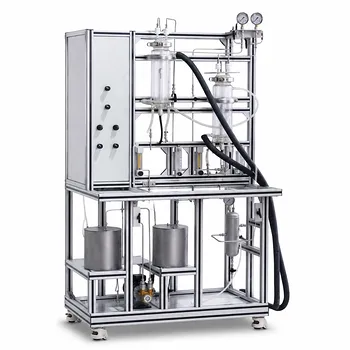
Mastering fluid dynamics like the Reynolds number requires precise, hands-on experimentation. LABPARK provides state-of-the-art Educational and Vocational Unit Operations Pilot Plants in chemical engineering, bioprocess & biotech, and environmental & water treatment.
Designed specifically for universities, research institutes, and enterprises, our pilot plants bridge the gap between micro-fluidic theory and industrial scale-up, helping you optimize mixing efficiency, residence times, and process economics.
Ready to elevate your laboratory capabilities? Contact us today to explore our custom pilot plant solutions!
Related Products
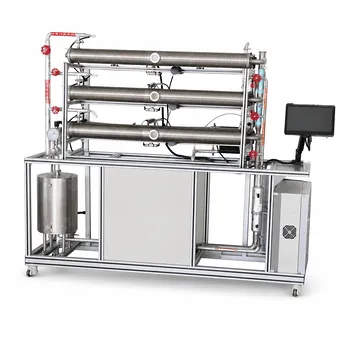
- Three-Tube Heat Transfer Educational Pilot Plant for Unit Operations Training
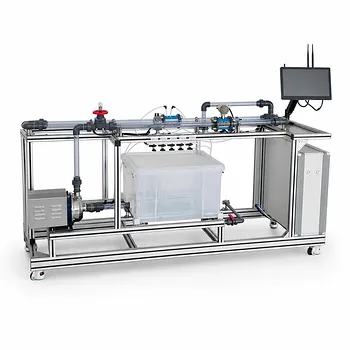
- Orifice and Venturi Flowmeter Calibration Educational Pilot Plant for Fluid Mechanics Laboratory
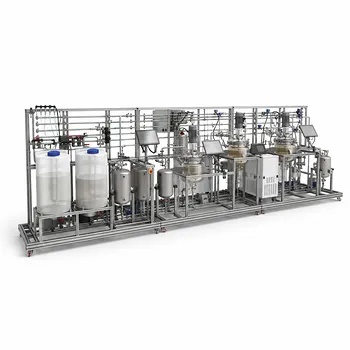
- Continuous Batch Extractive Distillation Educational Pilot Plant
- Multi-Functional Special Distillation Educational Pilot Plant
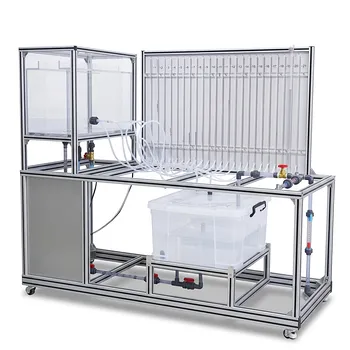
- Bernoulli Equation Demonstration Unit Operations Pilot Plant
People Also Ask
- When is ε-NTU preferred over LMTD in pilot plants? Predict heat exchanger performance without iteration.
- Why is emissivity critical in heat transfer pilot plants? Bridge the Gap Between Theory & Industrial Design
- How does cascade control achieve superior disturbance rejection in heat transfer pilot plants?
- What engineering trade-offs must students analyze in a heat transfer pilot plant? Balance performance & cost.
- How does transitioning to a multi-shell heat exchanger affect required area? Optimize pilot plant design.