The ability to accurately measure—and then act upon—fluid density and viscosity is the single most critical factor in transitioning from a "best guess" to true process control. Without these measurements, you are fundamentally unable to calculate the pressure drop your equipment must overcome, specify a pump that can deliver the required flow, or predict whether your system will operate in a safe and efficient turbulent regime.
The role of density and viscosity measurement is to transform a fluid transport system from an opaque black box into a transparent, predictable, and controllable unit operation. They are the essential inputs that allow operators to move beyond simple trial-and-error and instead make data-driven decisions about pump selection, energy consumption, and the behavior of complex fluids under real process conditions.
How These Properties Dictate System Behavior
To understand the role of measurement, you must first see how density and viscosity are wired into the fundamental physics of every liquid transport unit. They are not abstract numbers; they are the direct drivers of equipment load and flow character.
The Unforgiving Relationship with Pressure Drop
Every meter of pipe, every valve, and every fitting in your pilot plant creates a hydraulic resistance. The total pressure drop is a direct function of fluid density and viscosity. For a given pipe geometry and flow velocity, density increases the kinetic energy component of the pressure loss, while viscosity governs the frictional resistance against the pipe wall.
Measuring these properties allows you to proactively calculate the friction losses that the pump must overcome. Without this data, you risk selecting a pump with insufficient head, leading to starvation, or an oversized pump that wastes energy and forces you to throttle flow excessively.
The Control Lever of the Flow Regime
The most critical dimensionless number in fluid transport, the Reynolds number (Re), is a ratio of inertial forces (dominated by density) to viscous forces (dominated by viscosity). This single number tells you whether the flow will be laminar or turbulent.
This matters for control because the flow regime fundamentally changes how the system responds. In turbulent flow, pressure drop increases with roughly the square of flow velocity. In laminar flow, it is a linear relationship. By measuring density and viscosity, you can calculate Re and know which control response to expect, allowing you to tune a PID controller for pressure or flow without amplifying instability.
Calibrating Your Eyes and Ears: The Flowmeter and the Pump
Most volumetric flowmeters (like rotameters or turbine meters) are calibrated for a specific fluid. When you change fluids, the reading is only as good as your correction for mass flow rate. Density is the conversion factor between the volumetric reading and the actual mass of fluid being transported—the figure that matters for reaction stoichiometry or heat balance.
Similarly, a centrifugal pump's performance curve is created with water. To apply it to your actual process liquid, you must correct for viscosity. A high-viscosity fluid can dramatically reduce the pump's efficiency and shift its operating point. Measuring viscosity is not just academic; it is the difference between a pump that delivers and one that cavitates or operates far off its best efficiency point (BEP).
Moving Beyond the Idealized World of Newtonian Fluids
The value of measurement becomes even more pronounced when you leave the textbook and work with real industrial fluids.
The Newtonian Baseline and Its Limits
Most standard engineering calculations, from the Darcy-Weisbach equation to pump sizing charts, assume a Newtonian fluid, where viscosity is constant regardless of the shear rate. Measuring viscosity at one point allows you to size the system accurately for water, light oils, and simple solvents.
The Non-Newtonian Reality and Operational Danger
The moment you encounter a non-Newtonian fluid—a polymer solution, a slurry, a mayonnaise-like emulsion—the assumption of constant viscosity collapses. These fluids can shear-thin, meaning their viscosity drops as the pump imparts energy, or shear-thicken, meaning they can lock up your system entirely.
In this context, measurement becomes an active control tool. By characterizing how viscosity changes with shear rate, you can understand the anomalous velocity profiles and boundary layer effects that standard centrifugal pump curves simply cannot predict. This prevents the catastrophic operational surprise of a fluid that refuses to flow or a pump that draws exponentially more power than expected.
Understanding the Trade-offs and Pitfalls
While indispensible, the act of measuring density and viscosity in a transport loop is not a magic bullet. A true technical advisor will caution you about the trade-offs.
The Temperature Trap
The most dangerous variable is temperature. Liquid viscosity decreases sharply with rising temperature, while density changes are often smaller but still significant. A density or viscosity measurement taken at a cool start-up condition can become dangerously misleading once the system warms up due to pump work or ambient heating. The control must account for this drift, or the system’s hydraulic balance will slowly migrate.
Measurement vs. Real-Time Response
Inline viscometers and Coriolis density meters offer real-time data, but they introduce a capital cost and a small pressure drop themselves. The alternative—taking a sample and measuring properties offline—creates a time lag. You are always making a trade-off between the richness of the data and the speed at which you can react to a process upset.
The Peril of Simplified Models
Applying a single-point viscosity reading to a fluid that is even mildly non-Newtonian is the most common source of error. The model you use (e.g., power-law, Bingham plastic) is an approximation. Measurement tells you the fluid’s behavior at one condition, but it does not eliminate the need for careful judgement when scaling up or changing operating points.
How to Apply This to Your Project
The goal of measurement is not to have more data, but to solve a specific problem. Your approach should be ruthlessly pragmatic.
- If your primary focus is equipment sizing and selection: Prioritize measuring density and viscosity at the maximum operating temperature. Use this data to derate your pump efficiency and calculate the maximum pressure drop. Never rely on a cold-fluid reading for a process that heats up.
- If your primary focus is reliable process control: Invest in an inline measurement method that tracks trends over time. Use the Reynolds number calculation, dynamically updated with measured density and viscosity, to validate your flow regime and ensure your control loop tuning matches the system’s actual hydraulic response.
- If your primary focus is troubleshooting an underperforming transport line: Immediately measure the fluid’s viscosity across a relevant shear rate range. If the fluid is non-Newtonian, discard all original pressure drop estimates that were based on a single-point viscosity. Recalculate the pump’s operating point using the apparent viscosity at the effective shear rate in the pipe.
In the operation of liquid transport equipment, measuring density and viscosity transforms you from a passive observer of symptoms into an active controller of the underlying physical truths that govern every drop of fluid in motion.
Summary Table:
| Parameter | Role in Liquid Transport | Operational Impact |
|---|---|---|
| Density | Determines kinetic pressure loss & mass flow rate | Prevents pump sizing errors & calibrates flowmeters |
| Viscosity | Governs frictional resistance & flow regime (Re) | Dictates pump efficiency & PID control loop stability |
| Non-Newtonian Behavior | Alters viscosity based on shear rate | Prevents pipe blockages & sudden pump power spikes |
Enhance Your Process Control Training with LABPARK
Mastering fluid dynamics requires hands-on experience. LABPARK provides state-of-the-art Educational and Vocational Unit Operations Pilot Plants in chemical engineering, bioprocess & biotech, and environmental & water treatment for universities, research institutes, and enterprises.
Our pilot plants enable students and researchers to measure fluid properties, manage flow regimes, and optimize pump efficiency in real-world scenarios.
Contact LABPARK today to find the perfect pilot plant solution for your institution and empower the next generation of engineers!
Related Products
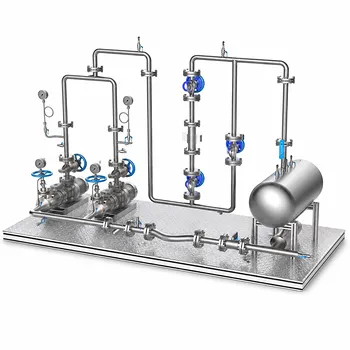
- Chemical Pipeline Assembly and Fluid Transport Practical Training Unit Operations Pilot Plant
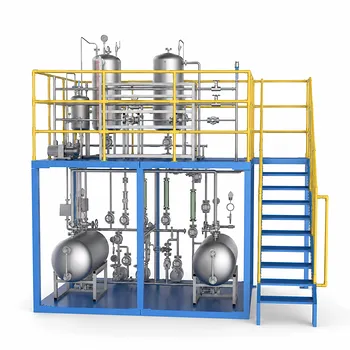
- Multi Pump Fluid Transport Process Piping Unit Operations Training Pilot Plant
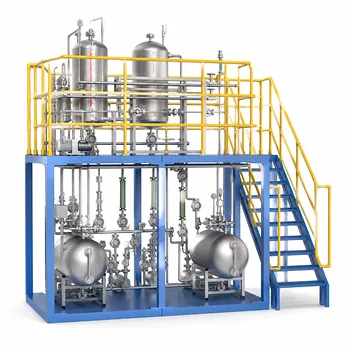
- Fluid Transport and Piping Dynamics Practical Training Unit Operations Pilot Plant
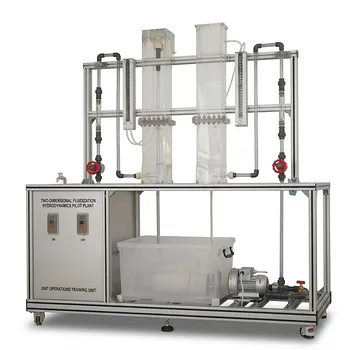
- Two-Dimensional Fluidization Hydrodynamics Educational Pilot Plant for Unit Operations Training
- Shell and Tube Heat Exchanger Heat Transfer Coefficient Determination Educational Pilot Plant
People Also Ask
- Why distinguish Newtonian & non-Newtonian fluids in pilot plants? Prevent design errors.
- Gear vs Centrifugal Pumps in Pilot Plants: How do operating characteristics and power requirements differ?
- How is shaft work (We) used to determine pump specifications? Optimize pilot plant fluid transport design.
- How to determine the operating point of a centrifugal pump in a pilot plant? A practical guide.
- How does fluid density affect pump head and pressure? Avoid Pilot Plant Motor Overload