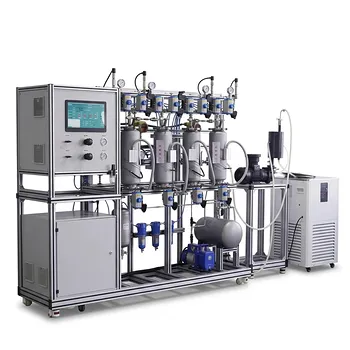
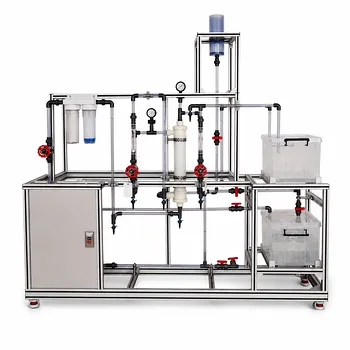
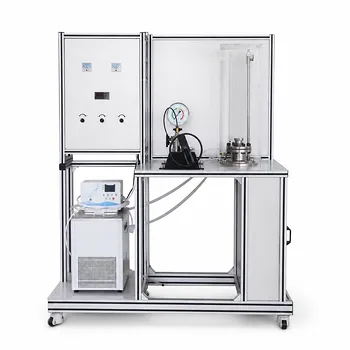
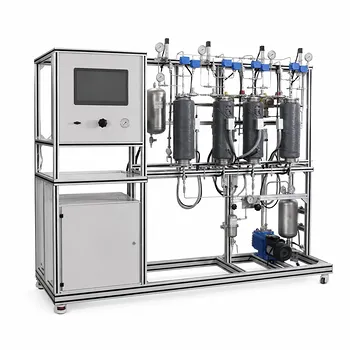
Physical property data is the basis for configuring phase separation units in educational unit operations pilot plants. Boiling points, melting points, vapor pressures, solubilities, densities, and related thermodynamic properties determine which separation method is appropriate, how equipment should be sequenced, and what temperatures and pressures students can safely operate. The data also reveals when condensation, flashing, distillation, crystallization, extraction, or absorption can achieve the desired separation more efficiently than a more extreme alternative.
Physical property data turns separation equipment from a collection of hardware into a controllable process. In an educational pilot plant, it helps operators predict phase behavior, select realistic operating windows, and compare theoretical calculations with observed plant performance.
Why Physical Properties Determine the Separation Strategy
Boiling Points Define Vapor-Liquid Separation
Differences in boiling points are central to configuring flash drums, condensers, and distillation columns. A component with a lower boiling point tends to enter the vapor phase more readily, while a higher-boiling component remains preferentially in the liquid phase.
For example, hydrogen has a boiling point near -253°C, ammonia near -33°C, nitric acid near 83°C, and water near 100°C. These differences indicate which components might be condensed, flashed, or left in a vapor stream under particular pressure and temperature conditions.
Melting Points Enable Crystallization
Melting points help determine whether a component can be separated by cooling and crystallization rather than by vaporization. This is useful when a material has a high boiling point, decomposes before boiling, or can be selectively crystallized from a solution.
In a pilot plant, operators can observe how cooling rate, concentration, and temperature influence crystal formation and liquid-solid separation.
Solubility Supports Liquid-Liquid Extraction
When two liquid phases have different solvent affinities, selective solubility can create a practical extraction process. A water-soluble component may be transferred into an aqueous phase while a non-water-soluble product remains in an organic phase.
This property data determines solvent selection, phase ratios, mixing requirements, settling time, and the likely composition of each outlet stream.
How Data Guides Equipment Configuration
Equipment Selection Follows Phase Behavior
Physical properties help engineers determine whether a stream should pass through a condenser, flash separator, absorber, distillation column, crystallizer, or liquid-liquid settler. The correct choice depends on how the components distribute between phases under achievable operating conditions.
For example, partial condensation may remove a readily condensable component without requiring complete liquefaction of the entire stream. Absorption or chemical scrubbing may be preferable when cryogenic cooling would be technically difficult or energy-intensive.
Temperature Profiles Define Operating Sequences
In a separation train, equipment is commonly arranged around progressively different phase-change conditions. A condenser or flash unit may first remove an easily condensed fraction, followed by absorption, distillation, or another polishing step.
For a mixture containing components with widely separated boiling points, this sequence can reduce the load on downstream equipment and make the separation easier to observe and control.
Property Data Supports Equipment Sizing
Vapor pressures, liquid densities, enthalpy changes, and heats of vaporization affect condenser duty, reboiler duty, vessel dimensions, residence time, pump requirements, and phase disengagement. Without these values, material and energy balances can produce unreliable equipment specifications.
Educational pilot plants make these relationships visible. Students can compare predicted flow rates, temperatures, and compositions with measurements from the actual unit.
What Educational Pilot Plants Add
They Make Phase Boundaries Observable
A simulation may predict when a component begins to condense or vaporize, but a pilot plant allows operators to see the consequence in real time. Temperature, pressure, flow, liquid level, and product composition can be related directly to changes in phase behavior.
This practical feedback helps students understand that a phase boundary is an operating condition, not merely a value in a property table.
They Expose Non-Ideal Mixture Behavior
Pure-component data is necessary, but mixtures do not always behave ideally. Strong hydrogen bonding, association, or supercritical behavior can cause actual vapor-liquid equilibrium and liquid densities to differ from simplified model predictions.
Experimental measurements from pilot plant runs can be used to calibrate thermodynamic parameters and improve activity-coefficient or equilibrium calculations.
They Connect Properties to Process Decisions
The educational value lies in connecting a physical property to a design choice. A boiling point difference explains a distillation profile, a solubility difference explains extraction, and a density difference explains how quickly two liquid phases separate.
This connection develops process judgment rather than relying on equipment operation by trial and error.
Choosing Between Separation Alternatives
Cryogenic Separation Is Not Automatically the Best Choice
A very low boiling point may suggest cryogenic cooling, but that does not make cryogenic separation the most practical option. Hydrogen, for example, requires extremely low temperatures to condense, creating significant refrigeration, materials, and safety demands.
An educational plant can demonstrate why chemical scrubbing, absorption, or partial condensation may achieve the required purity with less energy and less complex equipment.
Partial Condensation Can Reduce Energy Demand
Partial condensation uses temperature and pressure conditions that condense only selected components. This approach can remove a significant fraction of a condensable species while allowing other components to remain in the vapor phase.
Its success depends on vapor-pressure data, equilibrium behavior, heat-transfer capacity, and the required product purity.
Absorption Can Replace Extreme Cooling
Absorption transfers a gas component into a liquid solvent. When the target component is sufficiently soluble or reactive in the solvent, this method can avoid the need to cool the entire stream to a very low temperature.
The choice requires data on solubility, solvent capacity, phase equilibrium, reaction behavior, and the ease of regenerating or disposing of the solvent.
Understanding the Trade-offs
Property Uncertainty Affects Design Confidence
Physical property data may be incomplete, inconsistent, or uncertain, especially for complex mixtures. A small uncertainty may have little effect on one unit operation but substantially change the duty or size of another.
Shortcut calculations and sensitivity analysis help identify which uncertain properties actually influence cost, equipment sizing, purity, or operating limits.
Ideal Models Can Misrepresent Real Streams
Built-in simulation databases often use ideal or regular-solution assumptions. These approximations may be inadequate for mixtures with strong intermolecular interactions or unusual operating conditions.
Pilot plant measurements are therefore valuable for validating equilibrium predictions, refining thermodynamic models, and avoiding overconfidence in calculated results.
Safety Properties Are Part of Configuration
Physical property data must be considered alongside acute toxicity, flammability, corrosivity, and irritation hazards. These characteristics influence containment, ventilation, materials of construction, vent destinations, waste handling, and whether a stream can be treated as a product.
A technically feasible separation is not an acceptable configuration if its operating conditions or outlet handling create an uncontrolled hazard.
Purity and Energy Objectives Can Conflict
The most complete separation is not always the most economical or educationally useful. Achieving very high purity may require additional stages, lower temperatures, higher reflux, greater solvent circulation, or more complex waste treatment.
Pilot plants help students evaluate the balance between purity, recovery, energy use, equipment complexity, and safety.
Making the Right Choice for Your Goal
Physical property data should be used as an engineering decision framework, not simply entered into a simulator or posted in a laboratory manual.
- If your primary focus is equipment selection: Match boiling points, melting points, solubilities, densities, and vapor pressures to the phase change required by each separation unit.
- If your primary focus is energy efficiency: Compare partial condensation, absorption, extraction, and other alternatives before selecting extreme-temperature or cryogenic operation.
- If your primary focus is teaching process behavior: Configure experiments so students can measure phase boundaries and compare real operating data with equilibrium predictions.
- If your primary focus is scale-up reliability: Use pilot plant measurements and sensitivity analysis to validate thermodynamic models and identify the properties that most affect design.
- If your primary focus is safe operation: Combine phase-equilibrium data with toxicity, flammability, corrosivity, and waste-handling information before assigning stream destinations.
A well-configured educational pilot plant uses physical property data to make separation choices understandable, measurable, and defensible.
Summary Table:
| Physical property | Separation decisions it supports | Typical unit operations |
|---|---|---|
| Boiling point and vapor pressure | Predicts vaporization, condensation, flashing, and distillation behavior | Flash drums, condensers, distillation columns |
| Melting point and solubility | Determines whether cooling and selective crystallization are practical | Crystallizers, solid-liquid separators |
| Liquid-liquid solubility | Guides solvent selection, phase ratios, and extraction performance | Extraction units, liquid-liquid settlers |
| Density and viscosity | Influences phase disengagement, mixing, pumping, and residence time | Settlers, mixers, vessels, pumps |
| Enthalpy and heat of vaporization | Supports condenser and reboiler duty calculations | Condensers, reboilers, heat exchangers |
| Toxicity, flammability, and corrosivity | Defines containment, materials, ventilation, waste handling, and operating limits | All separation units |
| Pilot plant measurements | Validates equilibrium models and improves scale-up confidence | Educational and research pilot plants |
Configure More Effective Educational Pilot Plants
Contact LABPARK to discuss your requirements for Educational and Vocational Unit Operations Pilot Plants. We help universities, research institutes, and enterprises connect physical property data with practical equipment configuration, measurable phase behavior, and safe operating procedures.
LABPARK can support pilot plant solutions for chemical engineering, bioprocess and biotechnology, and environmental and water treatment applications. Our systems help students and operators compare theoretical calculations with real measurements, evaluate separation alternatives, improve process understanding, and build confidence in equipment selection and scale-up decisions.
Related Products
- Carbon Material Thermal Pretreatment Multiphase Separation Educational Pilot Plant
- Photocatalytic Membrane Separation and Degradation Unit Operations Pilot Plant
- Multi-Component Gas Pressure Swing Adsorption Pilot Plant for Unit Operations Education
- Gas-Solid Heterogeneous Separation Demonstration Educational Unit Operations Pilot Plant
- Pressure Swing Adsorption Educational Unit Operations Pilot Plant
People Also Ask
- What challenges do gravity transitions present for pressure control in multiphase separation pilot plants?
- How does steady-state multiplicity affect the operation and safety of exothermic reactions within a CSTR pilot plant? - Guide
- Why is temperature regulation via a cooling jacket a critical feature in CSTR pilot plants used for laboratory training?
- How does CSTR cooling jacket design influence stability? Control reactor oscillations.
- What parameters to monitor transitioning from Batch to CSTR? Master Pilot Plant Setup