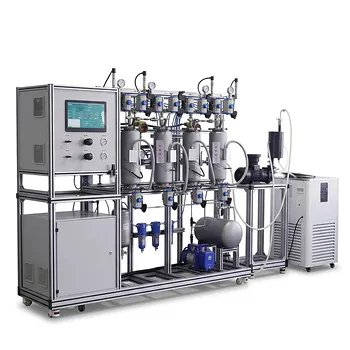
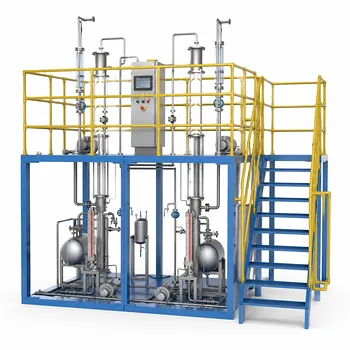
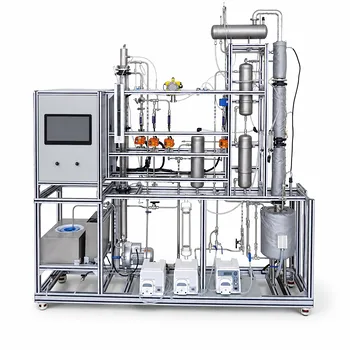
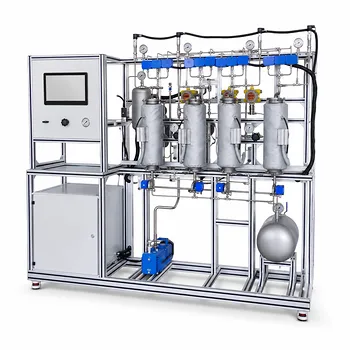
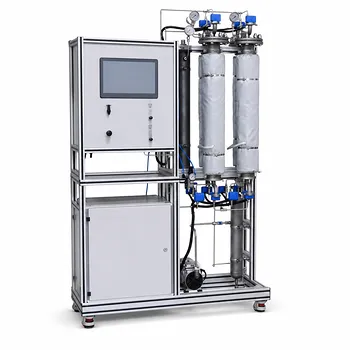
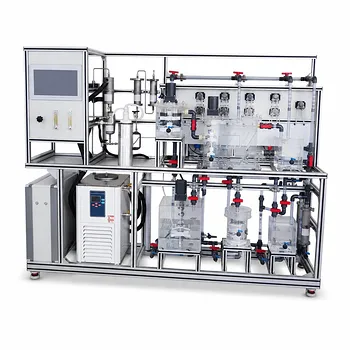
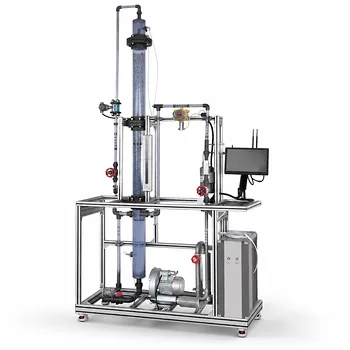
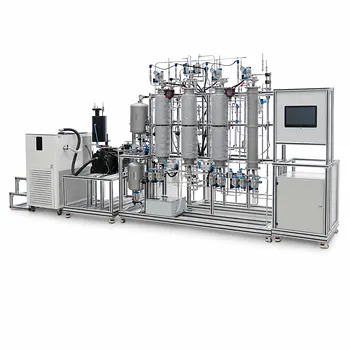
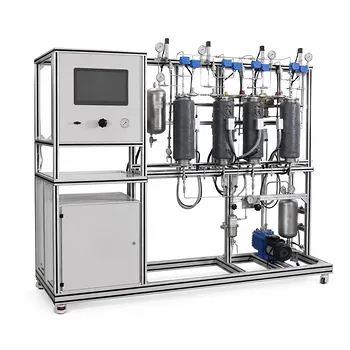
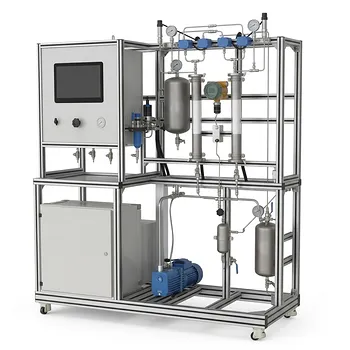
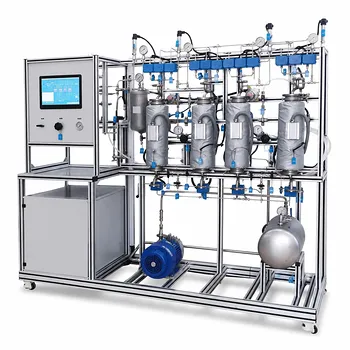
The definitive technique for quantifying a catalyst’s “active heart” is gas chemisorption analysis. In teaching pilot plants for heterogeneous catalysis, it provides the direct measurement of active metal surface area, metal dispersion, and average crystallite size—the very properties that dictate reaction rates. Unlike total surface area methods, chemisorption uses a selective chemical bond between a probe gas (e.g., H₂ or CO) and the catalytic metal sites, enabling students to calculate turnover frequencies (TOFs) and draw a clear, quantitative line from catalyst structure to reactor yield and selectivity.
Teaching the “black box” of a chemical reactor fails without a bridge from atomic-scale metal sites to macroscale performance. Chemisorption is that bridge: it isolates the active metal surface, making the abstract concepts of active sites and intrinsic kinetics tangible and measurable in a pilot plant environment.
Beyond Physical Adsorption: Why Specificity Matters
Students often first encounter surface area through BET analysis, which reports the total area of both the catalytic metal and its inert support. That number alone cannot explain why two catalysts with identical 200 m²/g total areas can show a ten‑fold difference in activity. Chemisorption solves this by only counting the atoms that actually participate in the reaction.
Selective Probing of Active Metal Sites
A chemisorption experiment exploits the fact that a probe molecule will form a covalent or strong dative bond exclusively with surface metal atoms. For example, hydrogen dissociates on nickel, and carbon monoxide adsorbs linearly or in bridge configurations on platinum. The support does not participate in this specific interaction, so the measured uptake directly reflects the metal dispersion.
The Critical Role of Stoichiometry
The measurement translates gas uptake to number of metal atoms by assuming a known adsorption stoichiometry (e.g., H : Ni = 1:1). This assumption is fundamental, and in a teaching pilot plant, it forces students to consider the surface chemistry of their system. If the stoichiometry is wrong—due to bridged CO or hydrogen spillover—the calculated metal area will be erroneous, underscoring the need for critical data interpretation.
Decoding Catalyst Structure with Chemisorption
Once the amount of chemisorbed gas is known, the data feed directly into three structural descriptors. These are the numbers that link synthesis conditions (impregnation, calcination) to catalytic function.
Calculating Metal Dispersion
Dispersion is the fraction of total metal atoms that reside on the surface. A high dispersion (e.g., 80 %) means most atoms are available for catalysis, typical of small nanoparticles. Students can immediately see how a synthesis that yields smaller crystallites maximizes the utilization of an expensive metal like platinum.
Determining Average Crystallite Size
Using the measured surface area and the known density of the metal, the average crystallite size can be estimated, usually on the order of nanometers. This turns an abstract TEM image into a statistically meaningful bulk property. In a pilot plant, seeing that a catalyst with an average crystallite size of 3 nm deactivates faster than one at 10 nm reinforces the real-world trade-off between activity and stability.
Bridging the Gap: From Lab Data to Pilot Plant Performance
The ultimate goal of any pilot plant is to deliver actionable performance data. Chemisorption makes this possible by introducing a universal metric that decouples catalyst amount from intrinsic activity.
Enabling Turnover Frequency (TOF) Calculations
The turnover frequency—the number of reactant molecules converted per active site per second—is the purest measure of a catalyst’s intrinsic efficiency. Students can compute TOF by dividing the observed reaction rate by the number of active sites (from chemisorption). This single number allows fair comparisons across catalysts with vastly different loadings or dispersions, building a mindset of mechanistic thinking.
Connecting Catalyst Properties to Reactor Yield and Selectivity
When a pilot plant run shows a drop in conversion, chemisorption data can diagnose whether it’s due to loss of active area (sintering) or poisoning of existing sites. For a bifunctional catalyst, where metal and acid sites work in concert, chemisorption isolates the metal contribution, helping students understand how selectivity toward a desired product is governed by the balance of site types, not just total activity.
Understanding the Trade‑offs and Educational Limitations
While chemisorption is powerful, its uncritical application can lead to misleading conclusions. A responsible teaching narrative must include its boundaries.
Pitfalls in Probe Gas Selection and Pretreatment
The choice of probe gas is not universal. Hydrogen may spill from the metal onto the support, overcounting active sites, while carbon monoxide can form multiple adsorption geometries with uncertain stoichiometries. Sample pretreatment is equally critical: incomplete reduction leaves oxide species, while excessive temperature can cause sintering, altering the very structure you aim to measure. Students learn that chemisorption isn’t a “plug‑and‑check” technique—it demands chemical understanding.
What Chemisorption Cannot Tell You
The technique gives an average picture; it cannot distinguish between corner atoms and terrace sites, which may have different intrinsic activities. For supported bimetallic catalysts, the simple stoichiometric assumption breaks down, and complementary methods like EXAFS or CO‑FTIR become necessary. Emphasizing these gaps teaches that real‑world catalyst characterization relies on a multi‑technique approach, not a single number.
Operational Realities in a Teaching Pilot Plant
In a teaching environment, the equipment (typically a dynamic flow or static volumetric apparatus) must handle air‑sensitive samples and require careful calibration. Downtime, limited gas handling, and the patience required for proper degassing cycles mirror the operational constraints students will face in industrial R&D, making the pilot plant experience richer and more authentic.
Making the Most of Chemisorption in Your Teaching Pilot Plant
The role of chemisorption is best realized when it is woven into the curriculum with a clear purpose, not treated as an isolated box to tick. Tailor your emphasis based on the learning objective.
- If your primary focus is teaching catalyst fundamentals: Use chemisorption early to illustrate that the “active site” is a physical reality with measurable concentration, not a vague concept. Pair it with a simple hydrogen‑uptake lab on Ni/Al₂O₃.
- If your primary focus is reactor engineering and scale‑up: Have students run the same reaction on two catalysts with identical total metal loading but different dispersions, then calculate TOF. The activity difference becomes a direct lesson in why “grams of catalyst” is a poor scaling parameter compared to “number of active sites.”
- If your primary focus is data analysis and critical thinking: Challenge students to identify cases where the assumed 1:1 stoichiometry fails, and design a set of experiments (e.g., comparing H₂ and CO chemisorption) to diagnose the discrepancy. This builds the sceptical, scientific approach required for industrial problem‑solving.
A well‑designed gas chemisorption experiment in a unit operations pilot plant transforms a complex catalytic process into a set of measurable descriptors, turning students into engineers who design catalysts and processes not by guesswork, but by understanding the atomic‑scale foundation of performance.
Summary Table:
| Metric | Measurement Target | Educational & Practical Value |
|---|---|---|
| Metal Dispersion | Fraction of active surface metal atoms | Explains how synthesis methods affect nanoparticle utilization. |
| Crystallite Size | Average size of active metal particles | Illustrates the real-world trade-off between activity and stability. |
| Turnover Frequency (TOF) | Conversion rate per active site per second | Decouples catalyst loading from intrinsic reaction kinetics. |
Elevate Your Engineering Curriculum with LABPARK
Bridge the gap between molecular surface science and macroscale chemical engineering. LABPARK designs and manufactures premium Educational and Vocational Unit Operations Pilot Plants in chemical engineering, bioprocess & biotech, and environmental & water treatment.
Specially built for universities, research institutes, and enterprises, our pilot plants empower students and researchers to master catalyst characterization, reactor kinetics, and process scale-up.
Ready to transform your laboratory training? Contact the LABPARK team today to explore our custom pilot plant solutions.
Related Products
- Multi-Component Gas Pressure Swing Adsorption Pilot Plant for Unit Operations Education
- Dual-Mode Gas Absorption and Desorption Unit Operations Training Pilot Plant
- Carbon Dioxide Absorption and Desorption Educational Pilot Plant for Carbon Capture Studies
- Carbon Dioxide Adsorption and Capture Educational Unit Operations Pilot Plant
- Absorption and Desorption Educational Unit Operations Pilot Plant
People Also Ask
- How does Pressure Swing Adsorption (PSA) technology operate? Optimize gas separation with pilot plants.
- How do two-film & penetration theories apply to gas absorption pilot plant teaching? Key pedagogical insights.
- How is the direction and driving force of mass transfer determined in a gas absorption unit operations pilot plant?
- How does partial pressure behavior influence gas absorption pilot plants? Master Mass Transfer
- What are the limitations of Henry's Law in gas absorption pilot plants? Avoid critical lab errors.