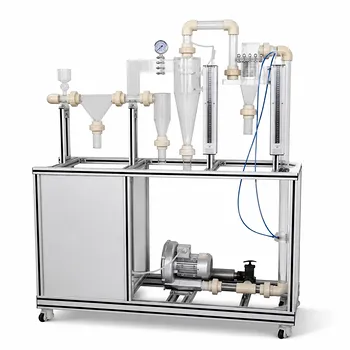
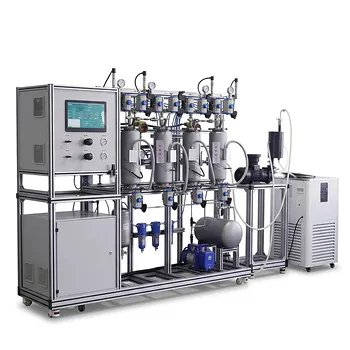
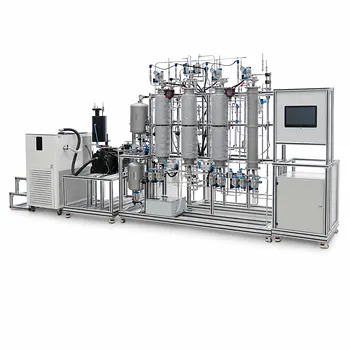
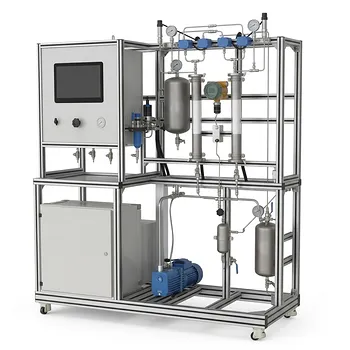
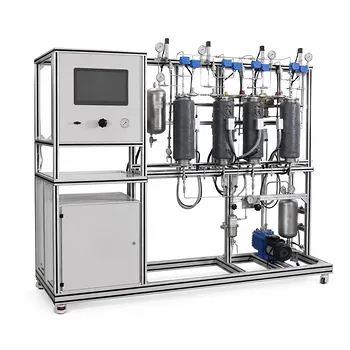
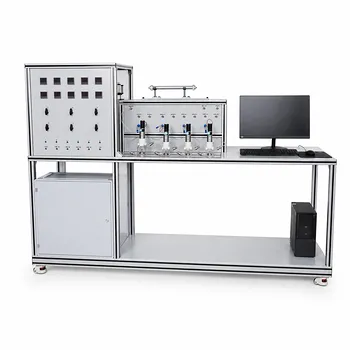
Polymer membranes are the functional heart of gas separation pilot plants. In chemical engineering education and research, these polymer films serve as the primary experimental platform to demonstrate, quantify, and optimize the separation of gas mixtures. They allow users to move beyond textbook equations and directly measure critical performance metrics—permeability, selectivity, and separation efficiency—under controlled variations in feed pressure, temperature, and composition, bridging the gap between fundamental diffusion theory and industrial realities like carbon capture and natural gas processing.
Polymer membrane pilot plants are not just demonstration tools; they are investigative platforms that expose the full lifecycle of a separation process. They turn abstract transport phenomena into tangible data, revealing the critical trade-offs between material chemistry, operating conditions, module design, and long-term stability—preparing the next generation to solve energy-intensive separation challenges.
Translating Transport Theory into Measurable Performance
At their core, pilot-scale membrane units let students and researchers directly observe the solution-diffusion mechanism that governs dense polymer membranes.
Quantifying Permeability and Selectivity
Unlike simple lab cells, pilot plants force users to measure gas flow rates, calculate stage cuts, and determine mixed-gas selectivity under realistic driving forces. This moves the learning goal from ideal single-gas measurements to the complex reality where components like CO₂, N₂, and O₂ interact within the polymer matrix. The pilot plant becomes a testbed for concepts like the permeability-selectivity trade-off, a fundamental limit described by Robeson’s upper bound that every chemical engineer must understand.
Demonstrating Process Intensification
Membrane systems embody process intensification by combining separation and mass transfer into one compact, modular unit. In a pilot plant, students can directly compare the energy footprint and physical size of a membrane skid against simulated data for pressure swing adsorption or cryogenic distillation. This visual, hands-on comparison cements the role of membranes as an energy-efficient, low-footprint alternative for modern petrochemical and environmental applications.
Investigating Material Science at Process Scale
The pilot plant elevates polymer science from a material sample to a functioning process module, highlighting how chemical structure dictates industrial viability.
From Glassy to Rubbery: A Spectrum of Behaviors
The choice of polymer dictates everything. Glassy polymers like polysulfones and superglassy poly(4-methyl-2-pentyne) (PMP) offer high size-sieving ability, demonstrating impressive selectivities—for instance, a mixed-gas butane/methane selectivity of 14 for PMP versus only 5 for rubbery PDMS. Students learn why glassy membranes excel in natural gas dewpointing, but also confront their Achilles’ heel: physical aging and susceptibility to plasticization.
Solubility-Driven Separations
In pilot units configured for volatile organic compound (VOC) recovery, rubbery polymers like PDMS shine. Here, the separation mechanism shifts towards solubility selectivity, achieving organic-over-nitrogen selectivities exceeding 100. Students operating a spiral-wound module for this application learn to correlate high organic vapor partial pressures with membrane swelling, directly observing how sorption enhances permeability but can threaten mechanical integrity.
The Hidden Curriculum: Operational Limitations and Trade-offs
Perhaps the most vital role of the membrane pilot plant is to expose the non-idealities that no datasheet fully captures. These lessons are essential for producing engineers who can troubleshoot, not just design.
Thermal Fragility
A stark operational constraint becomes immediately clear: polymeric membranes must operate below 100°C. Exceeding this threshold causes thermal degradation, structural collapse, and irreversible selectivity loss. The pilot plant teaches students to balance the desire for higher flux at elevated temperatures against the hard material limit, ingraining a safety-first, material-conscious operational mindset.
The Reality of Fouling and Aging
Over hours of continuous operation, the progressive decline in permeate flow tells its own story. Students witness membrane fouling firsthand—the slow accumulation of trace contaminants that reduces lifetime and selectivity. Additionally, they can log the steady loss of permeability in glassy membranes due to physical aging, and even chemical instability from unsaturated bonds, learning that long-term stability is as critical as initial performance.
The Scale-Up Paradox
One of the most counterintuitive lessons comes from capacity expansion. Unlike distillation columns or compressors, membrane modules lack traditional economies of scale; their scale-up factor is approximately 1. This means doubling capacity requires doubling the number of modules. The pilot plant forces students to think in terms of numbering-up and series/parallel configurations, a distinct design paradigm that influences capital cost, footprint, and maintenance strategy.
Making the Right Choice for Your Educational or Research Goal
The way you configure and operate a membrane pilot plant should directly reflect your primary learning or investigation objective.
- If your primary focus is industrial carbon capture fundamentals: Select a glassy polymer module and require students to map CO₂ permeability and CO₂/N₂ selectivity as a function of feed pressure and stage cut. Let them observe plasticization effects at high CO₂ partial pressures to understand the real-world limits of flue gas separation.
- If your primary focus is material science and polymer development: Use the pilot plant as a characterization tool. Swap flat-sheet membrane envelopes and run mixed-gas tests to benchmark novel polymers against industry standards, quantifying the trade-off between permeability and selectivity under process conditions.
- If your primary focus is natural gas processing and dewpointing: Run a hydrocarbon-rich stream through both glassy and rubbery modules. Compare butane/methane selectivity and flux stability over time to teach the critical balance between performance and chemical resistance in the presence of heavy hydrocarbons.
- If your primary focus is process design and scale-up: Build the curriculum around module configuration. Let students design series and parallel arrays to meet a given separation target, using pilot plant data to confront the lack of scale economies and optimize for total membrane area and pressure drop.
Ultimately, a gas separation membrane pilot plant is far more than a teaching aid—it is an accelerated environment for building the intuition required to manage the trade-offs between material chemistry, operational reliability, and process economics that will define the future of clean energy and industrial gas purification.
Summary Table:
| Polymer Membrane Type | Primary Mechanism | Key Separation Focus | Mixed-Gas Selectivity | Primary Limitations |
|---|---|---|---|---|
| Glassy Polymers (e.g., Polysulfone, PMP) | Size-sieving (Mobility) | Carbon capture, $CO_2/N_2$, natural gas processing | High size-selectivity (e.g., Butane/Methane = 14) | Physical aging, plasticization, thermal degradation (>100°C) |
| Rubbery Polymers (e.g., PDMS) | Solubility-selective | Volatile Organic Compound (VOC) recovery | High organic-over-nitrogen (>100) | Membrane swelling, mechanical instability, thermal limit (<100°C) |
Bring Industrial-Scale Gas Separation into Your Lab
LABPARK provides advanced Educational and Vocational Unit Operations Pilot Plants in chemical engineering, bioprocess & biotech, and environmental & water treatment. Designed specifically for universities, research institutes, and enterprises, our modular pilot plants empower you to:
- Bridge Theory and Practice: Translate abstract solution-diffusion equations into real-world, measurable data.
- Expose Process Limits: Teach students and researchers to navigate real-world operational challenges like fouling, plasticization, and scaling.
- Accelerate Research: Benchmark novel polymer materials under precise, industrial-grade operational control.
Ready to elevate your engineering curriculum or research capabilities? Contact LABPARK today to find the perfect pilot plant configuration for your goals!
Related Products
- Gas-Solid Heterogeneous Separation Demonstration Educational Unit Operations Pilot Plant
- Multi-Component Gas Pressure Swing Adsorption Pilot Plant for Unit Operations Education
- Bench Scale Dual Column Gas Separation and Capture Educational Pilot Plant
- Educational Pressure Swing Adsorption Ethylene Capture Unit Operations Pilot Plant
- Pressure Swing Adsorption Educational Unit Operations Pilot Plant
People Also Ask
- Why is pressure drop characterization critical in separation pilot plants? Key operational insights.
- What are the key thermodynamic considerations for gas mixture modeling? Expert Guide
- What are the primary operational objectives and physical requirements when running heterogeneous separation pilot plants?
- What are the material limitations of gas separation pilot plants? Key factors to consider.
- What are the trade-offs in olefin-paraffin separation? Optimize Pilot Plant Performance