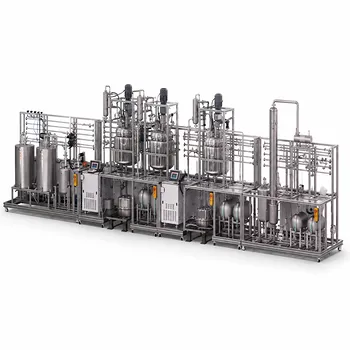
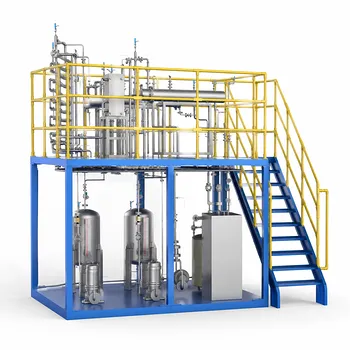
The linchpin of industrial resource recovery isn’t the laboratory discovery—it’s the pilot plant.
Pilot plants provide the essential, scaled-down industrial environment where resource recovery and waste reduction strategies are physically tested before full-scale deployment. They allow engineers to separate and recycle by-products from real process streams, pinpoint the exact operating conditions needed to minimize waste generation, and validate the integration of treatment technologies—all under conditions that reveal problems invisible at the bench. This transforms theoretical feasibility into a practical, risk-managed design.
Resource recovery processes are inherently messy to scale. A pilot plant is the only place where you can simultaneously test separation efficiency, validate economic models with real utility data, and prove that a green chemistry breakthrough won’t create a new toxic waste problem when run continuously. It is the ultimate de-risking engine for waste valorization.
Bridging the Valley of Death Between Lab and Industry
Laboratory beakers demonstrate chemistry; pilot plants demonstrate physics, hydraulics, and the unforgiving realities of continuous operation. This is the critical role of scale.
Replicating Industrial Conditions for Accurate Material Behavior
On a bench, you can filter a few liters of clean solution. In a pilot plant, you deal with real, heterogeneous waste streams containing solids, trace impurities, and biological material that fouls membranes unpredictably. Pilot-scale units like distillation columns, extraction centrifuges, and membrane filtration skids let you observe how these complex mixtures separate over hundreds of hours, yielding accurate mass and energy balances that a lab can only guess at.
Validating Source Reduction Strategies Safely
Eliminating waste before it forms—through alternative feedstocks, modified temperatures, or new reactor designs—cannot be proven on a hunch. Unit operations pilot plants give you a safe, isolated environment to deliberately stress-test these changes. You can run a fluidized bed reactor with a contaminated raw material at elevated pressure, measure the resulting byproduct profile, and capture failure data without risking a production line or personnel.
Identifying the Unscalable Unit Operation
Some processes look elegant on paper but fall apart when scaled. A reaction with a sticky solid that flows well in a 100-gram batch can plug pipes instantly at a 100-kg throughput. Pilot plants expose these “unscalable” steps early, allowing you to redesign around solids handling, high-pressure metering, or thermal runaway before a catastrophic investment.
De-Risking the Economics of Waste Valorization
A recovered by-product must not only be usable; it must generate net revenue. Pilot plant data is the only evidence any investor or CFO will believe.
Determining Actual Separation Costs
Turning a waste stream into a high-purity product almost always requires an extra separation step, like distillation or extraction. A pilot distillation unit reveals the real utility consumption—steam, cooling water, electricity—per kilogram of recovered product. These hard numbers feed directly into the economic model, replacing optimistic lab assumptions with balance-sheet certainty.
Quantifying Avoided Treatment Costs
Waste reduction isn’t just about selling a new product. It’s about not paying to incinerate or landfridge a toxic sludge. Pilot plants running an integrated process can measure exactly how much the effluent volume drops and how its chemical oxygen demand changes. That data converts a vague “green” promise into a defensible operating cost reduction.
Proving Equipment Durability and Maintenance Cycles
Corrosion, erosion, and biofouling happen on a 24/7 timescale. Running a pilot for several months lets you measure the actual rate of material loss on your chosen alloy or monitor how often you need to clean a bioreactor. This prevents you from ordering a multi-million-dollar plant with an undocumented maintenance nightmare.
Optimizing the Circular Economy Through Integrated Loops
True resource recovery is rarely a single, linear step. Pilot plants are the playground where material and energy loops are closed.
Demonstrating Recycling of Unreacted Feedstock and Solvents
In educational and research pilot plants, specially designed recycle loops redirect unreacted raw materials and recovered solvents back into the feed. This allows you to study the buildup of trace impurities in a closed system and determine the exact purge rate needed to prevent catalyst poisoning, enabling maximum conversion without compromising product quality.
Pinpointing Energy Recovery Integration
Heat exchangers and thermal integration setups on a pilot scale let you measure how much steam can be generated from an exothermic reaction to preheat the next batch. By physically connecting these streams, you can confirm the net energy ratio—for example, verifying if your bioethanol process actually yields a positive energy return beyond the textbook combustion value of 29,714 kJ/kg.
Testing Bio- and Chemical Degradation End-to-End
For persistent wastes like plastics or complex wastewater, a bioprocess pilot plant can run an enzymatic degradation or an activated sludge treatment continuously. You observe biocatalyst stability, nutrient requirements, and filtration efficiency over weeks, ensuring the biology doesn’t crash under real variable loads—a failure mode impossible to simulate in a shaker flask.
Understanding the Trade-offs: The Cost of Certainty
Pilot plants are indispensable, but they are not a trivial investment. Objectivity demands acknowledging their limitations.
Capital and Time Investment
A custom pilot plant with the necessary instrumentation, containment, and data acquisition systems is expensive to build and operate. A campaign lasting several months can delay a project, and there is always pressure from stakeholders to skip this phase. You must weigh the cost of the pilot against the cost of a failed full-scale plant—and in high-risk processes, the pilot pays for itself many times over.
Scale Still Leaves Residual Risk
A pilot plant typically operates at 1/100th to 1/10th of the commercial scale. Fluid dynamics, heat loss, and mixing patterns do not scale linearly. The pilot reduces, but does not eliminate, the risk of unforeseen behavior at the final size. You will still need a robust scale-up methodology based on the pilot data, not a blind extrapolation.
Potential for Misinterpreted Data
If a pilot is run only for a few hours at steady state, it may miss the slow accumulation of foulants or the unpredictable nature of raw material variability. The value of a pilot lies in its duration and the challenge you throw at it. A poorly executed pilot study gives false confidence, which is worse than no study at all.
Charting Your Path from Pilot to Production
The right approach depends on your primary driver—technical novelty, economic rigor, or sustainability validation.
- If your main concern is scaling a novel, unproven technology (e.g., continuous high-pressure synthesis): Use a unit operations pilot plant first to isolate the risky step and gather baseline reaction rate and safety data before integrating any recovery loops.
- If you are focused on the business case for by-product sales: Prioritize a pilot that includes the final purification step and run it with real, variable waste feedstock over an extended period. The goal is utility consumption data and a product sample for customers, not just a composition analysis.
- If you are optimizing an existing plant for source reduction and circularity: Start with a pilot that mimics your current process but allows you to systematically swap feedstocks and adjust operating parameters. Measure the integrated mass and energy balance to prove net gains before retrofitting the full plant.
- If you are developing a biological treatment for a persistent pollutant: Insist on a bioprocess pilot that operates continuously for several months to observe microbial community stability and any toxic secondary waste formation in the effluent.
A pilot plant is not a checkbox; it is the physical validation that transforms a promising idea into an industrial asset you can build a business on.
Summary Table:
| Key Function | Focus Area | Critical Outcome |
|---|---|---|
| Process Scale-Up | Technical Feasibility | Identifies unscalable operations, fouling, and solids handling issues |
| Economic De-Risking | Financial Viability | Quantifies actual utility, separation, and avoided waste treatment costs |
| Loop Optimization | Circular Economy | Validates recycle loops, energy integration, and bio-degradation stability |
Ready to bridge the gap between laboratory discovery and industrial-scale resource recovery? LABPARK provides premium Educational and Vocational Unit Operations Pilot Plants in chemical engineering, bioprocess & biotech, and environmental & water treatment.
Designed specifically for universities, research institutes, and enterprises, our systems allow you to safely test waste reduction, optimize recycle loops, and validate process economics. Contact LABPARK today to discover how our pilot plants can de-risk your scaling process and advance your circular economy initiatives!
Related Products
- Natural Product Extraction Unit Operations Training Pilot Plant
- Fixed-Bed Chemical Reaction and Gas Dust Tar Removal Unit Operations Pilot Plant
- Ethyl Acetate Synthesis Unit Operations Pilot Plant for Practical Training
- Methanol Synthesis and Catalyst Performance Evaluation Educational Unit Operations Pilot Plant
- Electrolytic Hydrogen Production Educational Unit Operations Pilot Plant
People Also Ask
- How to Demo Solubility Sensitivity in SFE Pilot Plants? Practical Thermodynamics
- How do pilot plants differentiate physical vs chemical extraction? Enhance Chemical Engineering Training
- How are HTU and NTU applied to determine extraction column height? Guide to Pilot Plant Scaling
- How can Hotelling's T² & Q statistics detect pilot plant abnormalities? Optimize Safety
- Why use split-plot designs in pilot plants instead of CRD? Optimize process parameters effectively.