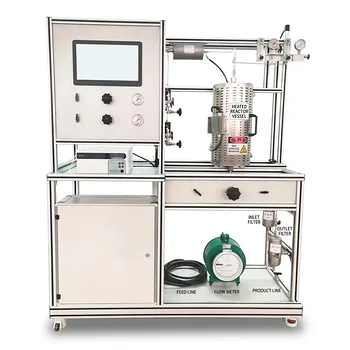
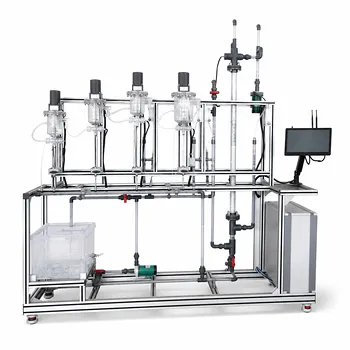
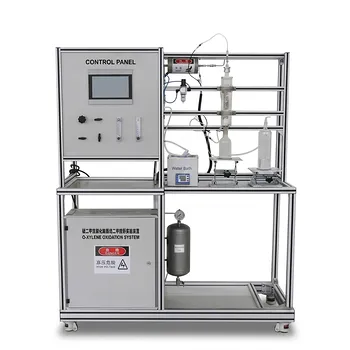
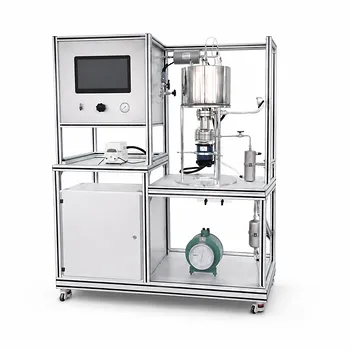
The minimum viable pilot-plant setup for a Claisen-Schmidt condensation centers on a jacketed reactor, precise thermal regulation, controlled agitation, and a reliable condenser. For the synthesis of dibenzalacetone—a room-temperature reaction between benzaldehyde and acetone in aqueous ethanol—these four features prevent side-product formation, ensure intimate contact between immiscible phases, and safely manage volatile solvents. Together they transform a simple benchtop procedure into a reproducible, scalable process that teaches the core unit operations of mass transfer and heat exchange.
The dibenzalacetone synthesis operates under gentle conditions, yet small deviations in temperature, mixing, or solvent inventory can drastically reduce yield and purity. A pilot plant must therefore prioritize uniformity and stability over extreme operating envelopes: the critical design elements are a jacketed vessel with a circulating temperature bath, variable-speed agitation, and an overhead condenser system.
The Four Essential Reactor Features for Condensation Chemistry
Jacketed Reactor Vessel with Circulation Bath
A jacketed vessel serves as the thermal backbone of the pilot plant.
It allows heat to be added or removed uniformly through the reactor wall, preventing the formation of local hot or cold spots.
Even though the Claisen-Schmidt reaction is typically conducted near 20–25°C, the heat released during mixing and reaction can subtly shift the temperature profile.
A circulating bath or external temperature control unit (TCU) maintains the jacket fluid at a precise setpoint, counteracting any exothermic drift.
Stable temperature is not just about comfort—it directly suppresses the aldol condensation side pathways that produce unwanted oligomeric or polymeric byproducts.
For pilot-plant education, the jacket also demonstrates how industrial reactors decouple heating/cooling duty from the reaction medium, a principle that scales from glass-lined vessels to multi-tonne production units.
Variable-Speed Agitation for Two-Phase Mass Transfer
The reaction mixture is inherently biphasic: benzaldehyde (organic phase) and acetone in aqueous ethanol (polar phase) are only partially miscible.
Mass transfer across the phase boundary often becomes the rate-limiting step at pilot scale.
Variable-speed agitation with an impeller suited to low-viscosity liquids (e.g., a pitched-blade turbine or retreat-curve impeller) breaks one phase into small droplets, dramatically increasing interfacial area.
Higher agitation rates accelerate conversion, but excessive shear can create stable emulsions that hinder downstream separation. The pilot plant must therefore offer broad, adjustable RPM control so operators can map the relationship between power input per volume, droplet size, and yield.
This teaches the fundamental scale-up lesson: what works in a magnetically stirred flask rarely translates directly, and deliberate mixing studies are required to avoid “oversizing” or “undersizing” the agitator.
Overhead Condenser for Solvent Integrity
Ethanol, the primary solvent, is volatile even at room temperature. An unclosed reactor would slowly lose solvent, altering reagent concentrations and potentially pushing the reaction toward side products.
An overhead condenser returns vaporized solvent to the vessel, maintaining a constant liquid composition throughout the batch cycle.
The condenser also serves a safety role: it prevents accumulation of flammable vapor in the headspace and allows the system to remain at atmospheric pressure during mild thermal excursions.
For a pilot plant, a simple shell-and-tube or coil condenser using chilled water is sufficient, but it should be sized to handle the maximum vapor generation rate at the highest anticipated temperature.
Integrated Process Control and Safety Logic
Beyond individual components, the pilot plant must integrate these features into a single control architecture.
A programmable logic controller (PLC) that links the temperature bath, agitator motor, and condenser coolant flow enables automated safety interlocks—for example, halting heating if agitation stops, or triggering an alarm if condenser inlet water pressure drops.
For educational settings, this integration provides a hands-on introduction to recipe-driven batch control: students learn to define temperature ramps, hold steps, and agitation profiles that match the reaction's kinetic requirements.
Understanding the Trade-offs and Common Pitfalls
Why “Room Temperature” Still Demands Active Thermal Management
A frequent mistake is assuming that a reaction that “runs at room temperature” does not need a jacket.
In a pilot-scale vessel, the surface-area-to-volume ratio is far lower than in beaker-scale glassware. Heat generated internally cannot dissipate passively without creating a radial temperature gradient. A jacket is essential to enforce near-isothermal conditions, even if the setpoint is ambient.
Over-Mixing vs. Under-Mixing
Not all agitation is beneficial. While low RPM starves the phases of contact and extends batch time, excessive agitation can:
- Emulsify the mixture, making phase separation and product filtration lengthy.
- Entrain air, potentially oxidizing benzaldehyde to benzoic acid, a persistent impurity.
The optimal agitation speed must be determined experimentally at the pilot scale; there is no simple geometric scaling law that predicts it from a magnetic stir bar setting.
Material Selection: When Simplicity Suffices
The dibenzalacetone condensation operates at atmospheric pressure and moderate temperatures. Consequently, borosilicate glass or standard austenitic stainless steel (e.g., 316L) is entirely adequate.
Unlike the high-temperature shift reaction described in supplementary references, there is no need for creep-resistant alloys (Inconel, Incoloy) or killed steel to meet ASME BPV Code limits above 482°C. The pilot plant’s design emphasis remains on transparency and observability—glass reactors with external jackets are often preferred for teaching because they reveal the fluid dynamics, phase dispersion, and colour changes in real time.
Making the Right Choice for Your Pilot-Plant Goal
Your selection of specific reactor components should be guided by what you need to demonstrate or quantify.
- If your primary focus is teaching mass transfer and heat exchange fundamentals: Prioritize a glass jacketed vessel with a high-turndown agitator and a simple recirculating chiller/heater. The visual insight into mixing patterns is worth more than automation depth.
- If your primary focus is generating reproducible kinetic data for scale-up: Invest in an automated PLC with data logging for jacket temperature, internal temperature, RPM, and condenser coolant flow. Consistent batch records allow you to separate physical mixing effects from intrinsic reaction kinetics.
- If your primary focus is process safety demonstration for condensation reactions: Specify an explosion-proof motor, a condenser with a dedicated chiller loop, and interlocks that cut heating if cooling water fails. Document all safeguards as a template for future exothermic chemistry.
The dibenzalacetone synthesis is a gentle reaction by design, but the pilot-plant features it demands are the very same ones that control far more aggressive chemistries—mastering them here builds the intuition you will need for every subsequent scale-up challenge.
Summary Table:
| Reactor Feature | Key Function | Main Benefit for Condensation Reactions |
|---|---|---|
| Jacketed Vessel + TCU | Uniform thermal regulation | Prevents hot spots and side-product formation |
| Variable-Speed Agitation | Phase dispersion (biphasic) | Enhances mass transfer and prevents emulsion |
| Overhead Condenser | Solvent recovery | Maintains constant solvent composition and safety |
| Integrated PLC Control | System automation & safety logic | Enables precise recipe runs and safety interlocks |
Scale Up Your Chemical Engineering Education with LABPARK
Ready to equip your lab with state-of-the-art training systems? LABPARK provides premium Educational and Vocational Unit Operations Pilot Plants in chemical engineering, bioprocess & biotech, and environmental & water treatment. Designed for universities, research institutes, and enterprises, our pilot plants deliver hands-on experience in mass transfer, heat exchange, and advanced process control.
Empower your students and researchers with industry-grade hardware—contact us today to discuss your laboratory requirements!
Related Products
- Fixed-Bed Chemical Reaction and Gas Dust Tar Removal Unit Operations Pilot Plant
- Fixed Bed Gas Solid Catalytic Reaction Educational Pilot Plant
- Multi-Reactor Educational Pilot Plant for Reaction Engineering Unit Operations
- Residence Time Distribution and Reactor Flow Characteristics Determination Educational Pilot Plant
- Tubular Reactor Flow Characteristics Determination Educational Unit Operations Pilot Plant
People Also Ask
- When to transition from PID to adaptive control in pilot plants? Key process indicators.
- How do deviations in estimating latent heat impact pilot plant thermal systems? Avoid hardware mis-sizing.
- Why Compare Predicted and Experimental Excess Enthalpy? Key to Accurate Pilot Plant Scale-up
- How to study gasification in pilot plants? Compare exit gas composition & efficiency
- Why Use PTFE & Hastelloy in Chemical Pilot Plants? Prevent Corrosion & Ensure Safety