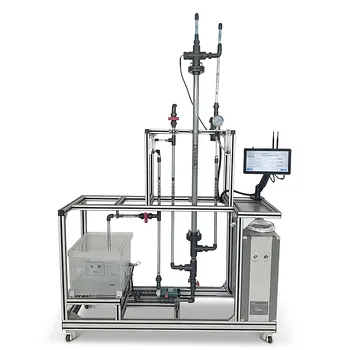
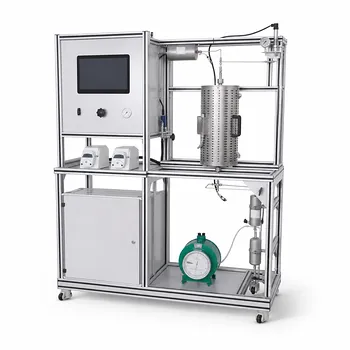
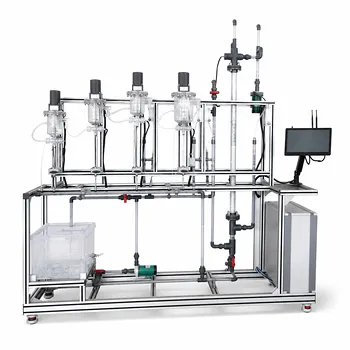
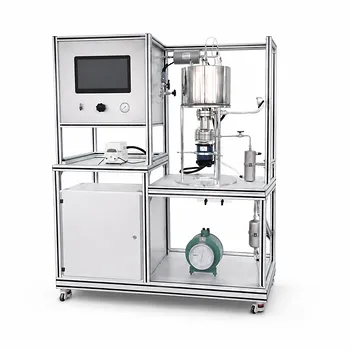
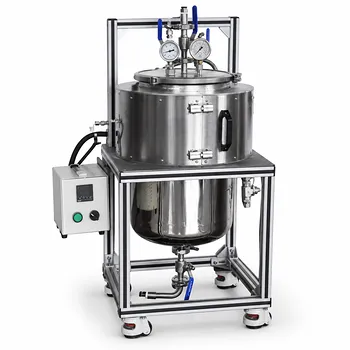
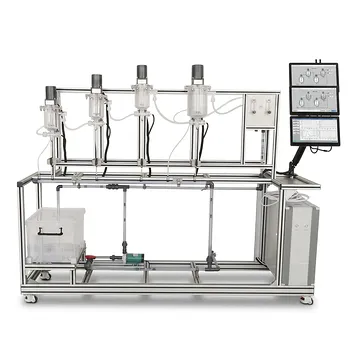
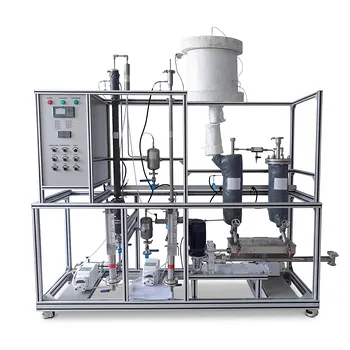
When you move from high-throughput parallel screening to lab-scale and pilot-scale reactors, you are fundamentally trading sample throughput for process control fidelity. High-throughput systems sacrifice independent control over individual sample environments—temperature, pressure, and flow patterns become less defined—to rapidly screen hundreds of catalysts. In contrast, lab- and pilot-scale units meticulously control each of these parameters, delivering the high-accuracy, representative data essential for scale-up. Understanding this trade-off is your first step toward making sound development decisions.
The core trade-off is between the number of experiments and the quality of each experiment’s process control. High-throughput screening gives you speed and relative rankings, but lab- and pilot-scale reactors give you the transferable engineering data you need for industrial design. Your job is to use each tool for its proper purpose, without expecting one to do the other’s job.
The Fundamental Trade-off: Throughput vs. Individual Control
High parallelization delivers massive screening velocity. But that velocity comes at the cost of precise experimental authority over each sample.
How Parallelization Erodes Parameter Independence
As you scale from 1–8 reactors (lab scale) to over 250 parallel channels, your ability to independently set and hold temperature, pressure, and feed flow for each catalyst bed deteriorates. Common feed manifolds, shared heating blocks, and standardized flow splitting force every sample into a compromised, averaged environment. You can no longer guarantee that the space velocity you intended is what each particle actually experiences.
The Illusion of Identical Conditions
Even with careful design, small differences in channel packing, bypass flows, or local heat transfer create hidden variability in parallel arrays. What you gain in statistical replication you lose in knowing exactly what each sample endured. Lab-scale and pilot-scale reactors eliminate this ambiguity by dedicating independent mass flow controllers, heaters, and pressure sensors to each vessel, ensuring that your data reflects true process intent rather than array artifacts.
Key Process Parameters Under Pressure
When you reduce parallelization, you regain mastery over the variables that govern reaction performance. These parameters are the language of scale-up.
Temperature Control and Isothermality
In high-throughput arrays, ensuring a uniform, measured temperature across every position is difficult. Hot spots, cold edges, and axial gradients can mask or exaggerate catalytic activity. Lab- and pilot-scale reactors use sophisticated jacket systems, internal coils, or multiple heating zones to maintain tight isothermal control, a prerequisite for reliable kinetic modeling.
Defining Weight Hourly Space Velocity (WHSV)
WHSV—the ratio of feed mass flow to catalyst mass—is the key metric linking lab data to industrial reactor size. In parallel systems, uneven flow distribution makes WHSV a bulk average, not a sample-specific value. Dedicated bench-scale and pilot rigs let you set and verify the true WHSV for each reactor, giving you data you can use directly for scale-up equations.
Flow Patterns and Catalyst-Feed Contacting
Plug flow, backmixing, and channeling all distort performance away from ideal behavior. High-throughput units often operate in poorly defined hydrodynamic regimes. Pilot-scale reactors are engineered for well-characterized flow patterns, including options like recycle or Berty-type reactors, so you understand—and can model—residence time distributions precisely.
Heat and Mass Transfer Diligence
For exothermic reactions or viscous broths, the ability to remove heat and supply oxygen becomes the limiting factor. As volume increases, the surface-area-to-volume ratio drops, reducing natural heat dissipation. Benchtop and pilot systems combat this with adjustable agitation, cooling jackets, and controlled air sparging to maintain critical parameters like the volumetric oxygen transfer coefficient ($k_La$). Without this control, your data reflects equipment limitations, not intrinsic catalyst or organism performance.
The Impact on Data Fidelity and Scale-up Risk
Your downstream decisions are only as good as the data they’re based on. The quality of process control directly determines whether your results are descriptive or predictive.
High-Throughput Data: Relative Rankings, Not Absolute Truths
Parallel screening excels at quickly identifying the top candidates from a large library. It yields high-quality relative comparisons of activity, selectivity, or lifetime—provided all samples operate under identical, albeit approximate, conditions. However, such data is rarely sufficient to predict performance in a well-mixed, continuous-flow pilot plant, because the mass transfer and thermal history are fundamentally different.
Lab and Pilot Data: The Bridge to Reality
Laboratory and pilot-scale reactors, operated with precise control, are designed to generate representative performance data. These units allow you to validate catalyst stability under industrial flow rates, quantify heat and mass transfer limitations, and optimize process parameters in an environment that mimics full-scale operation. The data they produce is the bedrock of techno-economic analysis and engineering design.
Understanding the Trade-offs: When to Accept Imperfect Control
No single scale is always right. The art is deliberately choosing the right tool for the right phase of development.
When Speed Outweighs Precision
If your goal is to discover a novel lead from a library of thousands, the 10–100x speed advantage of high-throughput screening far outweighs the loss in individual control. You accept that 10–20% of your data may be noise, because finding the one hit matters most. The key is to never skip the later, low-throughput verification step.
When Precision Is Non-Negotiable
Once you have a shortlist, you need reliable intrinsic kinetics and deactivation rates. Here, even a 5% error in temperature control can alter rate constants by over 20%. Lab-scale reactor precision becomes mandatory. You are building the foundation for a pilot plant that may cost millions—you cannot afford to scale up on a foundation of approximate relative data.
The Pitfall of Premature Scale-Up
The most expensive mistake is treating high-throughput screening data as final scale-up data. It leads to oversized heat exchangers, underperforming reactors, and unexpected deactivation. Always demand a dedicated, well-controlled lab-scale validation step before committing to pilot-plant construction.
The Bioprocess Parallel
In bioprocessing, the same principle applies: a shaken microtiter plate cannot replicate the gas-liquid mass transfer or shear environment of a stirred-tank bioreactor. Maintaining $k_La$ and heat removal at pilot scale is non-negotiable, and you must plan for the engineering controls—variable-speed drives, sparger design, cooling coils—that high-throughput systems deliberately omit.
Making the Right Choice for Your Development Goal
Your process control strategy must match the phase of your project. Use the criteria below to guide your decision on when to accept the trade-off and when to insist on precision.
- If your primary focus is accelerating discovery across a vast chemical space: Prioritize high-throughput parallel screening, understanding that the data will only provide relative rankings. Plan to verify top hits later with lab-scale control.
- If your primary focus is generating kinetic parameters for scale-up or reactor design: Commit to low-parallelism lab- and pilot-scale reactors. Insist on independent control of temperature, WHSV, and pressure for each reactor to produce engineering-grade data.
- If your primary focus is bridging a lead candidate to a commercial process: Use pilot plants to validate performance under realistic continuous flow, challenge the system with heat and mass transfer limitations, and fine-tune the control philosophy you will use in production.
- If your primary focus is training or academic unit operations: A pilot plant with dedicated, transparent process control is essential. It teaches the cause-and-effect of operational changes in a way that a black-box parallel array never can.
Embrace the inherent trade-off between throughput and control as a deliberate strategy, not a flaw, and you will accelerate development while de-risking your path to scale.
Summary Table:
| Feature / Parameter | High-Throughput Screening (HTS) | Lab & Pilot-Scale Reactors |
|---|---|---|
| Primary Goal | Rapid screening & relative rankings | Precise engineering data for scale-up |
| Control Precision | Shared, averaged environments | Independent, vessel-specific control |
| Flow & WHSV | Bulk estimates, potential channeling | Defined flow regimes, exact WHSV |
| Data Fidelity | Descriptive (identifies top leads) | Predictive (kinetic & mass-transfer data) |
| Best Used For | Discovering new catalyst/organism leads | Validating stability & modeling processes |
Scale Up with Confidence using LABPARK
Transitioning from screening to pilot scale requires uncompromising process control. LABPARK provides premium Educational and Vocational Unit Operations Pilot Plants in chemical engineering, bioprocess & biotech, and environmental & water treatment.
Designed specifically for universities, research institutes, and enterprises, our systems deliver the precise, independent parameter control and high-fidelity data needed to de-risk industrial scale-up and deliver hands-on operational training.
Ready to bridge the gap between discovery and production? Contact us today to find your pilot-scale solution.
Related Products
- Micro-Scale Gas-Solid Catalytic Reaction Educational Pilot Plant
- Tubular Reactor Flow Characteristics Determination Educational Unit Operations Pilot Plant
- Multi-Reactor Educational Pilot Plant for Reaction Engineering Unit Operations
- Educational Unit Operations Pilot Plant for Intraparticle Diffusion Effective Factor Measurement
- Fixed Bed Gas Solid Catalytic Reaction Educational Pilot Plant
People Also Ask
- Fluidized vs. Fixed Bed Reactors: Comparing Heat & Complexity in Pilot Plants
- Why is a multibed configuration necessary for exothermic reactions? Optimize your pilot plant trajectory.
- Why is thermal management a major challenge in methane oxidative coupling? Reactor Solutions for Pilot Plants
- How does the Mears criterion evaluate transport resistance? Key Guide to Intrinsic Kinetics
- How do reactor pilot plants safely study gas-solid reactions? Master kinetics with thermal & flow control.